Profile:
Ajit Chakraborty was an important modern Indian sculptor and art educator whose practice contributed significantly to the development of post-Independence sculpture in Bengal. Through a disciplined engagement with form, material, mass, and space, he developed a restrained modernist language that moved beyond academic naturalism without abandoning structural clarity or technical rigour.
Born in Bengal in 1930, Chakraborty graduated from the Government College of Art & Craft, Calcutta, in 1954. His training provided him with a strong foundation in modelling, carving, casting, and figurative construction. In 1958, he received a Cultural Exchange Scholarship to pursue advanced studies in sculpture in Prague, where he trained under Professor Jan Kavan until 1961. His years in Europe exposed him to modernist approaches to volume, abstraction, material, and spatial organisation, which became important to his later development.
Sculptural Language
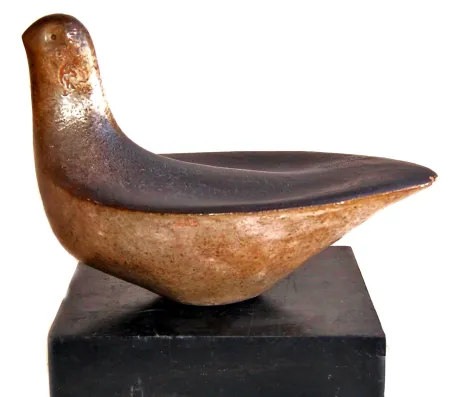
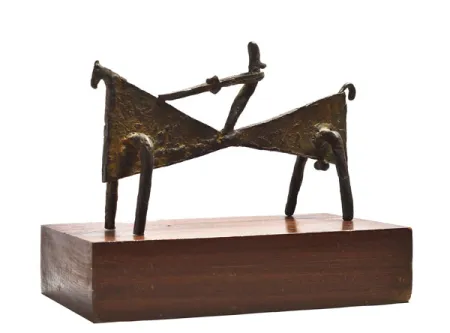
Chakraborty worked in materials including bronze, stone, ceramic, and cement. His sculptures are generally marked by compact volumes, carefully balanced masses, and a strong architectural sensibility. Rather than projecting dramatically into the surrounding space, many of his forms appear grounded, self-contained, and inwardly concentrated.
Although his sculptures often move towards abstraction, the human body remains an underlying point of reference. Torsos, seated figures, reclining forms, and organic structures may be suggested without being described anatomically. The body is reduced to its essential rhythms and spatial relationships, allowing the sculpture to exist between figuration and abstraction.
A defining quality of Chakraborty’s work is restraint. He avoided theatrical gesture, excessive surface treatment, and overt symbolism. Meaning emerges through formal relationships: weight and balance, compression and release, solidity and void, stillness and movement. In bronze, his surfaces are sensitively worked but rarely highly polished; in stone, he emphasised density, permanence, and the physical resistance of the material.
His sculptures reveal an understanding of craftsmanship as integral to artistic thought. Technique was not used to display virtuosity but to support the integrity of the form. This disciplined approach distinguished his practice within a period when many Indian sculptors were exploring expressive distortion, political narrative, and increasingly diverse materials.
Teaching and Institutional Contribution
Alongside his studio practice, Chakraborty had a distinguished career as an art educator. He taught at the Indian College of Art and Draftsmanship, Kolkata, Sainik School, Kapurthala, the Faculty of Fine Arts, Maharaja Sayajirao University of Baroda, the College of Fine Arts at Banaras Hindu University, and Kala Bhavana, Visva-Bharati, Santiniketan. Through these appointments, he contributed to the development of sculptural education and mentored students in several major centres of Indian art.
His association with Kala Bhavana also had a wider institutional impact. Chakraborty proposed adapting the Baroda Faculty of Fine Arts art-fair model at Santiniketan as a means of raising funds for student welfare. This initiative contributed to the establishment of Nandan Mela in 1973, which became an important annual event in the cultural life of Kala Bhavana.
Chakraborty became a member of the Society of Contemporary Artists in 1961, aligning himself with an influential Kolkata-based collective committed to modern artistic experimentation.
Exhibitions and Legacy
Ajit Chakraborty held solo exhibitions in Prague, Calcutta, and New Delhi and participated in important national and international exhibitions. These included Commonwealth Art Today in London and Edinburgh, Modern Asian Art involving India, China, and Japan, the Indian Triennale of World Art, New Delhi, and the São Paulo Biennale.
His works are represented in institutional and private collections in India and abroad. Aakriti Art Gallery’s collection includes sculptures in bronze and ceramic, documenting the range of materials within his practice.
Chakraborty died in 2005. His contribution lies not in stylistic spectacle but in his sustained commitment to sculptural discipline. By combining academic training, European modernist exposure, material sensitivity, and contemplative abstraction, he developed a body of work distinguished by formal integrity and quiet authority.
Association with Aakriti Art Gallery
Aakriti Art Gallery has continued to preserve, present, and research Ajit Chakraborty’s work. The gallery holds examples of his bronze and ceramic sculptures and has published a focused study titled Ajit Chakraborty (1930–2005): Form, Discipline, and the Quiet Modernism of Bengal Sculpture. Through its collection, scholarship, and wider documentation of modern sculpture in Bengal, Aakriti has contributed to renewed recognition of an artist whose importance deserves greater
attention.