Profile:
Gopesh Chandra Chakravarty, popularly known as G. C. Chakravarty, was an Indian modernist painter, illustrator, educator, and cultural activist whose contribution to twentieth-century Indian art has only recently begun to receive the recognition it deserves. An independent voice within the broader movement of Bengal Modernism, he developed a distinctive artistic language that evolved from mystical symbolism to powerful socio-political expression. Although respected during his lifetime, his work gradually disappeared from mainstream art history before being rediscovered through recent research and exhibitions.
Born in 1905 in Sylhet (then part of British India, now in Bangladesh), Chakravarty spent his childhood in the culturally rich Surma-Barak Valley. As a young man, he moved to Calcutta to study at the Government School of Art. Financial hardship, however, forced him to discontinue his studies. During this difficult period, he lived in extreme poverty and supported himself by working as a commercial illustrator while continuing to paint independently. The teachings of Ramakrishna Paramahamsa had a profound influence on his philosophy and artistic outlook, encouraging a lifelong search for spiritual and emotional truth.
His early paintings were inspired by the Bengal School of Art, particularly the delicate wash technique associated with artists such as Kshitindranath Majumdar. These works explored mythology, dreams, spirituality, and the subconscious through lyrical compositions filled with symbolic imagery and poetic atmosphere. Contemporary critics admired these paintings for their mystical quality and philosophical depth.
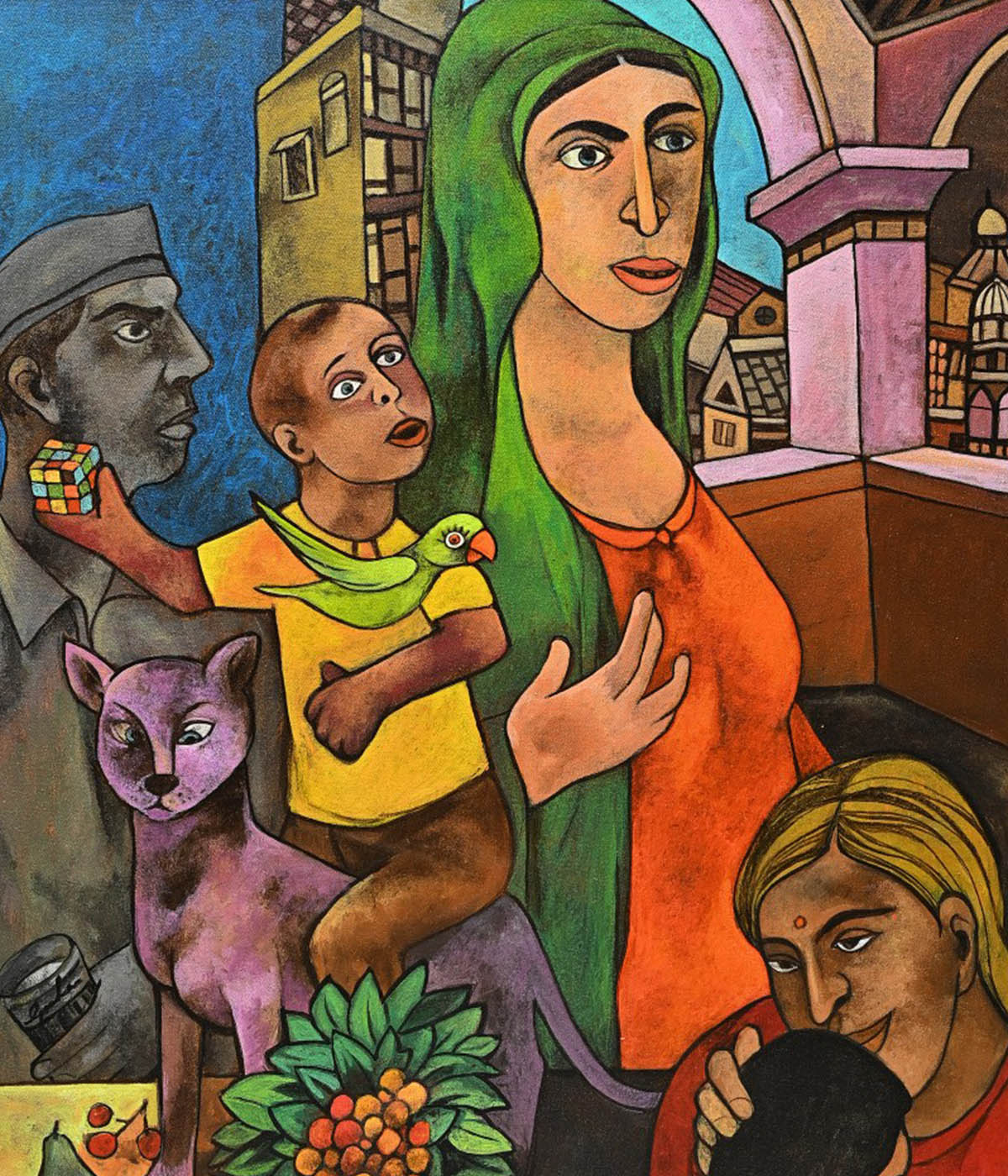
From the 1940s onwards, Chakravarty’s work underwent a significant transformation. The devastating experiences of the Bengal Famine, communal riots, the Partition of India, and later political violence deeply affected him. His paintings became more expressive and emotionally charged, with distorted human figures, fragmented forms, and dramatic compositions reflecting suffering, displacement, fear, and resilience. Through these powerful works, he emerged as one of the earliest Indian artists to employ the grotesque and psychological symbolism as a means of commenting on society and the human condition.
Alongside painting, Chakravarty worked extensively as a book illustrator, producing illustrations for Bengali editions of Russian and Eastern European literary classics. His experience as an illustrator enriched his paintings with a strong narrative quality, allowing symbolism and storytelling to coexist within his compositions.
During his lifetime, Chakravarty exhibited alongside many of the leading artists of modern India. His works were shown at the Academy of Fine Arts in 1936–37 with artists including Jamini Roy, Gopal Ghose, and Pradosh Das Gupta. He later participated in exhibitions in Kolkata, Shillong, and Sylhet. A publication on his work was brought out by Rabindra Bharati University, and his paintings received appreciation from distinguished personalities including Rajendra Prasad, Sarvepalli Radhakrishnan, art historian Kalidas Nag, and critic O. C. Gangoly.
Apart from his artistic practice, Chakravarty devoted considerable time to art education and cultural activities. He worked with educational and cultural organisations across West Bengal, Assam, Bihar, Uttar Pradesh, and the northeastern region of India, promoting art beyond major metropolitan centres and encouraging wider public engagement with visual culture.
Today, Gopesh Chandra Chakravarty is recognised as a significant modernist whose work successfully bridged the poetic spirituality of the Bengal School with the psychological and social concerns of twentieth-century modernism. His paintings stand as a powerful testament to artistic independence, human resilience, and the enduring ability of art to respond to the changing realities of society.