Profile:
Bengal Artist | Master of Wash Technique
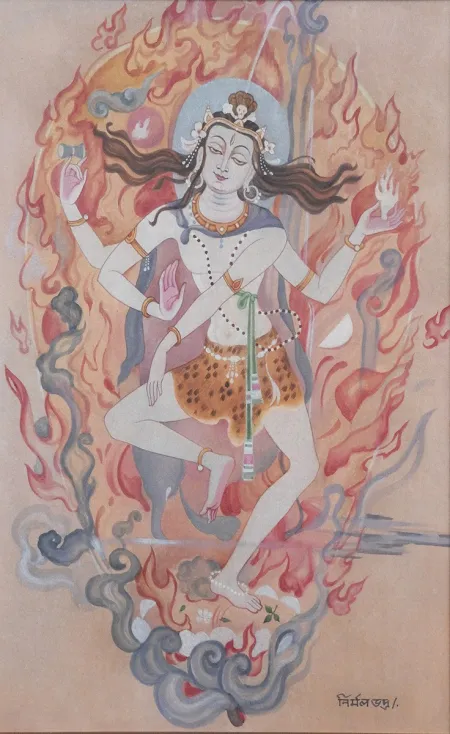
Though little is documented about Nirmal Bhadra’s formal education or birth date, his oeuvre unmistakably aligns with the stylistic and philosophical tenets of the Indian Society of Oriental Art, echoing the aesthetic sensibilities of the Abanindranath Tagore–Nandalal Bose era and the Swadeshi movement’s quest for cultural revival. Working primarily in the wash technique—popularised by the Bengal School—Bhadra produced deeply lyrical and spiritually resonant compositions that reflect the ideals of a modern Indian identity rooted in classical and devotional themes.
His work reveals a profound command of the delicate gradations and luminous layering characteristic of watercolour wash on paper, often depicting mythological scenes such as raas leela assemblies of Radha-Krishna, processional Parikrama, or divine musicians like Saraswati, rendered with a fine balance of naturalism and idealism. As in visions of Krishna encircled by gopis in eternal dance or Saraswati lost in melodic trance, his paintings evoke quiet devotion, feminine grace, and the sublime, frequently incorporating pastoral or symbolic settings—lush groves under cosmic trees—that serve as visual metaphors for divine union.
While biographical details remain scarce, pieced from signatures and collector lore, his works—mostly housed in private collections in Kolkata—continue to draw admiration for their technical finesse and cultural depth. Nirmal Bhadra stands as an important but under-recognized figure within the Bengal revivalist tradition, whose contributions deserve renewed scholarly and curatorial attention.