₹ 300,000
$ 3,333
₹ 300,000
$ 3,333
Profile:
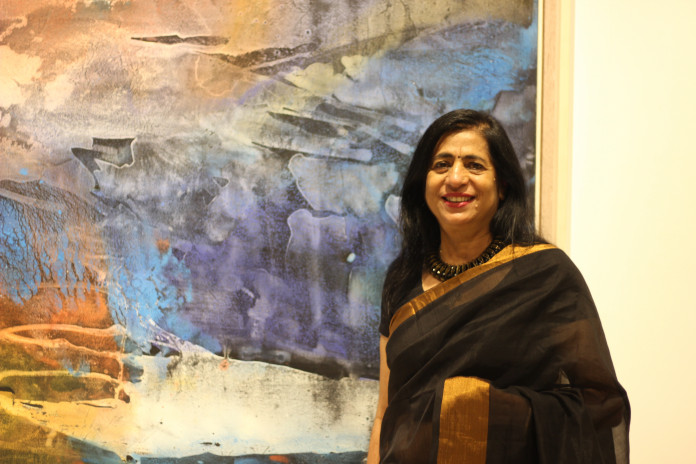
Rokeya Sultana is a leading Bangladeshi painter, printmaker, sculptor, and art educator whose practice explores womanhood, motherhood, memory, displacement, nature, and the emotional experience of contemporary life. Born in Chittagong, now Chattogram, in 1958, she completed her Bachelor of Fine Arts in printmaking from the Bangladesh College of Arts and Crafts, now the Faculty of Fine Art, University of Dhaka, in 1980. She subsequently received her master’s degree in printmaking from Kala Bhavana, Visva-Bharati, Santiniketan, in 1983.
Sultana’s formative years were shaped by the political upheaval surrounding the Bangladesh Liberation War of 1971 and by experiences of displacement and uncertainty. These memories entered her art indirectly, through images concerned with vulnerability, survival, identity, and the impermanence of human life. Her work is deeply personal, yet it frequently expands private experience into a wider reflection on the social position of women.
Visual Language and Major Series
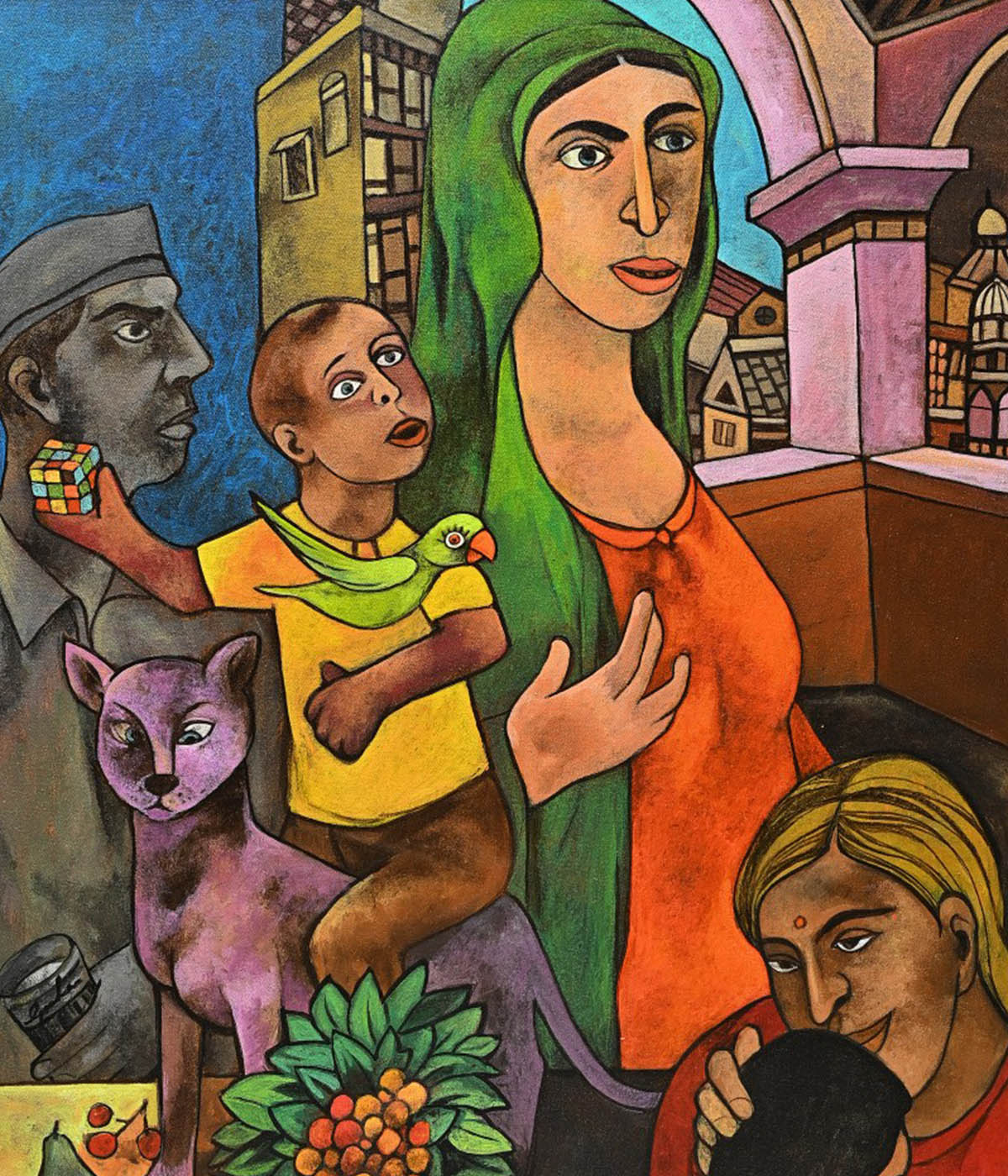
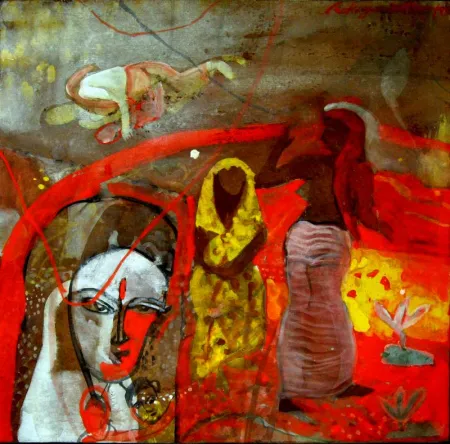
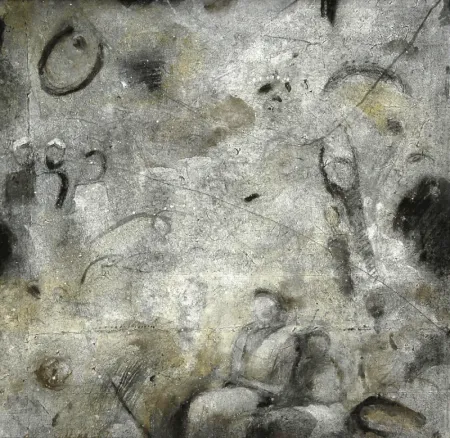
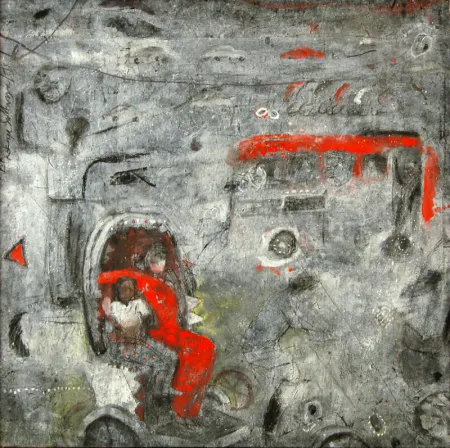
Sultana works across painting, printmaking, drawing, and metal sculpture. Her visual language moves freely between figuration and abstraction. Flowing lines, transparent layers of colour, simplified bodies, rhythmic forms, and areas of open space give her compositions a sense of movement and emotional immediacy.
Her figures occasionally recall the directness of naïve or childlike drawing, but the apparent simplicity of the image is carefully constructed. Repeated lines, overlapping forms, and juxtaposed areas of colour create complex surfaces in which memory, intuition, and lived experience remain active. Her work often reflects loss and displacement while retaining a strong sense of resilience and renewal.
The female figure is central to several of her best-known bodies of work. Her celebrated Madonna series examines motherhood not as an idealised condition but as an experience shaped by tenderness, responsibility, social pressure, labour, and resistance. The recurring protagonist represents both an individual mother and a broader symbol of women negotiating patriarchal structures. In these works, vulnerability coexists with determination and the maternal figure becomes an agent of protest and transformation.
Her Relation series considers intimacy, emotional dependence, conflict, and the changing connections among individuals. In the Fata Morgana prints, the idea of the mirage becomes a metaphor for desire, illusion, memory, and the uncertain boundary between dream and reality. Other important series include Bonobibi and Flaming Desire.
Nature assumes a more abstract form in works such as Earth, Water, Air. These compositions evoke the landscape and ecology of Bangladesh through layered colour, fluid movement, and atmospheric space. At the same time, they address environmental loss, the disappearance of wetlands and rivers, pollution, and the fragile relationship between human beings and the natural world.
Printmaking, Teaching and International Practice
Printmaking has remained fundamental to Sultana’s career. Her command of graphic processes is combined with an experimental approach to line, texture, and transparency. In 2003, she received a French government scholarship to work at L’Atelier Lacourière et Frélaut in Paris. She later received a Fulbright grant, which supported a nine-month residency at the University of Nebraska–Lincoln, and undertook another residency at Open Studio in Toronto in 2017.
Sultana has also made an important contribution as an educator. She served as a professor in the Department of Printmaking, Faculty of Fine Art, University of Dhaka, influencing successive generations of artists and strengthening the position of printmaking within Bangladesh’s contemporary art education.
Exhibitions, Awards and Collections
Rokeya Sultana has exhibited widely across Asia, Europe, the Middle East, Australia, and the United States. Her work has been presented in countries including India, Japan, France, Germany, Poland, Morocco, Oman, Iran, Egypt, Turkey, Taiwan, Nepal, Korea, Denmark, Pakistan, and the United States.
Her major honours include the Purchase Award at the Somerstown Gallery Fourth Biennial, New York, in 1992; the Grand Prize at the Third Bharat Bhavan Print Biennale in 1995; the Bengal Foundation Award at the Fourteenth National Art Exhibition in 1999; an Honourable Mention at the Ninth Asian Art Biennale in 1999; and the Bangladesh Shilpakala Academy Award in 2002. In 2025, she received the Ekushey Padak, one of Bangladesh’s highest civilian honours, for her contribution to fine art.
Her works are held in major collections, including the Bangladesh National Museum, Bangladesh Shilpakala Academy, Bengal Foundation, the National Taiwan Museum of Fine Arts, the University of Nebraska, the Zuckerman Museum of Art, the Academy of Art University, San Francisco, and Jorasanko Thakur Bari, Kolkata, among others.
Association with Aakriti Art Gallery
Aakriti Art Gallery includes Rokeya Sultana within its wider engagement with modern and contemporary art from Bangladesh and the broader Bengal region. Her presence in the gallery’s collection and artist programme reflects Aakriti’s interest in artists whose practices connect printmaking, figuration, women’s experience, and cross-border cultural histories.
Rokeya Sultana’s importance lies in her ability to transform personal memory and women’s lived experience into a visual language of wider social and cultural significance. Through fluid line, transparent colour, symbolic figuration, and experimental printmaking, she has created a body of work that is at once intimate, politically aware, and deeply connected to the histories of Bangladesh and Bengal.