News & Blog
Art for me is an expression. People around me are my inspiration…
Art for me is an expression. People around me are my inspiration…
Gurcharan Singh, born in 1949 in Patiala, Punjab, and a graduate of the Government College of Arts and Craft, Chandigarh (1973), occupies a distinctive position within the trajectory of post-independence Indian art. Over the course of five decades, he has developed a visual language that blends figurative clarity with allegorical depth, rooted in lived experience and enriched by memory, folklore, and social engagement. Singh’s practice is shaped by an unwavering attentiveness to the everyday—to the lives of those who dwell outside dominant narratives—and by a lyrical sensibility that elevates the ordinary into the poetic.
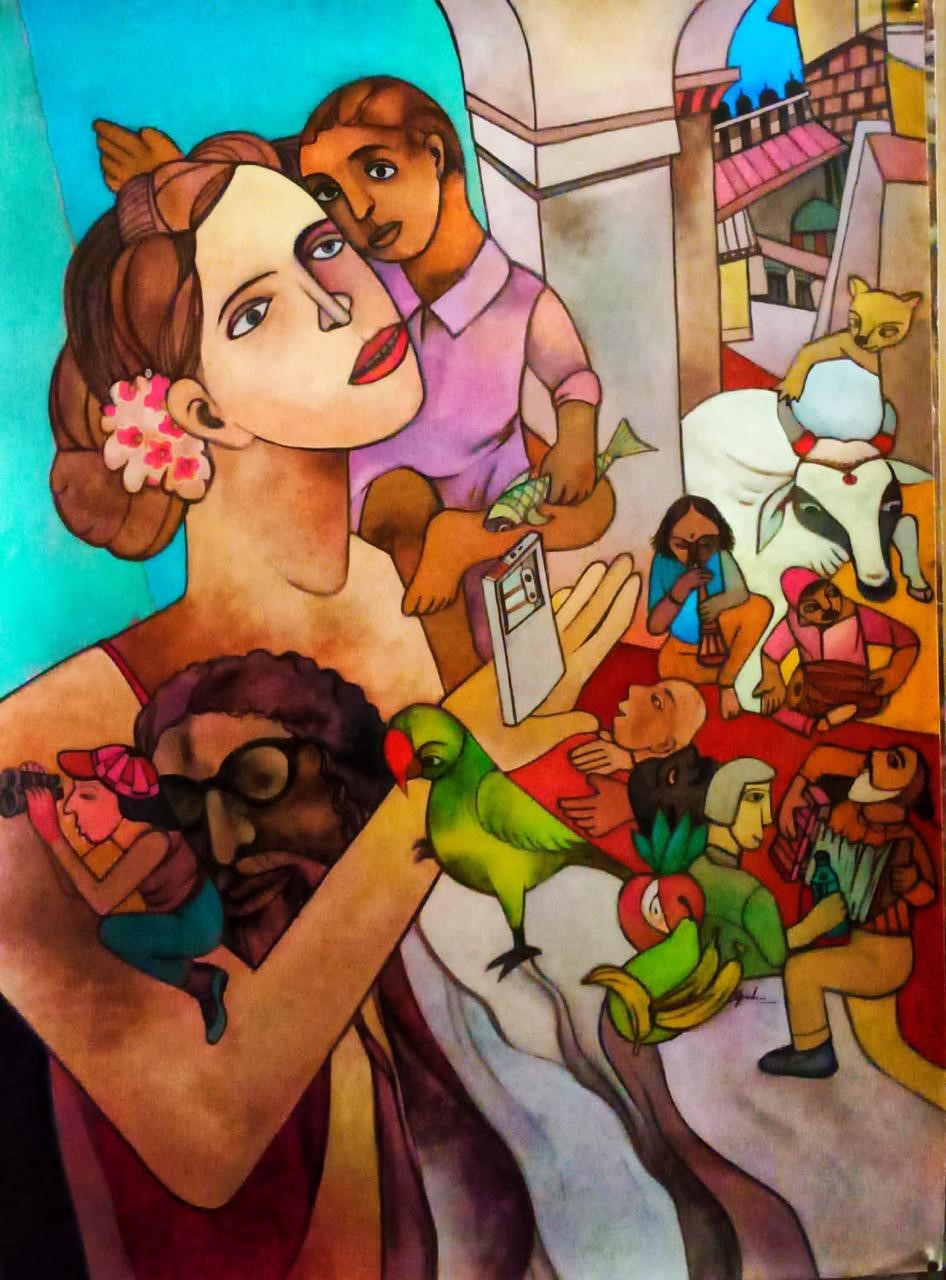
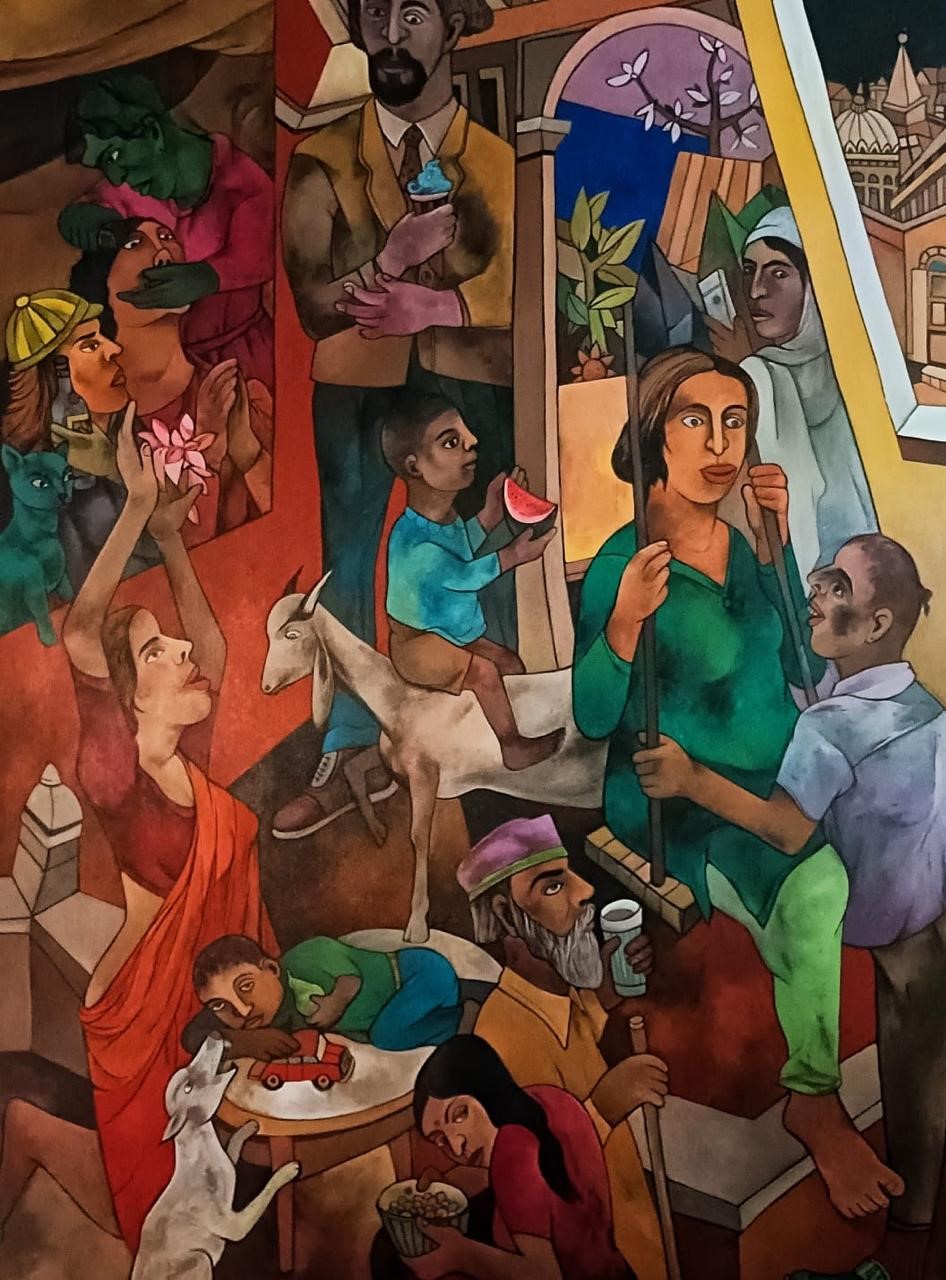
In his own words, “Art for me is an expression. People around me are my inspiration… Though to the common eye it may appear familiar, in truth, this is my world made visible from the invisible.” This philosophy is evident in his paintings, where street performers, domestic workers, animals, vendors, lovers, children, and mythic symbols coexist in shared urban and rural spaces. Singh’s compositions are densely layered, often eschewing linear perspective in favour of a flattened pictorial plane animated by vibrant colours and strong outlines. His works collapse temporal and spatial registers, bringing together memory and observation in tableaux that feel both personal and collective, intimate and theatrical.
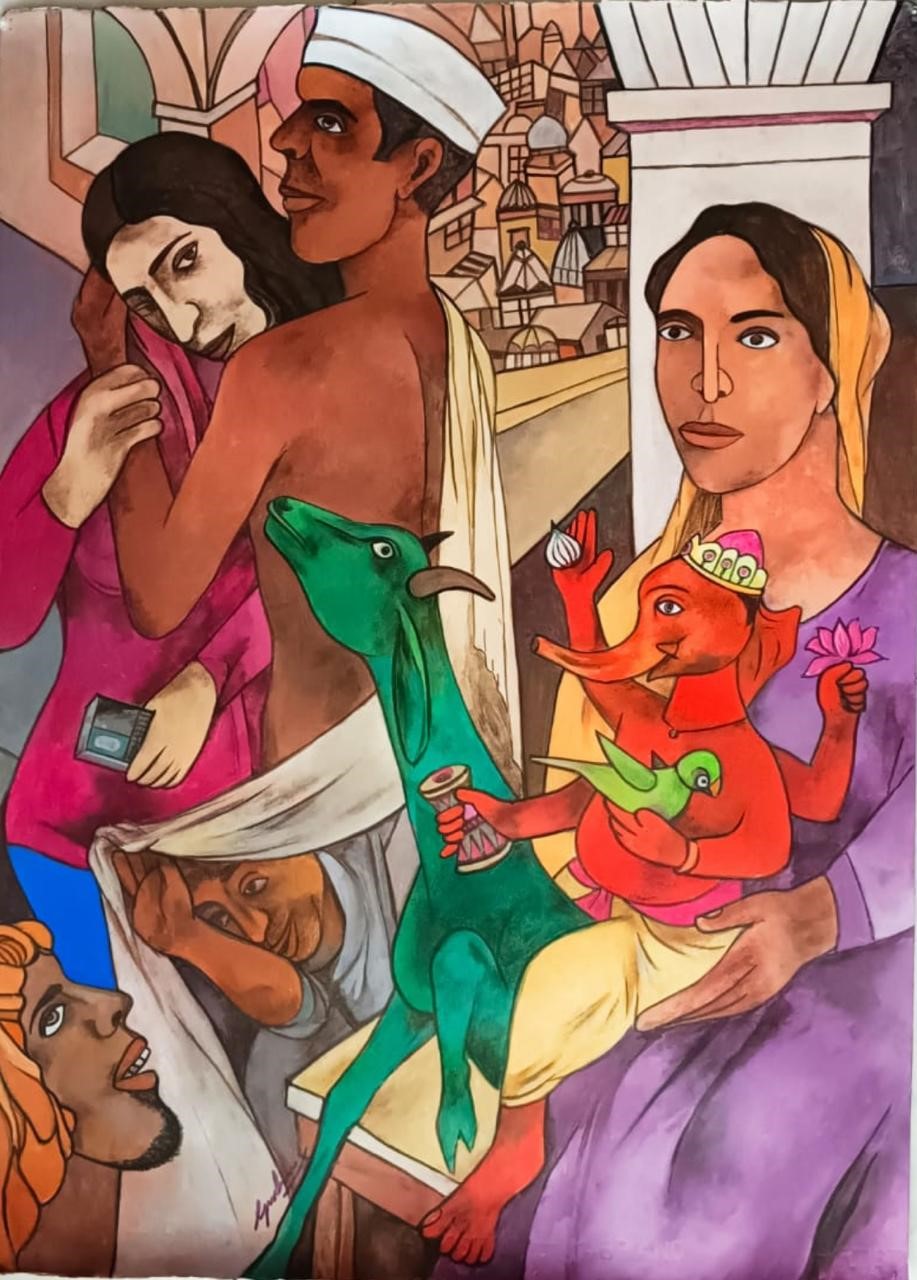
Singh’s art draws from a wide array of Indian visual traditions—ranging from the narrative fluidity of miniature painting to the social immediacy of folk forms—while remaining grounded in a modernist idiom. His stylised figuration, chromatic exuberance, and compositional rhythm recall aspects of muralism and post-cubist structure, yet always serve the larger ethical imperative of bearing witness. The sacred and the secular often overlap without dissonance in his works—a woman may cradle a Ganesha child while holding a parrot and lotus, a street sweeper may appear alongside a cityscape of domes and archways, a camera or a mobile phone may occupy the same space as a ritual gesture. These juxtapositions are not ironic; they are part of Singh’s worldview, in which myth, memory, labour, and intimacy coexist without hierarchy.
Singh’s career has been marked by a wide range of solo and group exhibitions across India and abroad. He has held solo shows in Chandigarh (1970, 1972, 1973), New Delhi, Mumbai, Paris (1977), Hamilton (Canada, 1977), and London (1988), among others. His works have been featured in prestigious international platforms such as the Tokyo Biennale (1984), the Seoul Contemporary Art Asian Shows (1986), the Festival of India in the USSR (1987), and the 6th Biennale in Cleveland, UK (1983). He has also participated in the Harmony Shows in Mumbai (1996, 1997, 1998) and various institutional exhibitions organised by the Lalit Kala Akademi, CRY, and others. His paintings are held in major collections including the National Gallery of Modern Art (New Delhi), Museum of Non-Aligned Countries (Yugoslavia), Birla Academy (Calcutta), Beckett Gallery (Canada), and numerous public and private collections across India and abroad.
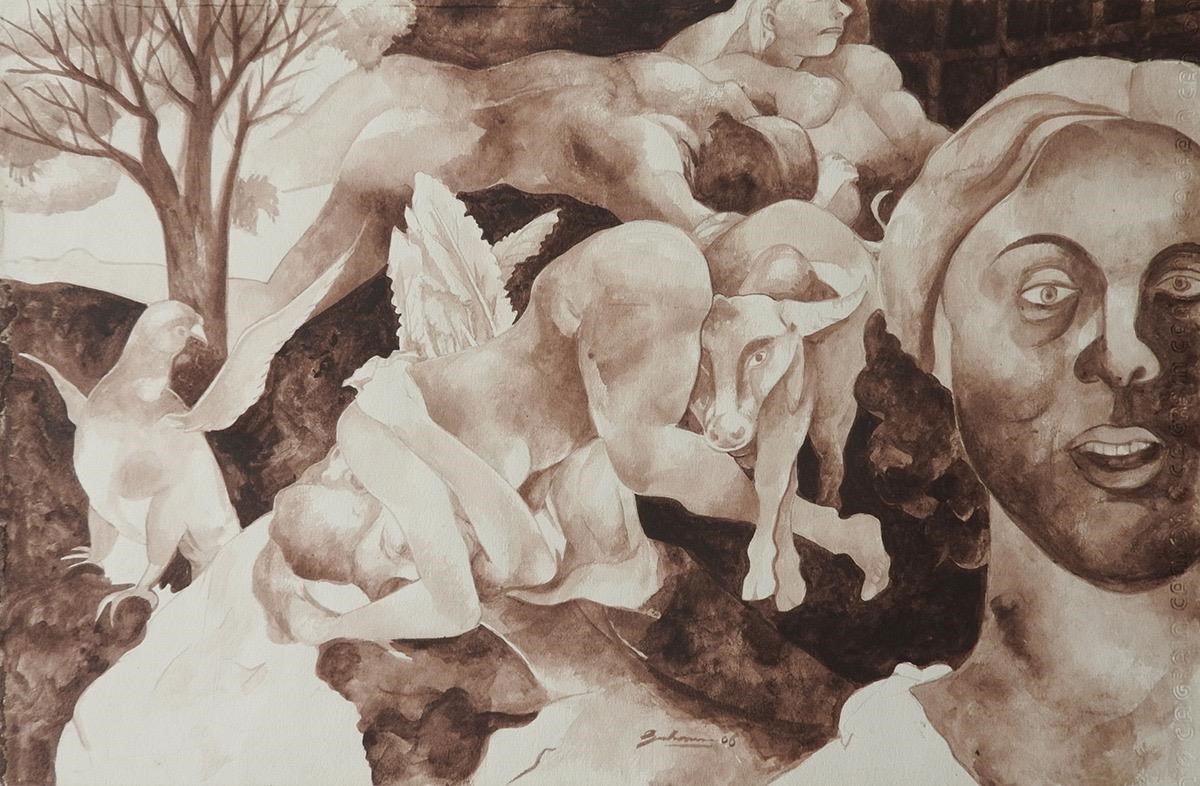
Throughout his career, Singh has remained committed to the act of remembering—to constructing, through image and gesture, a world that honours the unnoticed, the invisible, and the transient. His sepia-toned watercolours, in particular, stand out for their evocative tonal gradations and allegorical density, often populated by intertwined human and animal forms that evoke myths of origin, exile, and belonging. Yet even in his most abstracted compositions, Singh never loses sight of the human figure, which remains central to his vision.
What makes Gurcharan Singh’s work enduringly significant is its refusal of spectacle in favour of intimacy, its rejection of cynicism in favour of empathy, and its insistence that art remains tethered to life. In an age increasingly dominated by digital image economies and aesthetic detachment, Singh’s work restores to painting a quiet gravity and a generous gaze. His forthcoming solo exhibition at Aakriti Art Gallery, curated by Prayag Shukla, offers a timely and necessary engagement with an artist whose world—made visible from the invisible—continues to resonate with remarkable immediacy and depth.