News & Blog
Clay, Cosmos, and the Crimson Tongue: A Kali Tableau from Krishnanagar Signed by Bimal Das
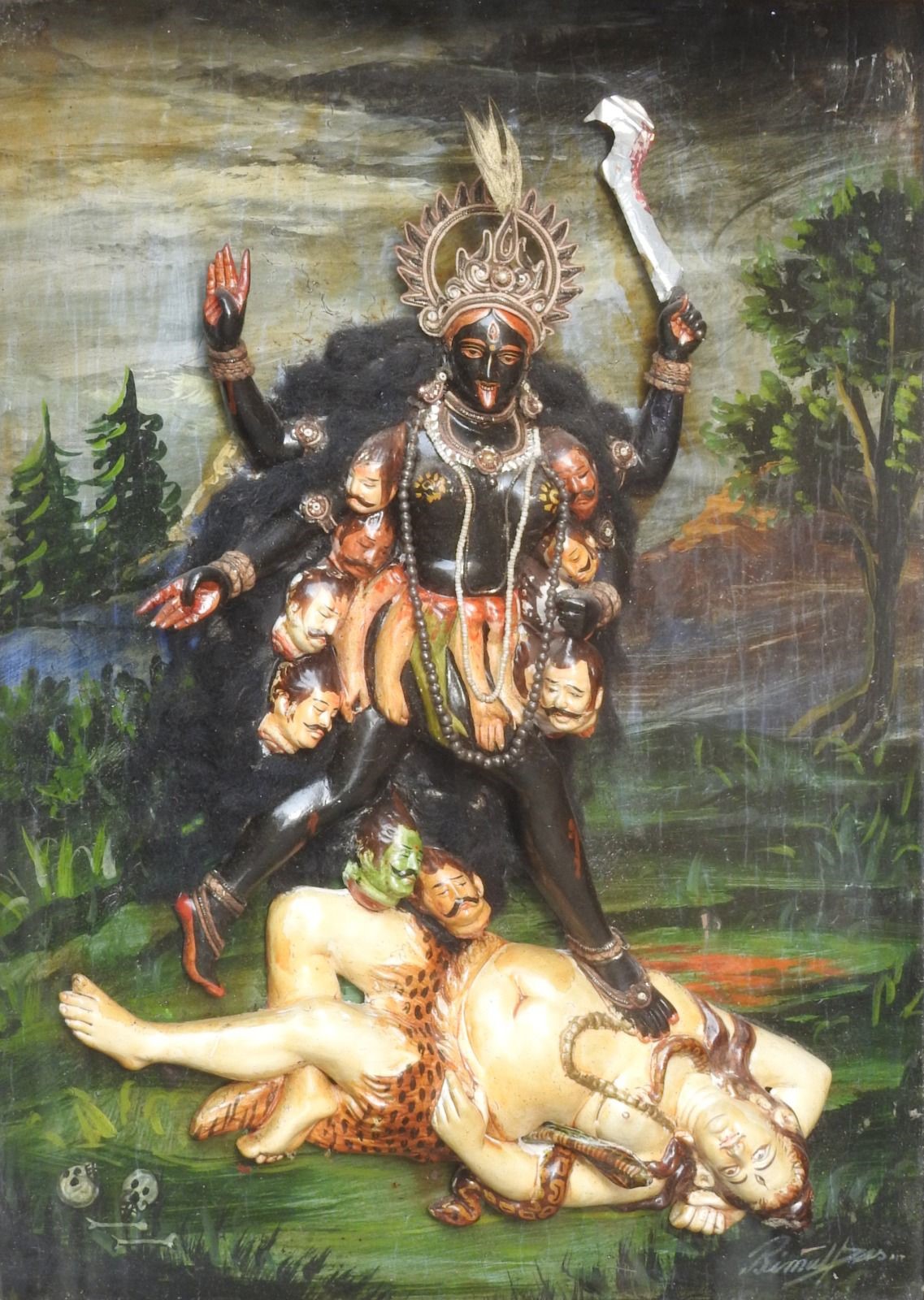
Among the many devotional forms that emerge from Bengal’s sacred art traditions, the figure of Goddess Kali has held a uniquely visceral presence—both feared and revered, dark yet radiant, ferocious yet maternal. This hand-modeled terracotta tableau, attributed to an artist named Bimal Das, draws powerfully from that tradition, presenting Kali in her classical Dakshina Kali form, with a level of detail, theatricality, and material nuance that places it within the lineage of Krishnanagar clay sculpture, though not without individual expression.
Krishnanagar, located in Nadia district of West Bengal, has long been associated with a vibrant tradition of clay modeling, especially in the neighborhood of Ghurni. From the mid-18th century onwards, under the patronage of local rulers like Maharaja Krishna Chandra, artisans developed a remarkable idiom of naturalistic sculpture—depicting colonial figures, mythological scenes, and religious icons in clay, often with lifelike precision and painterly embellishment. While many of these artisans remain anonymous, a few, like the present maker Bimal Das, have inscribed their names on their creations, allowing glimpses into otherwise undocumented artistic lives.
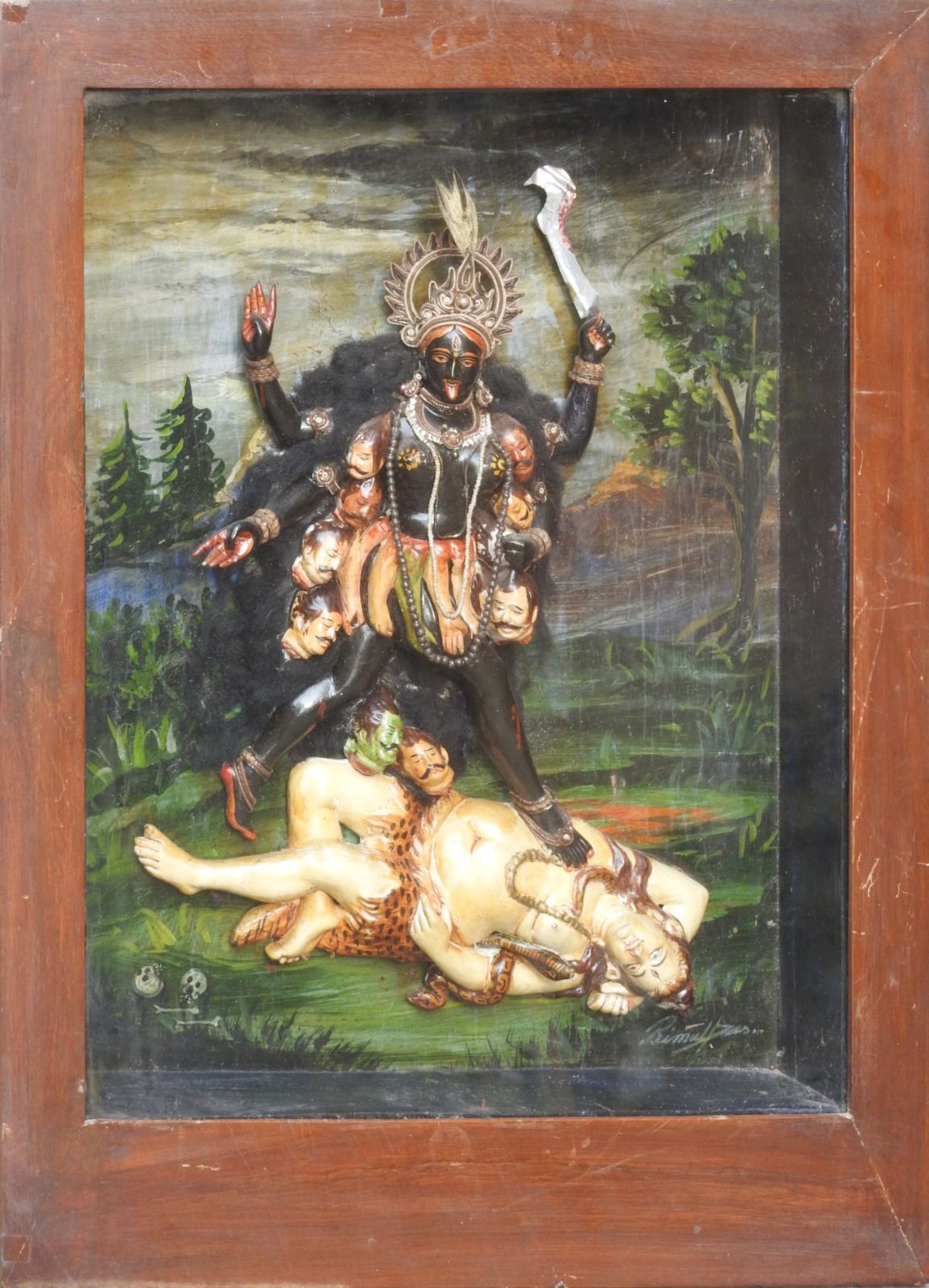
In this piece, Kali is shown standing atop the inert, supine body of Lord Shiva, with one foot placed gently on his chest—a pose symbolizing her return to consciousness after the frenzy of destruction. The goddess’s form is built in high relief using painted terracotta and natural fibers, framed within a shadow-box that serves both as shrine and narrative setting. Her outstretched arms hold symbolic attributes—a bloodied scimitar and a severed head in the upper hands, and gestures of blessing and fearlessness in the lower ones. Her body is adorned with a garland of decapitated heads, modeled individually, each with distinct expressions. The dramatic protrusion of her tongue, painted in vivid red, is central to her iconography, as is the voluminous black hair crafted from real fiber, attached with care to give it a flowing, animated effect.
What distinguishes this tableau is the painterly depth of the background—a dusk-lit forest rendered in soft brushwork, evoking the cremation ground that is symbolically tied to Kali’s cosmic abode. The figures of Shiva and the demon beneath him are rendered in warm skin tones, with shaded musculature and hand-painted textiles, anchoring the divine drama in tangible human realism.
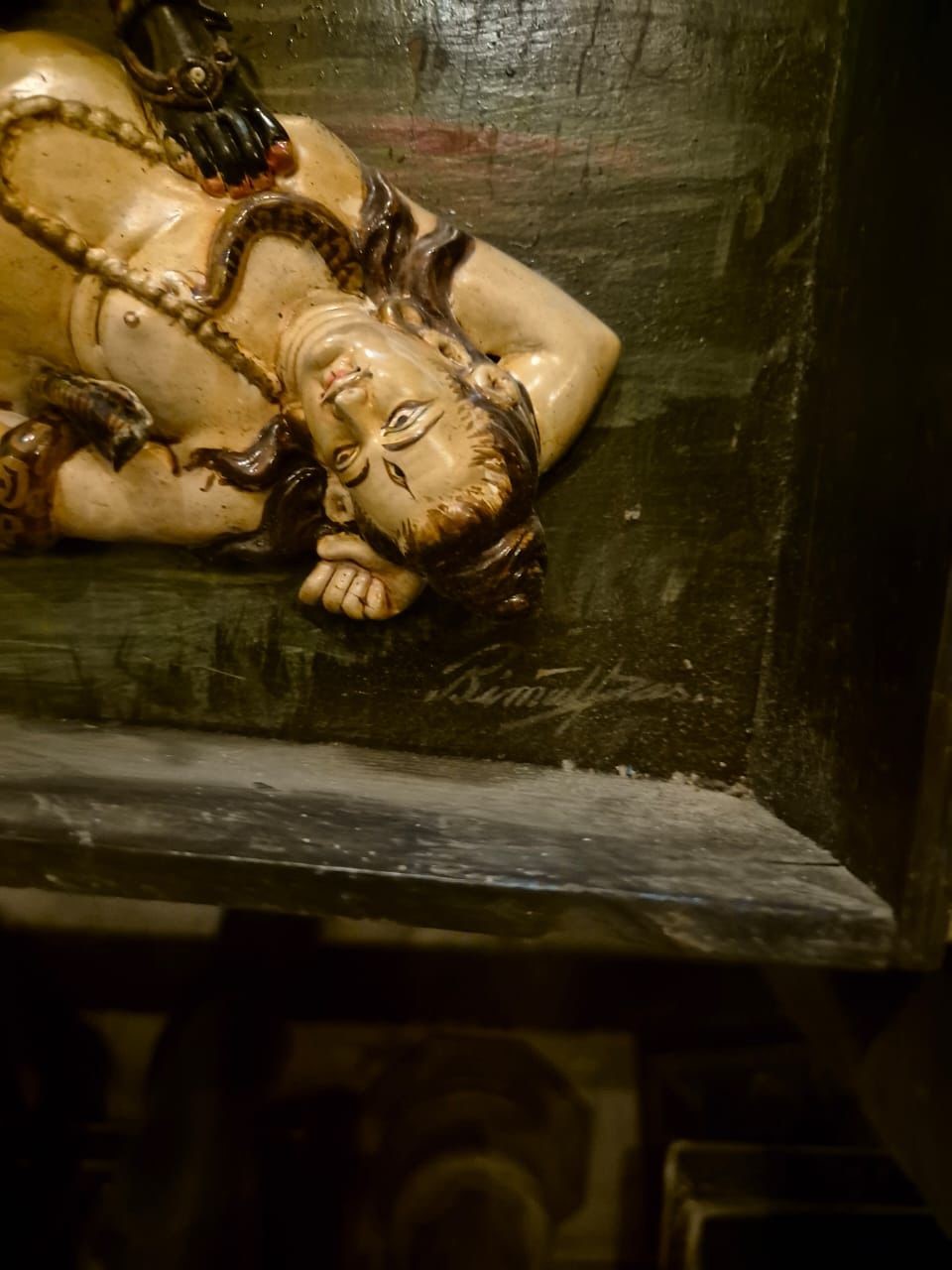
The sculpture is signed in English, Bimal Das, at the bottom right corner—rare in folk devotional work, where the identity of the artisan is often subsumed under collective tradition. There is, as yet, no documented biography or catalogue entry for Bimal Das, but the precision and confidence of this piece point to a practiced hand, likely trained within a family or regional workshop. It may be the work of a mid-to-late 20th-century artisan, created for domestic devotion or for a discerning collector drawn to folk religious sculpture.
In its scale, visual impact, and layered symbolism, this terracotta tableau occupies a space between sacred object and narrative sculpture. It brings together the inherited codes of Bengali religious art with the intimate authorship of a skilled regional maker. Though Bimal Das remains absent from the written histories of Indian art, this sculpture ensures that his work enters the visual archive—carrying forward the Krishnanagar tradition not as static heritage, but as living, evolving expression. Through clay, paint, and myth, he gives us not just Kali the goddess, but Kali the experience.