News & Blog
Forgotten Fold: Rediscovery, Restoration, and the Renewal of Bengal’s Realist Historiography
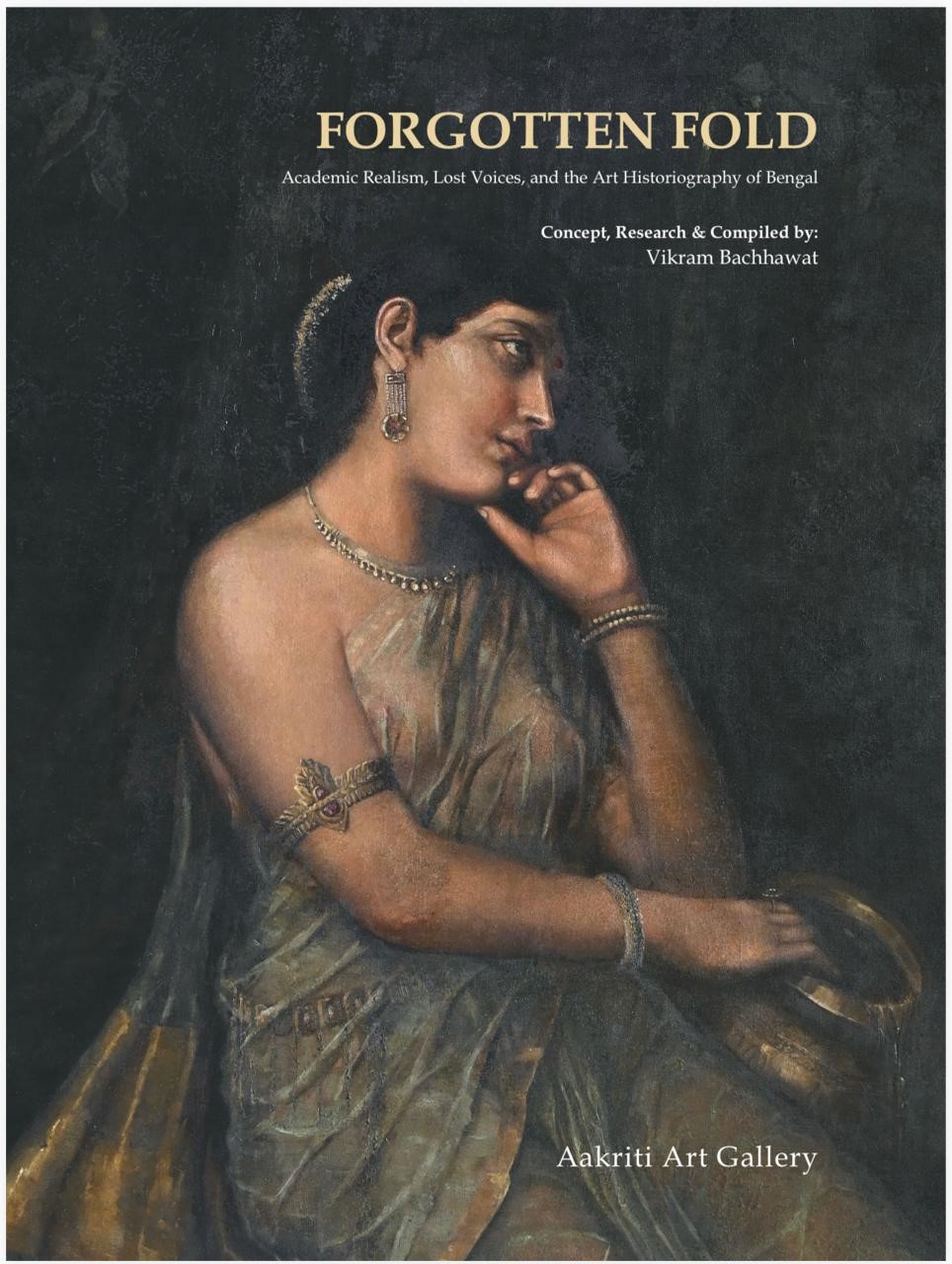
Forgotten Fold: Academic Realism, Lost Voices, and the Art Historiography of Bengal—to be released by Aakriti Art Gallery in the last week of December 2025—is a landmark contribution to the study of early twentieth-century Bengal art. Researched and compiled by Vikram Bachhawat, the volume undertakes a rigorous reassessment of Bengal’s academic realist tradition through the rediscovery and restoration of Ashru-Kumva (1918), an evocative oil painting now conclusively attributed to Ananda Mohan Shaha, an artist whose name had all but disappeared from the historical record.
The book offers a carefully structured narrative beginning with a contextual Prelude and Introduction that outline the circumstances of Shaha’s disappearance from scholarship and the methodological challenges involved in reconstructing his oeuvre. The early chapters situate academic realism within the institutional and aesthetic environment of colonial Bengal, mapping the relationships between the Government School of Art, the Jubilee Art Academy, and the Indian Academy of Art. Through archival reconstruction and stylistic analysis, the text illuminates how Shaha and his contemporaries absorbed, adapted, and transformed European academic techniques within local cultural frameworks.
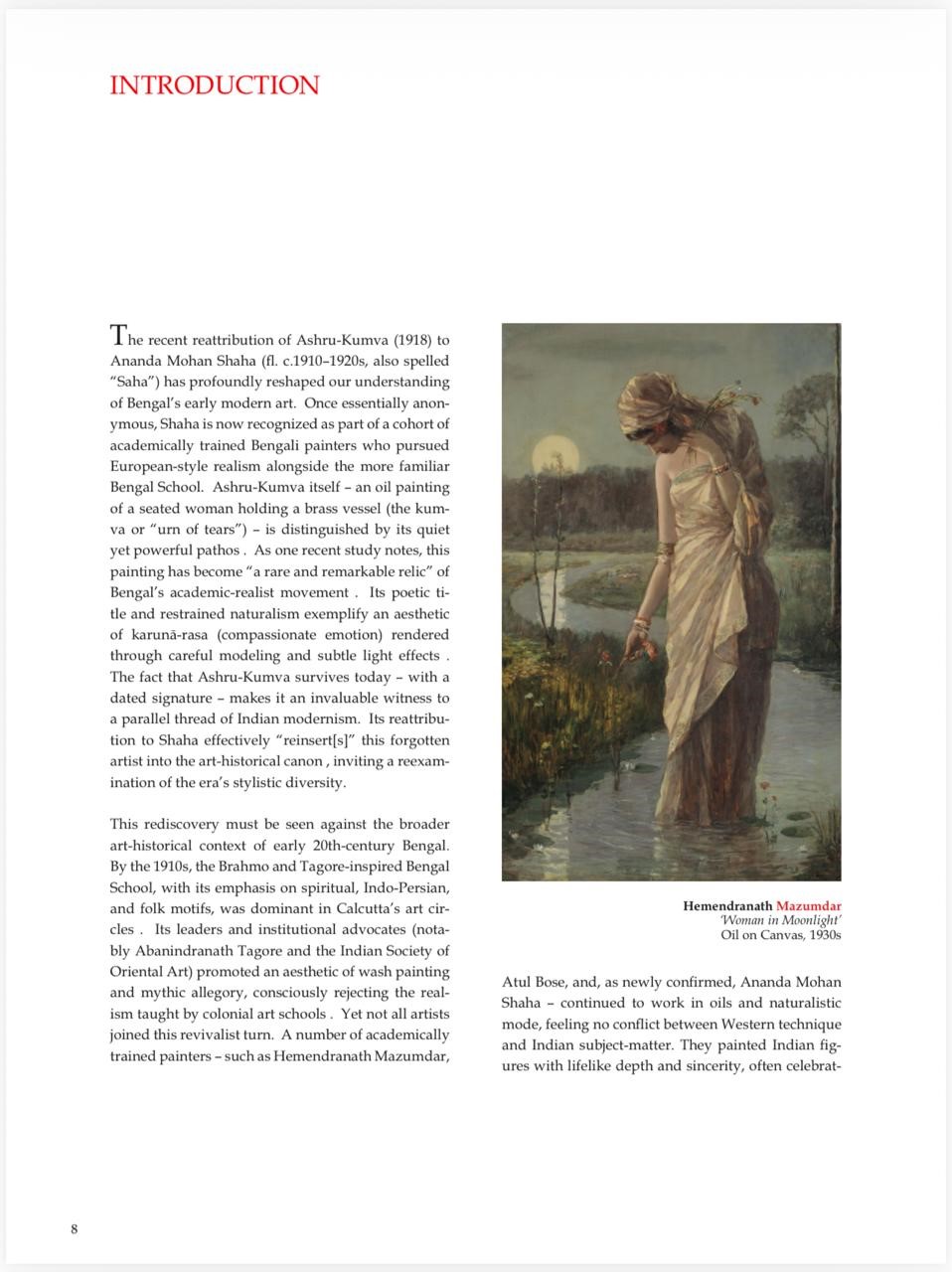
A major strength of Forgotten Fold lies in its exceptional visual documentation. The volume presents hundreds of high-quality images—including works by Hemendranath Mazumdar, Atul Bose, Jamini Roy, Bhabani Charan Law, Fanindra Nath Bose, and other significant yet understudied academic realists. These images serve not merely as illustration but as comparative evidence, enabling a deeper investigation of technique, drapery, gesture, surface treatment, and thematic continuities across the realist tradition. The inclusion of variations—sketches, watercolour studies, intermediate drawings, and finished oils—allows readers to understand academic realism as a process-driven discipline grounded in iteration and refinement.
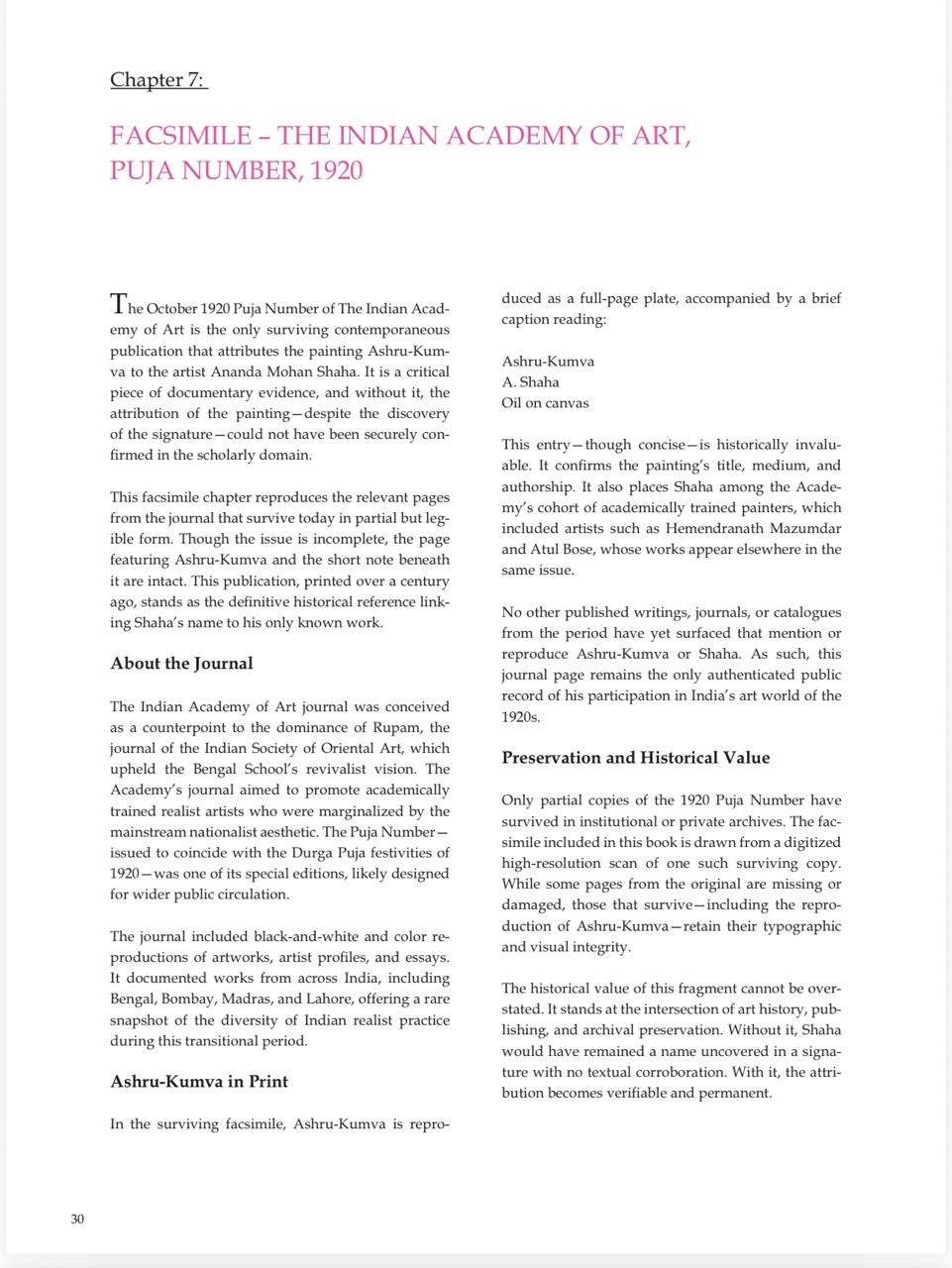
Chapter 7 offers a complete facsimile reproduction of the 1920 Puja Number of the Indian Academy of Art, the earliest publication to include Ashru-Kumva. This rare document anchors the book’s argument, demonstrating the visibility of realist practices within contemporary exhibition circuits and revealing the aesthetic networks that framed Shaha’s career.
Chapters 8 and 9 provide original scholarly contributions by examining the method of variation within the Jubilee lineage and the centrality of draped realism in Bengal’s figural vocabulary. These chapters reposition artists traditionally overshadowed by the nationalist or modernist narratives, showing how their meticulous work shaped the technical foundations of twentieth-century Indian art.
The concluding section—Chapter 10: Reflections & Responses—brings together distinguished writers and scholars:
- Uma Nair reflects on the emotional and poetic dimensions of Ashru-Kumva,
- Mrinal Ghosh situates Shaha within the broader emergence of modernity,
- Vikram Bachhawat analyses the wet-sari motif in its historical and cross-regional articulations,
- Soujit Das contemplates the psychological nuance of female figures in c.1900 paintings
- Debdutta Gupta reconstructs Shaha’s artistic milieu through archival fragments, and
- Dr. Anuradha Ghosh interprets the evolving semiotics and identity-politics embedded in the painting.
Together, these essays demonstrate how the rediscovery of a single artwork can realign art-historical narratives and restore visibility to artists pushed to the margins of academic study.
Forgotten Fold stands as a meticulously researched, visually rich, and historiographically significant volume. By reinserting Ananda Mohan Shaha into the artistic genealogy of Bengal, and by assembling an unprecedented visual corpus from the realist tradition, the book invites scholars, collectors, and institutions to reconsider the foundations of Indian art history. With its release in December 2025 as a limited edition of 500 copies, it promises to become an essential reference for future research into Bengal’s academic realism.