News & Blog
Reimagining Artistic Pedagogy: The Bachhawat Foundation Artist Residency 2025
Kolkata, 27th June 2025
In the contemporary Indian art landscape, residencies have emerged as critical spaces for the cultivation of emerging practices, transcending the limitations of formal art education. As part of Aakriti Art Gallery’s 20th anniversary celebrations, the 2025 Artist Residency initiated in collaboration with the Bachhawat Foundation marks a timely and considered intervention in this evolving ecology. Targeted specifically at young practitioners who completed their art education between 2015 and 2020, the residency seeks to reinvigorate the studio as a site of both practice and discourse.
The cohort, carefully selected through a national open call, consists of ten artists whose proposals reflect both conceptual rigor and material sensitivity. These artists—Kapil Jangid, Arpan Sadhukha, Prithwish Daw, David Malakar, Souvik Das, Raka Panda, Prajith Elampillai, Pratap Manna, Mitali Das, and Shitangshu Mondal—represent a cross-section of new voices in Indian contemporary art. Their selection was made by an academic panel comprising senior practitioners and educators, including Prof. Chhatrapati Dutta and Prof. Indrapramit Roy, whose curatorial stewardship ensures that the program moves beyond technical training to foster reflective, context-aware practice.
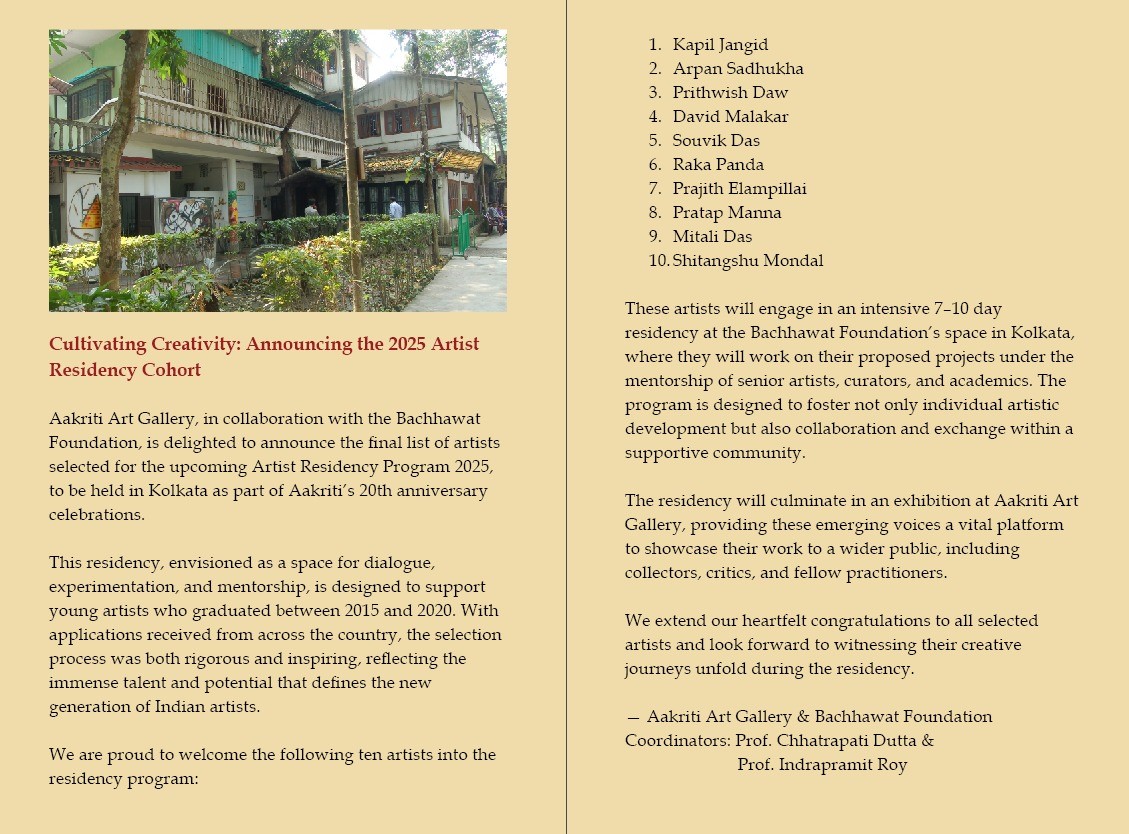
The residency is designed as a 7–10 day immersive engagement, hosted at the Bachhawat Foundation’s studio complex in Kolkata. While the duration is short, the structure is intensive and dialogic. Participants are not only provided logistical and material support but are embedded within a schedule of studio critique, peer learning, and one-on-one mentorship with artists and curators of national repute. These pedagogical strategies are intended to simulate the critical environment of a post-graduate atelier, while also encouraging artists to engage in intergenerational and interdisciplinary dialogue.
This initiative builds upon the legacy of Aakriti Art Gallery’s GenNext series, first launched in 2006. That platform was instrumental in bringing forth several now-established names in Indian contemporary art. However, unlike GenNext—which focused primarily on exhibition opportunities—the Bachhawat Foundation Residency reinserts process at the center of artistic validation. The final exhibition, to be hosted at Aakriti Art Gallery, is not the culmination but a continuation of this dialogic process, reflecting the outcomes of experimentation, mentorship, and critical feedback.
From an institutional perspective, the residency reflects a growing recognition that emerging artists today must be supported not just with space and visibility, but with structured pedagogical tools and mentorship. In the absence of state-run transitional programs or artist development grants, such private initiatives become increasingly vital. The emphasis here is not merely on exhibiting talent but on shaping artists capable of sustaining long-term, meaningful practices.
Furthermore, by situating the residency within the cultural and historical milieu of Kolkata—long regarded as a crucible for modern and contemporary art—the program benefits from both heritage and immediacy. The setting allows participants to draw from Bengal’s rich artistic past while engaging with its dynamic present.
In this sense, the Bachhawat Foundation Artist Residency serves not merely as a program but as a proposition: that mentorship, process, and reflective practice remain indispensable components of an artist’s journey. As such, it not only supports individual growth but actively contributes to the broader discourse on how institutions can—and must—reimagine their roles in shaping the future of Indian art.