News & Blog
Sculpting Across Empires: The Life and Work of Fanindra Nath Bose (1888–1926)
By Vikram Bachhawat
In the landscape of early twentieth-century sculpture, Fanindra Nath Bose occupies a unique position as a transnational artist who bridged colonial India and metropolitan Europe. Born on 2 March 1888 in Bohor, Vikrampura (in present-day Bangladesh), Bose emerged from the artistic ferment of Bengal at a time when the region was navigating cultural nationalism, modernism, and colonial institutional frameworks. He would later become the first Indian sculptor to receive formal recognition from the Royal Scottish Academy—an unprecedented honour for an Asian artist at the time—and his life and practice reveal both the cosmopolitanism and contradictions of a colonial subject asserting artistic agency on European soil.
Bose’s early education took place at the Jubilee Art Academy in Calcutta, a lesser-known but influential institution that operated alongside the more formal Government School of Art. At the latter, Bose studied under Ernest Binfield Havell, a key reformer who sought to resist the dominance of academic naturalism and revive Indian aesthetic traditions. Despite Havell’s advocacy for indigenous idioms, Bose’s early practice remained firmly anchored in figurative realism, a tendency that would define his mature works. By the age of sixteen, Bose resolved to train in Europe—an unusual and ambitious decision for an Indian sculptor of his generation.
Denied entry to the Royal College of Art in London and several academies in Italy, Bose eventually travelled to Edinburgh in 1905, where he enrolled at the Board of Manufacturers School of Art, which would soon evolve into the Edinburgh College of Art (ECA). He quickly distinguished himself as an exceptional draughtsman and modeler, winning the prestigious Stuart Prize at the RSA Life School by 1906. His early mentors included the sculptor Percy Portsmouth, who later praised Bose’s “phenomenal control of minutiae” and his sophisticated understanding of anatomical form. In 1911, Bose graduated with a Diploma in Sculpture and was awarded a competitive travel scholarship co-sponsored by the University of Edinburgh and the Bengal Government—an award that further consolidated his standing as a colonial subject excelling within imperial institutions.
Between 1912 and 1915, Bose relocated to Paris, where he studied in the atelier of Auguste Rodin. While direct documentation of this period remains sparse, stylistic analysis of his later works reveals a synthesis of Rodin’s expressiveness with the crisp detail and compositional stability inherited from British “New Sculpture” artists such as Hamo Thornycroft and George Frampton. Bose’s work from this period began to show a sculptural fluency that was simultaneously emotive and controlled—an idiom not typically associated with colonial Indian artists of the time, many of whom were constrained by nationalist expectations to conform to a revivalist aesthetic.
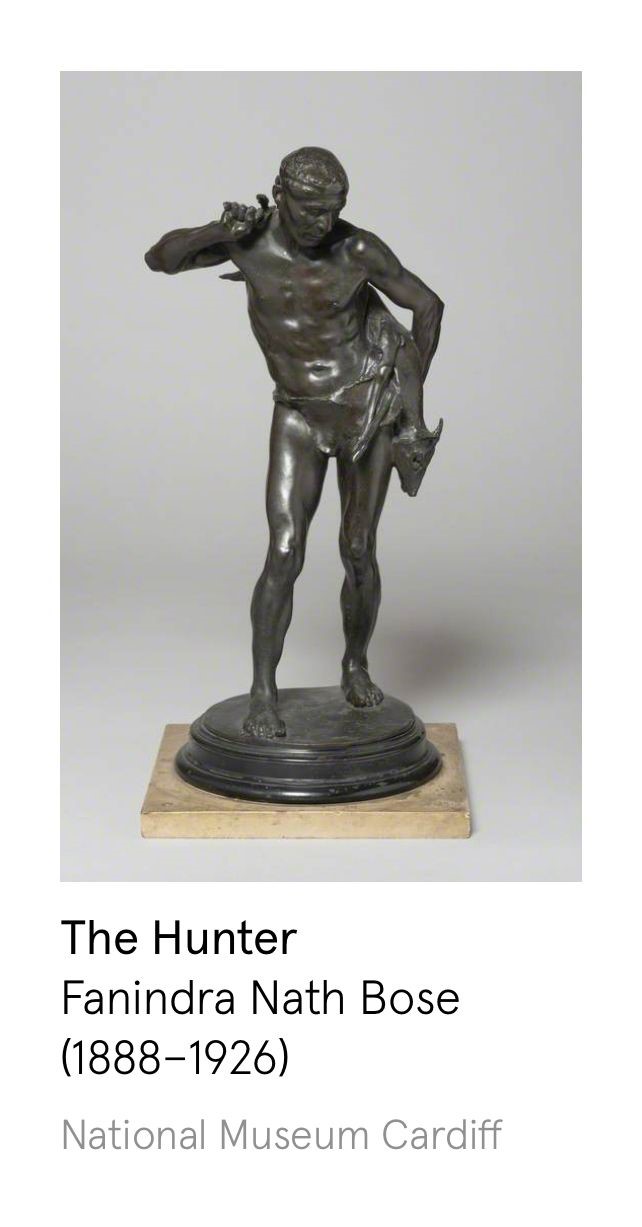
Bose’s exhibition history during this period was impressive. In 1913, he debuted at the Royal Scottish Academy with two bronze statuettes, The Boy and the Crab and The Hunter. The latter caught the attention of both William Goscombe John—a leading British sculptor who acquired it for his private collection—and the Maharaja Sayajirao Gaekwad III of Baroda. By 1915, Bose was appointed sculptor to the Gaekwar, leading to a series of commissions that resulted in eight bronze sculptures for the Laxmi Vilas Palace and two for the Baroda Museum. These works, though now largely undocumented in public discourse, reportedly reflected Bose’s signature style: intimate figurative compositions infused with rhythmic dynamism. His position in Baroda also marked a moment of triangulated patronage—between British institutions, princely India, and a diasporic Indian artist working across both.
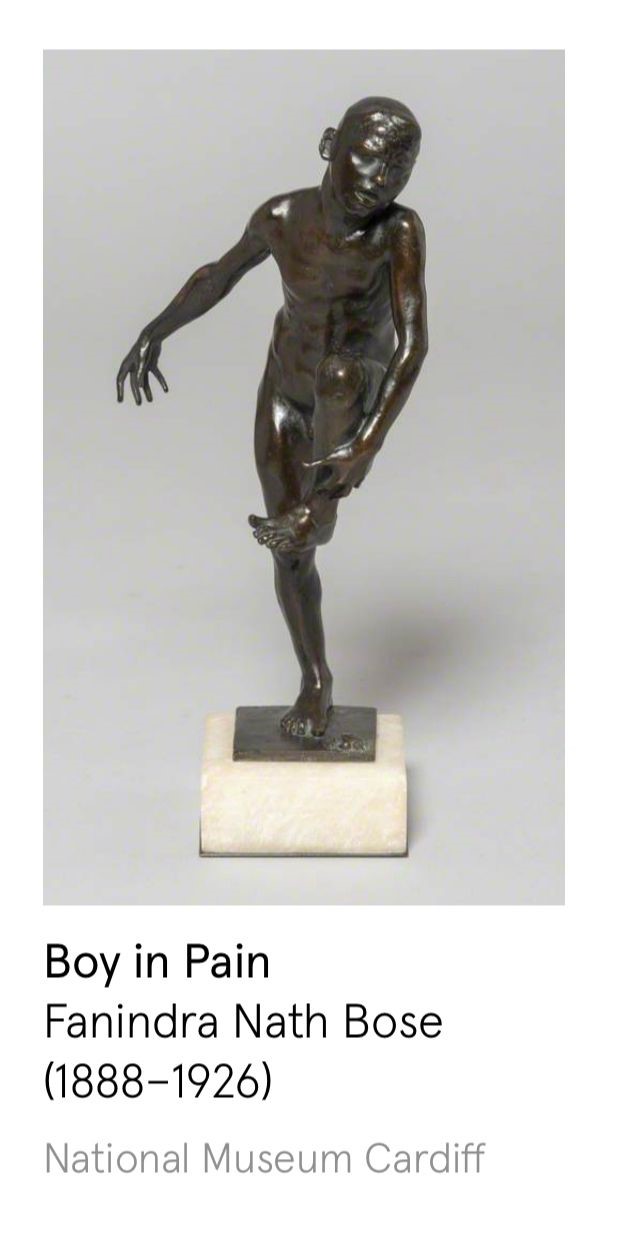
Bose’s international standing continued to grow in the years following World War I. He exhibited regularly at the Royal Academy in London, showing Boy in Pain (1914), The Snake Charmer (1919), and The Athlete and the Hound (1924). These works often dealt with themes of physical tension and animal-human interactions—motifs which allowed him to demonstrate both anatomical mastery and allegorical subtlety. It is worth noting that The Snake Charmer received mixed reactions in India, where some nationalist critics, such as O.C. Gangoly writing as “Agastya,” decried its so-called “un-Indian” aesthetic. Such critiques, while indicative of the fraught reception of diasporic Indian artists working in Western modes, also reveal the complicated expectations placed upon artists like Bose, who were caught between nationalist revivalism and cosmopolitan modernism.
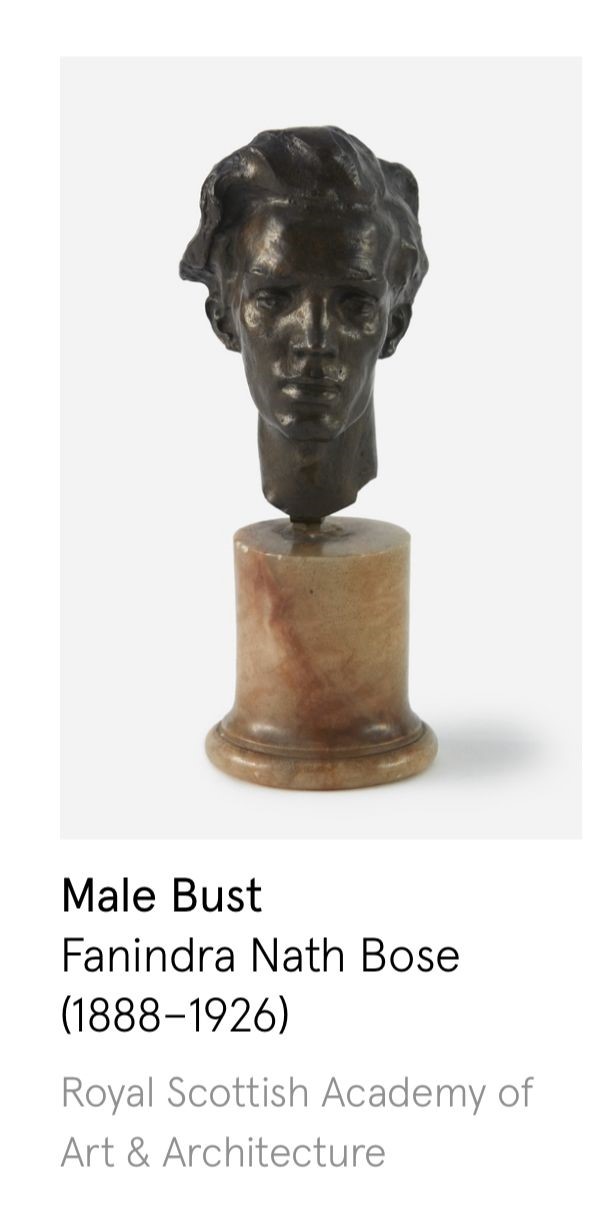
In Scotland, Bose continued to produce public commissions, including a war memorial in Ormiston, East Lothian (c. 1925), and a statue of St John the Baptist for the memorial shrine at St John’s Church in Perth. These works reflected his commitment to civic art and his integration into Scottish artistic life. His election as an Associate of the Royal Scottish Academy (ARSA) in March 1925 was a historic moment: not only did it formalize his place within the British artistic elite, but it also marked a rare moment of institutional recognition for a non-European artist in early twentieth-century Britain.
By this time, Bose had established a studio at 4 Belford Road in Dean Village, Edinburgh, and married a Scottish woman known as Molly, with whom he had settled into domestic life. Tragically, his career was cut short when he died of a heart attack on 1 August 1926 during a fishing trip near Peebles. He was buried in Liberton Cemetery, where a memorial plaque was later installed—though reports suggest it may now be missing.
Bose’s oeuvre, much of which remains in private collections or princely estates, is ripe for reassessment. His trajectory—stretching from colonial Bengal to Parisian ateliers, from Edinburgh to Baroda—embodies the complexities of cross-cultural modernism in the colonial world. Neither wholly aligned with the nationalist Bengal School nor assimilated into British artistic identity, Fanindra Nath Bose crafted a singular vision rooted in transnational training, figurative innovation, and diasporic negotiation. His legacy invites us to reconsider the geographies of modern sculpture and to recover the voices that shaped them across imperial and artistic frontiers.
——————
Recommendations for Further Research :
1. Detailed Visual Analysis of key works (The Hunter, Boy in Pain, The Snake Charmer) with stylistic comparisons to Rodin and New Sculpture peers.
2. Archival Excavation, including ECA student records, correspondence about potential commissions (e.g., Gokhale statue), and Maharaja Gaekwad’s patronage files ? ?.
3. Postcolonial Framework, exploring Bose’s identity negotiation amid imperial, nationalist, and cosmopolitan pressures.
4. Cataloguing Existing Works, especially those in National Museum Wales and sites like Baroda and Scottish memorials, to map his extant footprint.