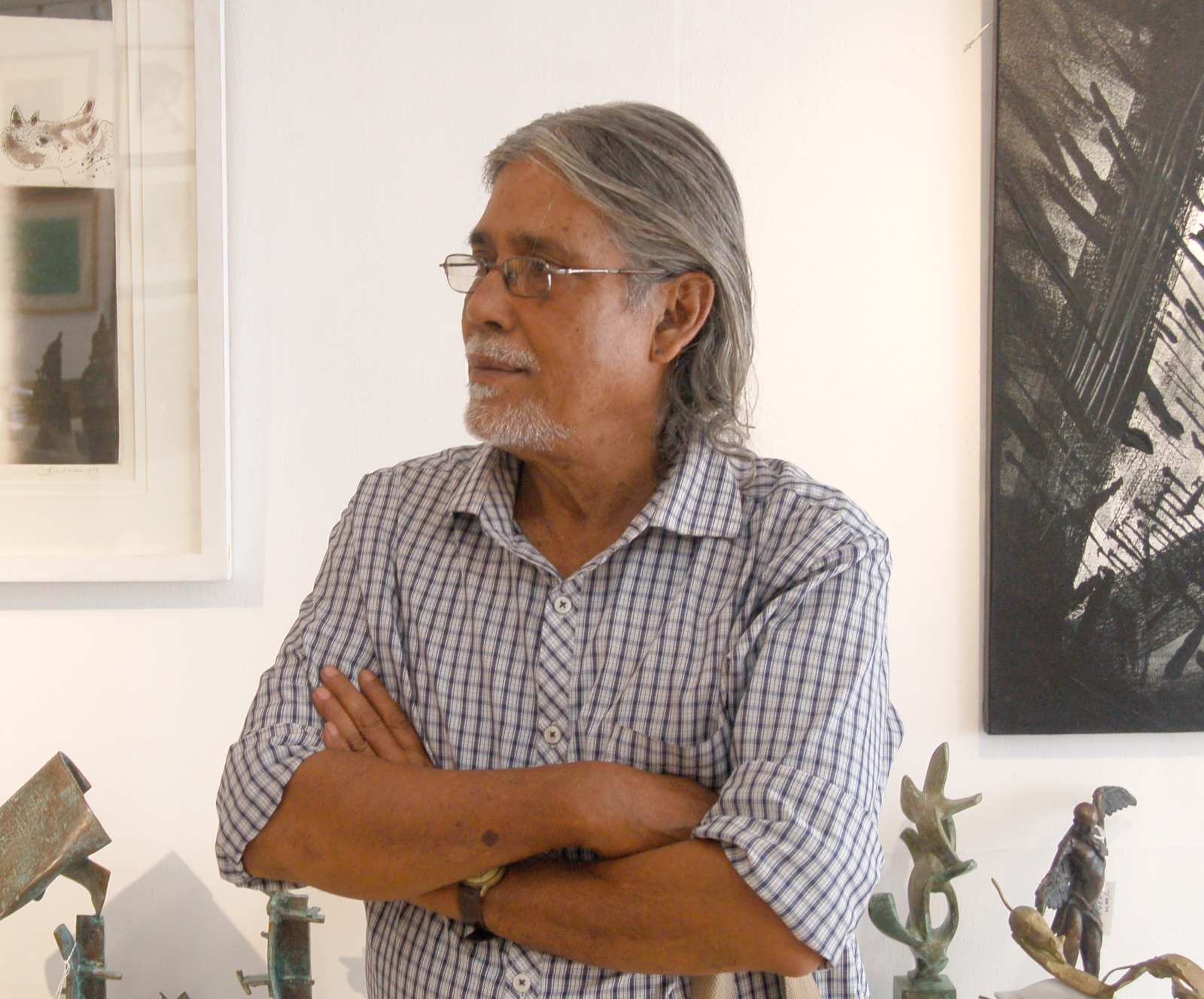
Asim Basu is a senior Indian sculptor whose practice occupies an important position within post-Independence sculpture in Bengal. Born in 1947, he received his formal training at the Government College of Art & Craft, Kolkata, where he developed a strong foundation in drawing, modelling, composition, and three-dimensional form. Over a career spanning more than five decades, he has created a distinctive sculptural language that moves fluently between observation, imagination, figuration, and symbolic abstraction.
Basu works primarily in bronze, while also engaging with wood, terracotta, and mixed media. The human figure remains central to his practice, but his sculptures rarely aim at strict anatomical realism. Bodies are simplified, elongated, compressed, or rhythmically reorganised to convey movement, emotion, and narrative. Through these transformations, the figure becomes both a physical presence and a carrier of wider social and psychological meaning.
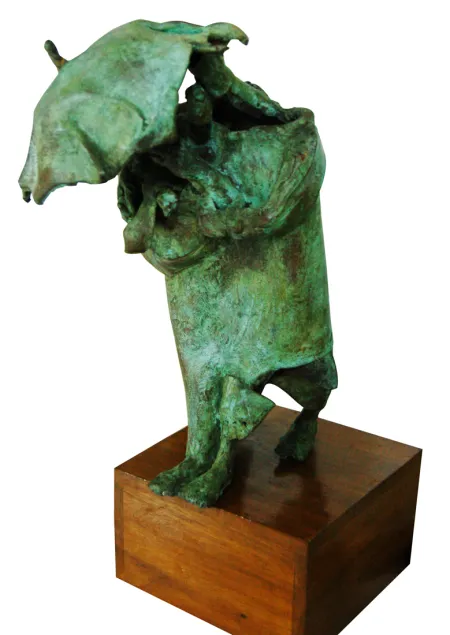
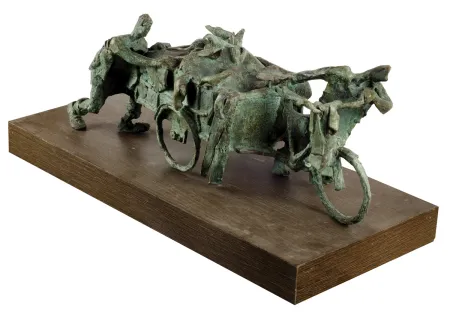
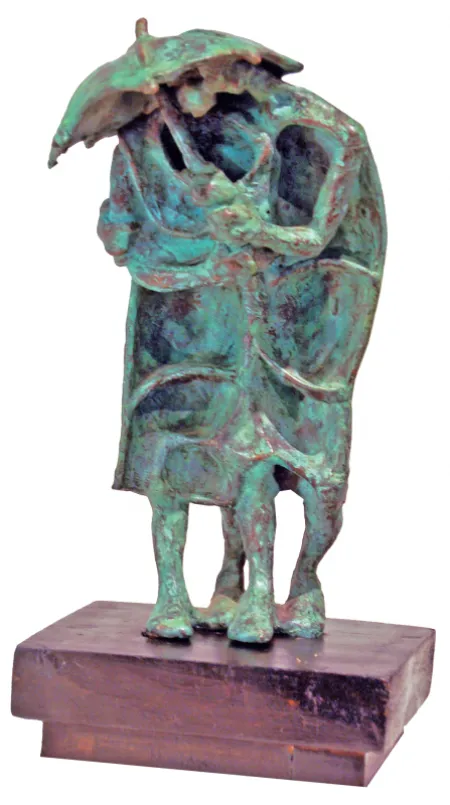
A defining feature of Basu’s work is its narrative quality. His sculptures often resemble condensed visual stories drawn from everyday life. Families, musicians, labourers, children, animals, couples, and solitary individuals appear in situations that combine humour, tenderness, irony, struggle, and quiet observation. Works such as Romance, Violin Player, Pig Family, Garbage, In the Rain, and Thirsty Woman with Child demonstrate the range of his engagement with human relationships and social experience.
Despite their recognisable subjects, Basu’s sculptures are not merely descriptive. He frequently alters proportion and spatial relationships to heighten meaning. A figure may lean dramatically, stretch across an unusual support, or interact with another body in ways that create tension and movement. His training as a draughtsman is evident in the clarity of contour and gesture, while his understanding of mass allows even small sculptures to possess a strong physical presence.
Social Observation and Human Experience
Basu’s practice is marked by a sustained engagement with the human condition. Domestic affection, social hardship, ageing, physical labour, protest, and the desire for dignity recur across his work. He approaches these themes without excessive sentimentality. Humour and compassion often coexist with social criticism.
His large bronze composition Fight for Right presents a procession of people carrying flags, raising their hands, and displaying banners. Basu described the work as an extension of his reflections on protest, the protection of rights, and the continuing struggle for human freedom. The sculpture transforms a public demonstration into a dynamic arrangement of bodies, gestures, and collective movement.
Asim Basu press cutting.pdf
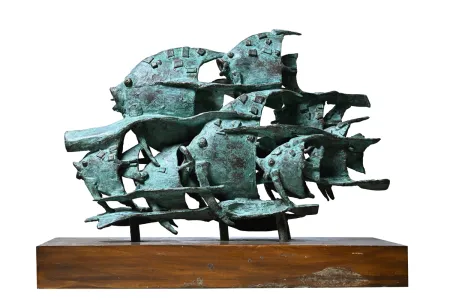
Animals also appear regularly in his work, sometimes as independent subjects and at other times as companions or symbolic participants in human narratives. These forms reveal Basu’s ability to observe physical movement while avoiding purely naturalistic modelling. Their surfaces and proportions are adjusted to strengthen rhythm, humour, or emotional effect.
Form, Surface and Material
Basu’s sculptures are distinguished by their sensitive treatment of volume and surface. Bronze allows him to combine structural durability with expressive modelling. Some surfaces are smoothly resolved, while others retain irregularities that record the physical process of shaping and casting. These variations enable light to move across the sculpture, strengthening its emotional and spatial presence.
Geometry often provides an underlying structure within his compositions. Although the figures remain recognisable, their bodies may be organised through triangular, curved, or horizontal movements. Contemporary criticism has noted the importance of geometric construction within his work, particularly the way formal organisation supports rather than suppresses narrative and human feeling.
Asim Basu press cutting.pdf
His works move between figuration and abstraction without fully belonging to either category. A sculpture may begin with an everyday incident yet become increasingly concerned with balance, weight, rhythm, void, and the relationship between separate masses. This ability to preserve human meaning within formally inventive structures is central to his artistic achievement.
Exhibitions and Recognition
From the 1980s onwards, Basu’s sculpture received sustained attention in exhibitions and critical reviews. Contemporary press accounts repeatedly recognised his technical confidence, imaginative treatment of form, and ability to create expressive narratives through sculpture. His work has been discussed in publications including The Telegraph, Anandabazar Patrika, Desh, Bartaman, and The Economic Times.
Asim Basu press cutting.pdf
He has participated in exhibitions at major venues, including the Academy of Fine Arts, Kolkata, and in national presentations of contemporary sculpture. Archival photographs document his participation in exhibitions and award ceremonies from at least the mid-1980s.
Asim Basu press cutting.pdf
The presently available records refer to honours from the Academy of Fine Arts, Kolkata, and the West Bengal Charukala Parishad. The exact titles and years of all awards should be verified from the artist’s curriculum vitae or original certificates before the final website profile is uploaded.
Association with Aakriti Art Gallery
Asim Basu has maintained a close and continuing association with Aakriti Art Gallery, Kolkata. The gallery represents an important body of his bronze sculpture and has presented his work through exhibitions, publications, catalogues, and online documentation. The current gallery collection includes works from different phases of his practice, reflecting his continuing interest in human relationships, social experience, music, labour, and everyday life.
His sculpture has also appeared in Aakriti’s publications, including Masterpieces 2016 and Shaping Bengal: Modern Sculpture in Bengal. Works such as Garbage and Violin Player were reproduced and documented in these publications, while Thirsty Woman with Child was included in Aakriti’s journal Art Insights.
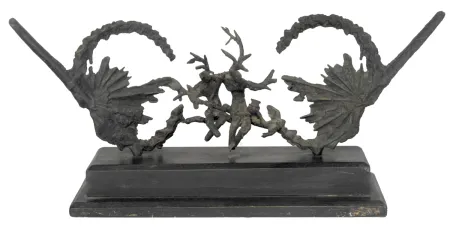
Basu also created the bronze sculpture associated with the Aakriti Art Gallery Trophy, further strengthening his relationship with the institution. Through continued representation and research-led documentation, Aakriti has contributed to bringing renewed attention to his importance within the history of modern sculpture in Bengal.
Asim Basu’s significance lies in his ability to combine formal invention with an enduring humanistic concern. His sculptures transform familiar experiences into expressive arrangements of mass, gesture, movement, and space. Through bronze and other materials, he has created a body of work that is technically accomplished, socially attentive, and distinguished by imagination, empathy,



_-thumb.webp)