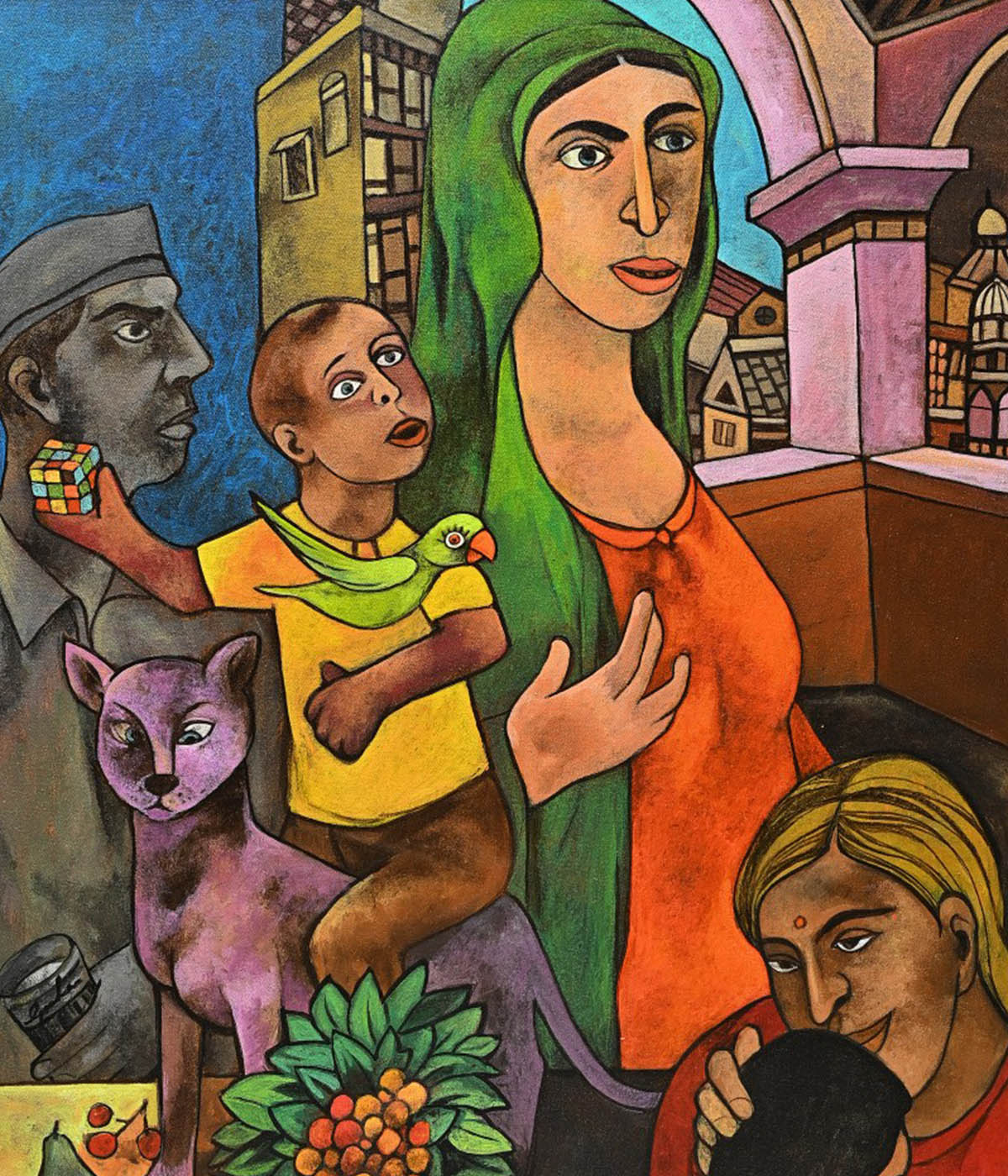
Rabin Mondal was a major Indian modernist whose uncompromising figurative paintings addressed suffering, violence, alienation, power, and moral decline. Working primarily through an expressionist language, he transformed the human figure into a powerful instrument of social criticism. His kings, queens, deities, wounded bodies, and solitary protagonists are among the most distinctive images in post-Independence Indian art.
Born as Rabindra Nath Mondal in 1929 in Howrah, West Bengal, he grew up within the densely populated and heavily industrialised environment adjoining Kolkata. The poverty, labour, social inequality, and physical harshness he observed in Howrah remained important to his artistic imagination. His formative years were also marked by the Bengal Famine of 1943, communal violence, the Independence movement, and the Partition of Bengal. These experiences contributed to the dark emotional and political character of his mature work.
Mondal began drawing seriously during childhood while recovering from a knee injury. He later studied at the Indian College of Art and Draughtsmanship, Calcutta, and continued his study of art at the Asutosh Museum of Indian Art, University of Calcutta. He also completed a degree in commerce from the University of Calcutta in 1952. His training was therefore shaped by both formal art education and an independent engagement with modern Indian and international visual traditions.
Expressionism and the Human Figure
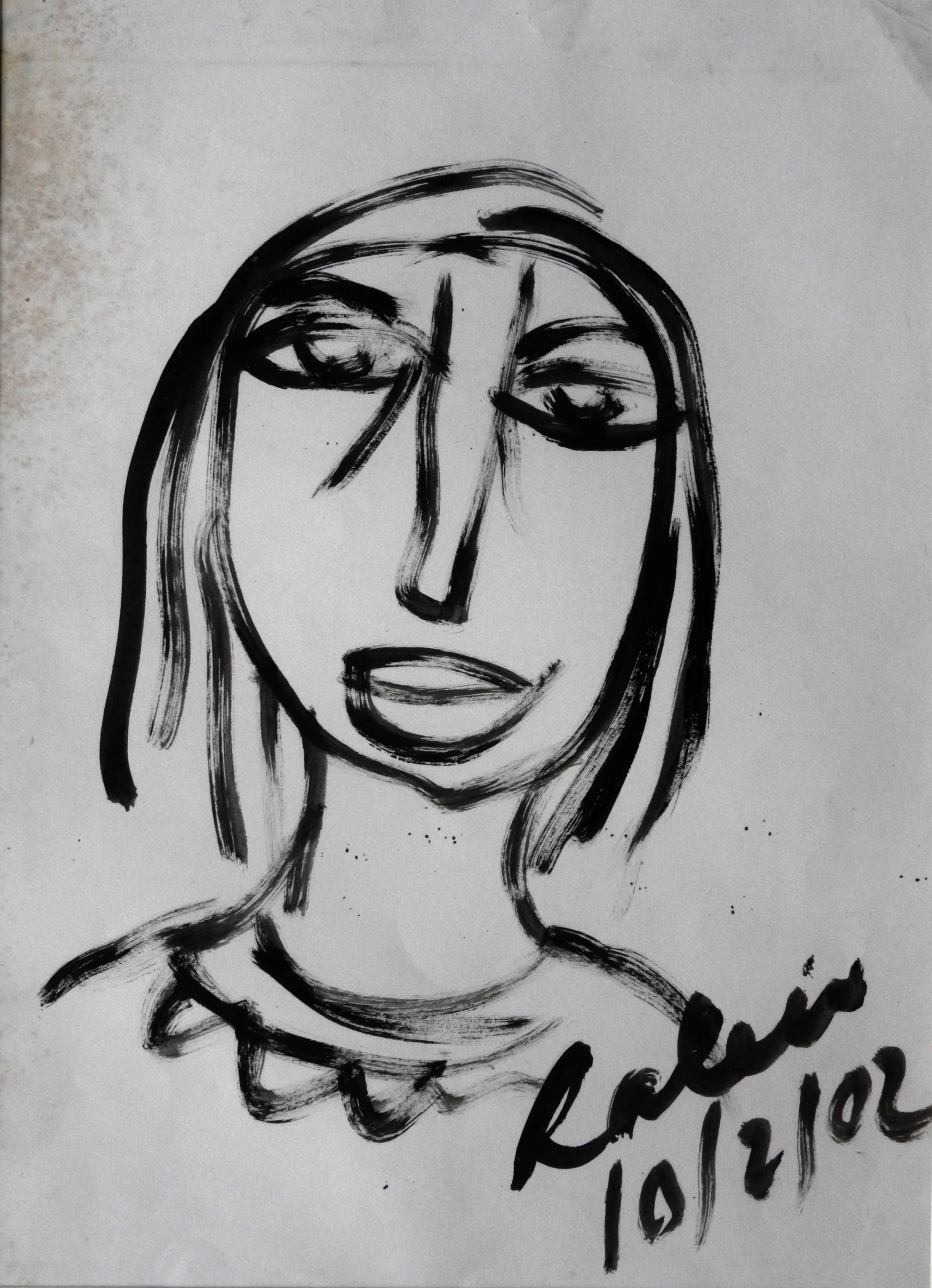
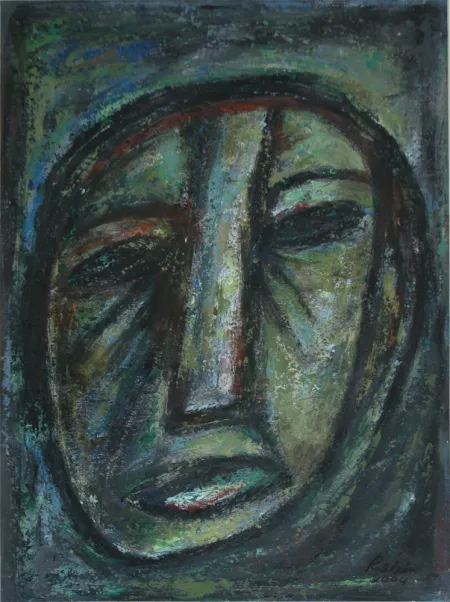
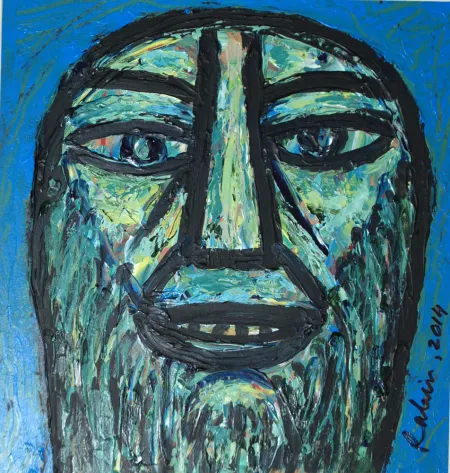
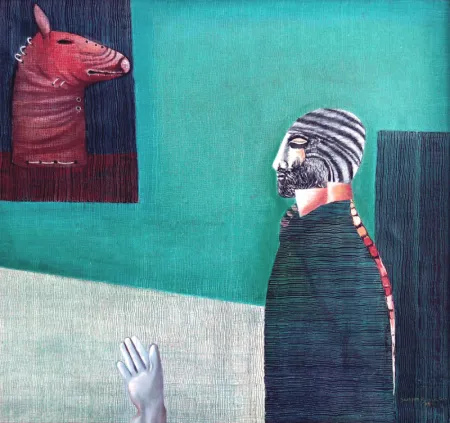
Mondal developed an intensely personal form of expressionism. His figures are often distorted, fractured, heavily outlined, and compressed within shallow pictorial spaces. Their bodies may appear scarred, rigid, skeletal, or monumental. Rather than seeking anatomical realism or physical beauty, he used distortion to reveal emotional and psychological truth.
His art was influenced by Cubist structure as well as the forceful simplification found in tribal and so-called primitive art. These influences were absorbed into a language shaped by his own encounter with suffering and social injustice. Heavy blacks, earthy browns, deep reds, ochres, and occasional flashes of blue or green give his compositions a sombre and confrontational presence.
Mondal did not depict suffering from a position of detached observation. His images communicate anger, empathy, and protest. The figures often appear trapped within systems of political authority, social hypocrisy, fear, and deprivation. Their damaged bodies become metaphors for the wider condition of humanity.
Kings, Queens and Deities
Among Mondal’s best-known works are his recurring images of kings and queens. These figures are not celebratory representations of royalty. They appear anxious, isolated, grotesque, and morally compromised. Their crowns and ceremonial poses suggest authority, but their distorted faces and fragile bodies reveal fear, corruption, and decay.
Works with titles such as Man Acting as King, King Making Confession, King Being Appeased, and King and His Assassin examine the instability of power. The ruler becomes both oppressor and victim, trapped within the structures that sustain his authority. Mondal’s queens similarly embody vulnerability, desire, loneliness, and emotional confinement.
His images of deities extend this enquiry into power and belief. Although distinguished by radiating crowns or symbolic attributes, these figures remain profoundly human. They are neither idealised nor spiritually distant. Instead, they appear wounded, burdened, and implicated in the anxieties of contemporary life.
Mondal also painted brothels, harems, marginalised women, and scenes of social degradation. Such subjects allowed him to confront exploitation and moral contradiction without romanticising poverty or suffering. His approach remained direct, disturbing, and deliberately resistant to decorative beauty.
Calcutta Painters
In 1964, Mondal became a founding member of Calcutta Painters, an important collective established by artists seeking alternatives to both academic naturalism and the inherited conventions of the Bengal School. The group encouraged modernist experimentation and helped bring greater national attention to contemporary art from Kolkata. Mondal’s association with the collective placed him within a wider generation of artists responding critically to the social and cultural realities of post-Independence India.
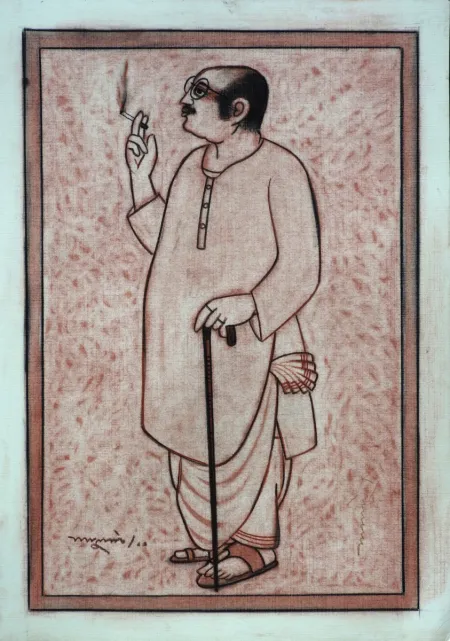
Although he remained deeply connected to the artistic life of Bengal, Mondal followed an individual path. He worked for many years from his studio in Howrah and did not adjust his visual language to prevailing market expectations. His paintings retained their severity and emotional intensity even when more decorative forms of modernism became commercially popular.
Exhibitions and Collections
Mondal exhibited widely in India and abroad, although broader recognition came comparatively late in his career. Major retrospective and survey exhibitions in Kolkata, Mumbai, and New Delhi during the 2000s brought renewed attention to the historical importance of his work. Later retrospectives included exhibitions devoted to his images of power, exile, suffering, and human vulnerability.
His works are represented in institutional collections including the National Gallery of Modern Art, New Delhi, the Birla Academy of Art & Culture, Kolkata, and other public and private collections in India and internationally.
Association with Aakriti Art Gallery
Rabin Mondal maintained an important relationship with Aakriti Art Gallery, Kolkata. The gallery organised significant solo presentations of his work and has continued to preserve, exhibit, and document his artistic legacy. Aakriti identifies Mondal among the major modern Indian artists whose solo exhibitions have formed an important part of its institutional programme.
The gallery also holds and presents a substantial body of his work, including paintings and works on paper from different periods of his career. The current Aakriti artist page records more than sixty works, reflecting the depth of the gallery’s engagement with his practice.
The exact titles and dates of all solo exhibitions organised by Aakriti should be inserted after consultation with the gallery’s printed catalogues and internal archive, as the publicly accessible website does not provide a complete chronological record.
Legacy
Rabin Mondal died on 2 July 2019. He left behind a body of work that remains central to the history of expressionist figuration in India.
His importance lies in the moral seriousness with which he approached the human condition. He refused idealised beauty and instead created a visual language capable of confronting violence, corruption, loneliness, and social inequality. Through his kings, queens, deities, and wounded figures, Mondal revealed the fragility concealed beneath authority and the persistence of human suffering beneath the appearances of civilisation.






_9_.5_x_7_.5_in_2014_3000_-thumb.webp)