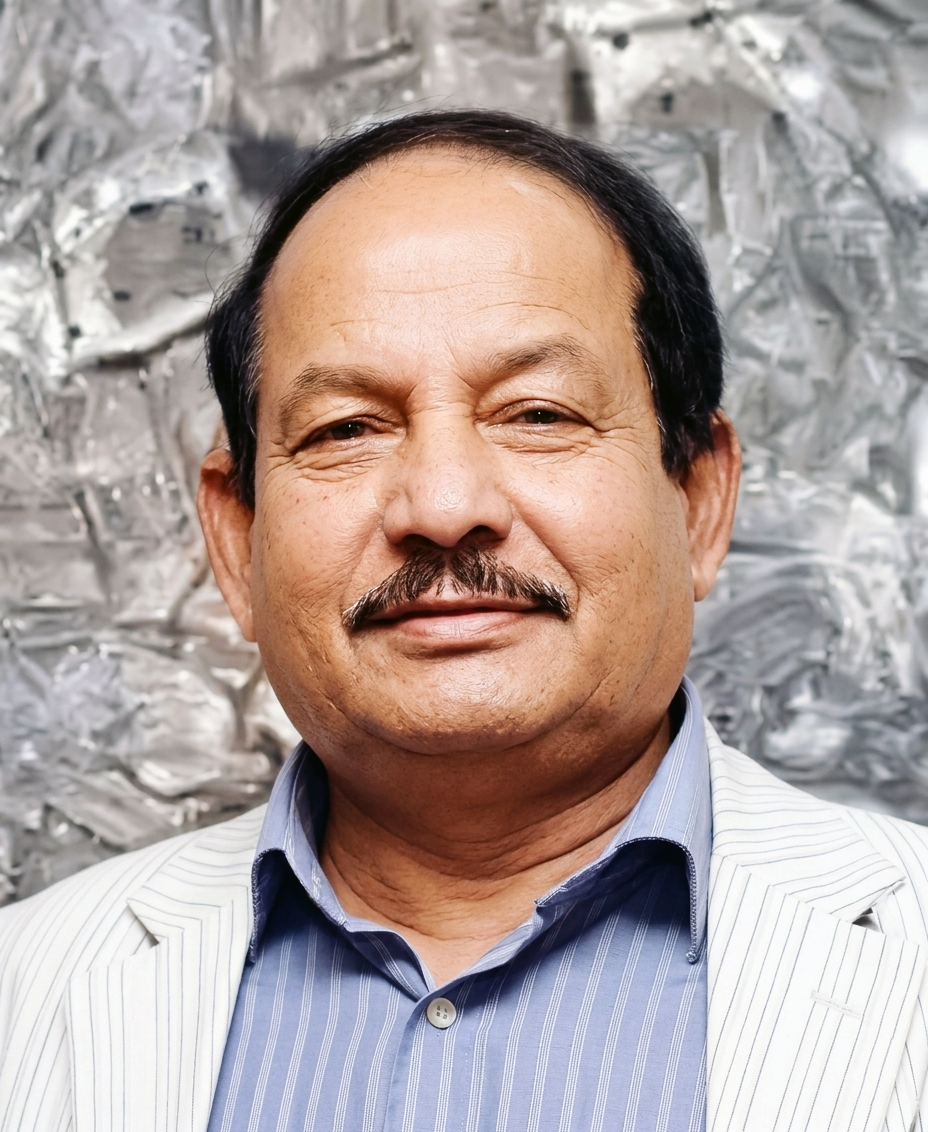
Mahmudul Haque was a distinguished Bangladeshi painter, printmaker, educator, and cultural administrator whose practice contributed significantly to the development of modern art and printmaking in Bangladesh. His work brought together disciplined technical enquiry, abstraction, and a sensitive understanding of colour, surface, and pictorial space.
Born in 1945 in Srifaltala village, Bagerhat district, Bangladesh, Haque studied at the Bangladesh College of Arts and Crafts, now the Faculty of Fine Art, University of Dhaka. He completed his Bachelor of Fine Arts in Printmaking in 1968 and joined the institution as a faculty member the following year.
From 1980 to 1984, Haque studied in Japan under a scholarship from the Japanese government. He undertook research in printmaking at the University of Tsukuba and received his master’s degree in 1984. His years in Japan had a lasting influence on his artistic and intellectual development, particularly in his approach to spatial balance, restraint, material sensitivity, and the relationship between form and emptiness.
Artistic Practice
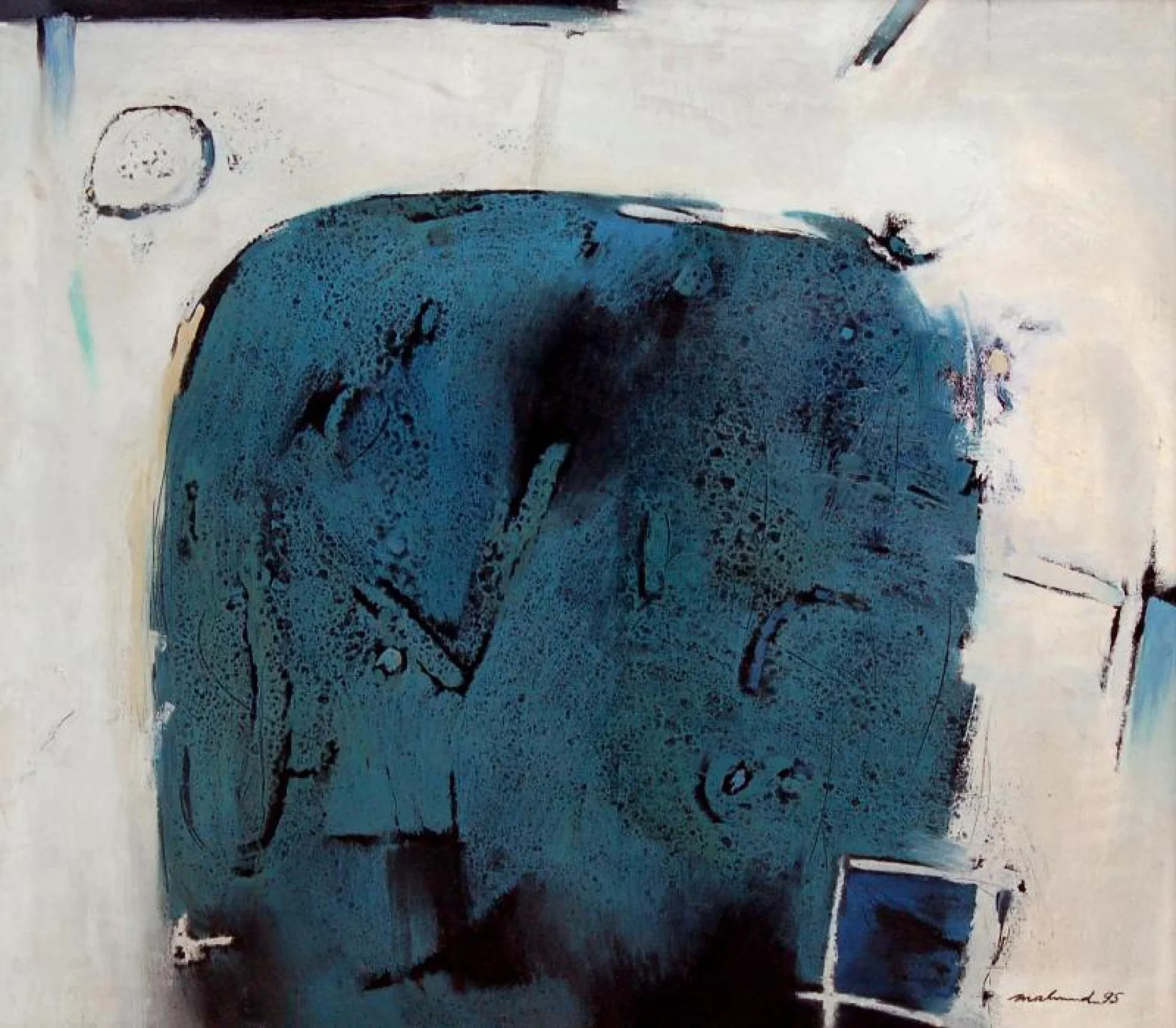
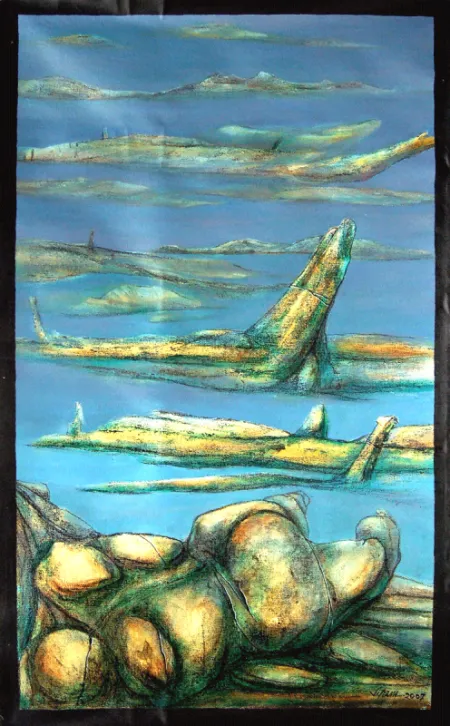
Haque worked across painting, drawing, and several printmaking processes. Although recognised as an important printmaker, he did not remain limited to a single medium. His paintings and prints share an interest in layered surfaces, abstract forms, atmospheric colour, and the expressive possibilities of texture.
His compositions often move between abstraction and suggestions of the natural world. Colour-fields, gestural marks, irregular shapes, and open spaces may evoke landscape, water, vegetation, weather, or inner emotional states without describing them directly. The visible subject is frequently reduced, allowing colour and surface to carry much of the work’s meaning.
A defining quality of Haque’s practice is the balance between control and spontaneity. His technical training is evident in the careful organisation of space and the sensitive handling of materials. At the same time, his works retain an intuitive rhythm, with forms appearing to emerge, dissolve, or float across the surface.
The influence of Japanese aesthetics can be recognised in his use of negative space and visual silence. However, his work was not an imitation of Japanese art. He incorporated these principles into a broader South Asian modernist language shaped by his experiences in Bangladesh, his knowledge of printmaking, and his engagement with nature and abstraction.
Printmaking and Education
Haque played an important role in establishing printmaking as a major area of artistic study and practice in Bangladesh. Through his long association with the University of Dhaka, he influenced several generations of artists and helped strengthen the technical and institutional foundations of the medium.
He served as Head of the Department of Printmaking and later as Director of the Institute of Fine Arts, University of Dhaka, from 1999 to 2002. He was subsequently appointed Honorary Professor in the Department of Printmaking. He also taught as a visiting professor at the University of Tsukuba, the University of Nebraska, and the Indus Valley School of Art and Architecture in Karachi.
Beyond the university, Haque served as Director General of the Bangladesh National Museum from 2004 to 2006. He was also associated with the Artist Association of Bangladesh, the Bangladesh–Japan Friendship Association, and the Asian Art Biennale Bangladesh. His work as an administrator and educator extended his contribution beyond his personal studio practice.
Exhibitions and International Participation
Mahmudul Haque held approximately 39 solo exhibitions in Bangladesh and internationally. These included numerous exhibitions in Japan, as well as presentations in Pakistan, Germany, Sri Lanka, India, Switzerland, and the United States.
He participated in major exhibitions such as the Third Triennale–India, New Delhi, in 1975; Contemporary Bangladesh Art at the Whitechapel Art Gallery, London, in 1980; the Asian Art Show in Fukuoka in 1985; the International Print Biennale in London in 1986; the Lahore International Biennale in 1987; the Sharjah International Art Biennale in 1999; and numerous editions of the National Art Exhibition and Asian Art Biennale in Dhaka.
His participation in exhibitions across Asia, Europe, the Middle East, Africa, and the United States placed him among the internationally visible figures of modern Bangladeshi art.
Awards and Honours
Haque received several important awards during his career. These included the Best Painting Award, Tsuchiura City, Japan, in 1982; the Bangladesh Shilpakala Academy Award at the Tenth National Art Exhibition in 1992; honourable mentions at several editions of the Asian Art Biennale Bangladesh; the Lalit Kala Akademi Purchase Award, India, in 1994; and second prize at the Twelfth Kuwait International Biennale in 1996. He received the S. M. Sultan Padak in 2006.
In recognition of his contribution to cultural relations between Bangladesh and Japan, he received the Japanese Foreign Minister’s Commendation in 2017 and the Order of the Rising Sun in 2019.
Association with Aakriti Art Gallery
Aakriti Art Gallery holds and presents an example of Mahmudul Haque’s painting practice, including an oil on canvas dated 1995. His inclusion in the gallery’s collection reflects Aakriti’s broader engagement with modern and contemporary art from Bangladesh and with artistic exchanges across Bengal and South Asia.
Mahmudul Haque died in Dhaka in January 2022. His legacy rests on the unity he achieved between artistic practice, education, and cultural institution-building. Through painting and printmaking, he developed a refined abstract language, while through his teaching and administrative work he helped shape the growth of modern art in Bangladesh.