Bhajju Shyam is one of the most widely recognised contemporary artists to have emerged from the Pardhan Gond community of central India. Born in 1971 in Patangarh village, Madhya Pradesh, he has played a major role in bringing Gond visual traditions to national and international audiences through painting, mural-making, illustration, and artist books. His work combines inherited stories, natural imagery, and community memory with an inventive response to modern life.
Shyam grew up in a cultural environment in which oral storytelling, music, ritual, and the natural world were closely connected. As a young man, he moved to Bhopal in search of employment. There he came into contact with his uncle and mentor, Jangarh Singh Shyam, the pioneering artist associated with the development of the contemporary Pardhan Gond painting movement. Bhajju initially assisted Jangarh by filling colours and preparing surfaces before developing an independent artistic practice.
Visual Language and Subject Matter
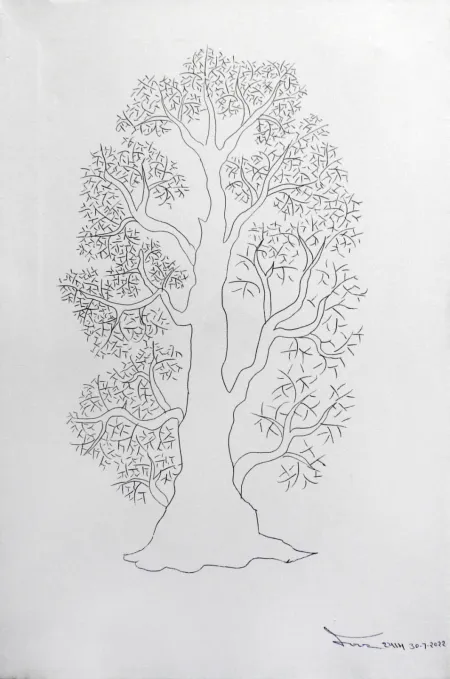
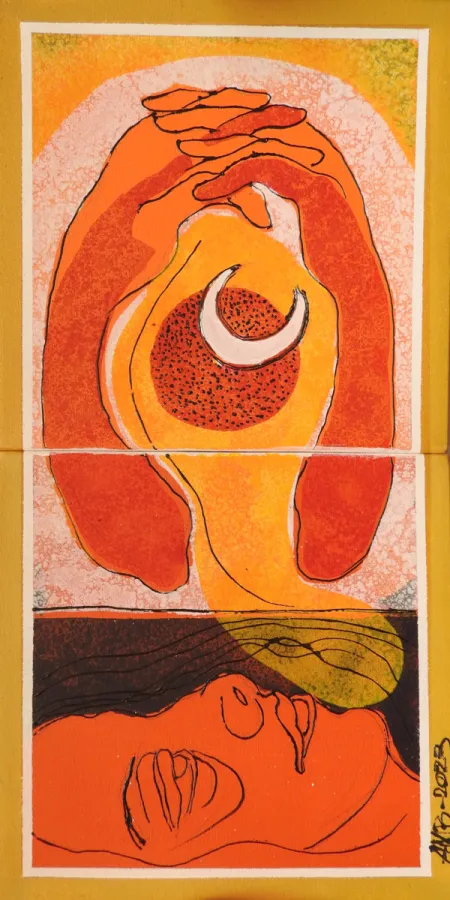
Bhajju Shyam’s paintings are distinguished by strong silhouettes, rhythmic patterning, and the detailed use of dots, lines, scales, leaves, and repeated organic forms. Animals, birds, trees, deities, and human beings are often constructed through dense internal patterns that give the image a sense of movement and vitality.
His motifs are drawn from the Gond pantheon, community origin stories, folk narratives, dreams, and close observation of nature. Trees may become protective beings, animals may carry human characteristics, and birds may act as messengers between different worlds. These images reflect a worldview in which the human, animal, spiritual, and natural realms are interdependent rather than separate.
Although rooted in Pardhan Gond traditions, Shyam’s work is not limited to inherited subjects. He frequently interprets contemporary cities, machines, migration, travel, and unfamiliar social environments through the symbolic language of his community. This ability to translate modern experience into a traditional yet continually evolving visual vocabulary is central to his originality.
The London Jungle Book
Shyam achieved major international recognition through The London Jungle Book, first published by Tara Books in 2004. The book developed from his first visit to London in 2002, when he travelled there to paint murals for a restaurant. Confronted with an unfamiliar urban environment, he interpreted the city through visual metaphors drawn from the animal and natural worlds.
In the book, buses, underground trains, buildings, and social customs are transformed into imaginative creatures and symbolic forms. The work reverses the conventional ethnographic gaze: instead of an urban observer describing a tribal community, an Indigenous artist interprets the modern metropolis according to his own cultural and visual framework. The publication was translated into several languages and established Shyam as an important artist and storyteller internationally.
He has subsequently contributed to several illustrated books, including The Night Life of Trees and Creation. These publications demonstrate the close relationship between painting and storytelling within his practice. The Night Life of Trees received recognition at the Bologna Children’s Book Fair in 2008.
Exhibitions and Public Projects
Bhajju Shyam’s works have been exhibited widely in India and abroad. His international presentations include exhibitions in Paris, London, Milan, and other major cultural centres. His work has been shown at institutions including the Musée des Arts Décoratifs, Paris, and the Museum of London. He has also undertaken public art projects and became the first Gond artist to work with the St+art India Foundation on a mural in New Delhi’s Lodhi Art District.
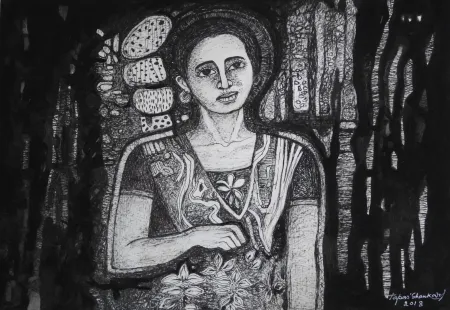
His paintings are valued not only for their decorative intricacy but also for their ability to communicate complex relationships among memory, ecology, community, and contemporary experience. Shyam has helped demonstrate that Gond painting is not a static or anonymous folk practice but a living field shaped by identifiable artists, individual innovation, and changing historical circumstances.
Association with Aakriti Art Gallery
Bhajju Shyam has an important exhibition association with Aakriti Art Gallery, Kolkata. In 2022, the gallery presented his solo exhibition Van Katha, opening on 30 July at its Hungerford Street premises. The exhibition brought together a suite of paintings centred on forests, animals, oral traditions, and the interconnected worlds of nature and human life.
The exhibition reflected Shyam’s continued engagement with the forest not simply as a physical environment but as a repository of ancestry, mythology, knowledge, and spiritual experience. Through Van Katha, Aakriti introduced Kolkata audiences to a significant body of recent work and strengthened its engagement with important Indigenous and contemporary artistic practices.
Aakriti Art Gallery identifies Bhajju Shyam among the distinguished artists whose solo exhibitions form part of the gallery’s institutional history.
Honours and Legacy
Bhajju Shyam was awarded the Padma Shri in 2018 for his contribution to art. The honour recognised his role in bringing Pardhan Gond painting to wider national and international attention.
His importance lies in his ability to preserve the philosophical foundations of Gond visual culture while continually expanding its subjects and methods. Through paintings, murals, and books, he has created a distinctive contemporary language in which inherited knowledge encounters the modern world. His work has helped transform the understanding of Indigenous Indian art by establishing the Gond artist not as an anonymous bearer of tradition, but as an individual thinker, author, and innovator.