Rabindranath Tagore (1861–1941)
India
0 Artworks
India
0 Artworks
Profile:
Rabindranath Tagore occupies a singular position in global cultural history as a poet, philosopher, artist, and educator whose contributions transcend disciplinary boundaries. Born in 1861 in Kolkata, Tagore was a central figure of the Bengal Renaissance, shaping modern Indian identity through literature, music, art, and educational reform.
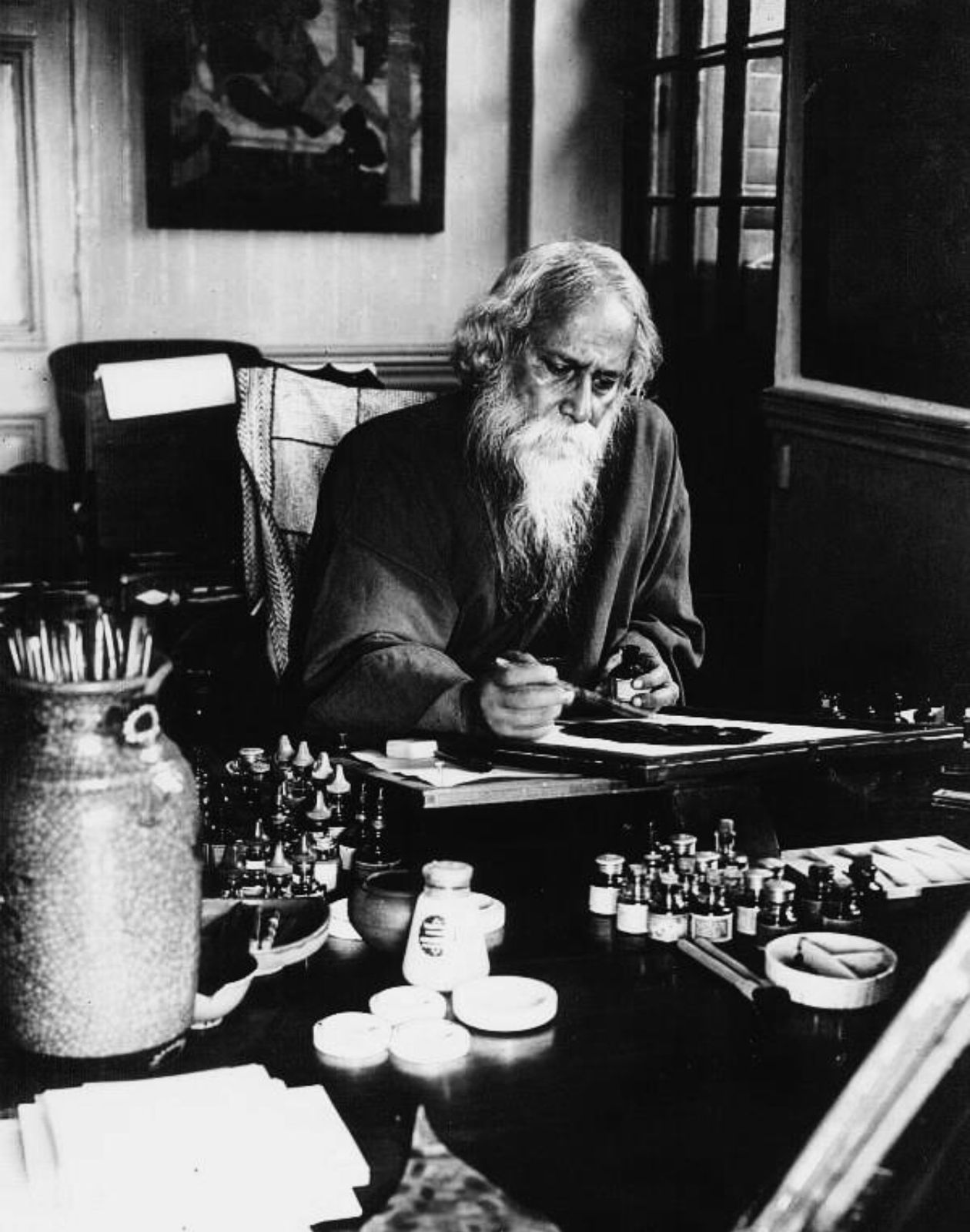
Though widely celebrated as the first non-European Nobel Laureate in Literature (1913) for Gitanjali, Tagore’s engagement with visual art began relatively late, around the age of sixty. Yet, within a remarkably short span, he developed a highly original pictorial language that defied both academic conventions and the stylistic tendencies of the Bengal School. His paintings reveal a deeply intuitive and experimental approach, free from formal training and grounded instead in subconscious expression.
Tagore’s visual works are characterised by bold lines, fluid forms, and a dark, atmospheric palette, often populated by enigmatic human figures, fantastical creatures, and abstracted landscapes. His imagery resists narrative clarity, functioning instead as a projection of inner psychological states. Unlike his literary works, which are rooted in lyrical clarity, his paintings explore ambiguity, transformation, and the unknown—aligning them with early modernist and expressionist tendencies.
A key aspect of Tagore’s artistic philosophy was his belief in the unity of creative expression. This vision found institutional form in Visva Bharati University, which he founded at Santiniketan as an alternative educational space integrating art, nature, and learning. His role as an educator and thinker influenced generations of artists and intellectuals, including many associated with modern Indian art.
Tagore exhibited his paintings internationally during his lifetime, including in Paris, London, Berlin, and Moscow, where they were received as powerful expressions of a non-Western modernism. Today, his works are held in major collections and continue to be studied within the broader discourse of global modern art.
Rabindranath Tagore’s legacy lies not only in his individual achievements but in his redefinition of creativity itself—as a fluid, interconnected process that transcends medium, discipline, and geography.