Profile:
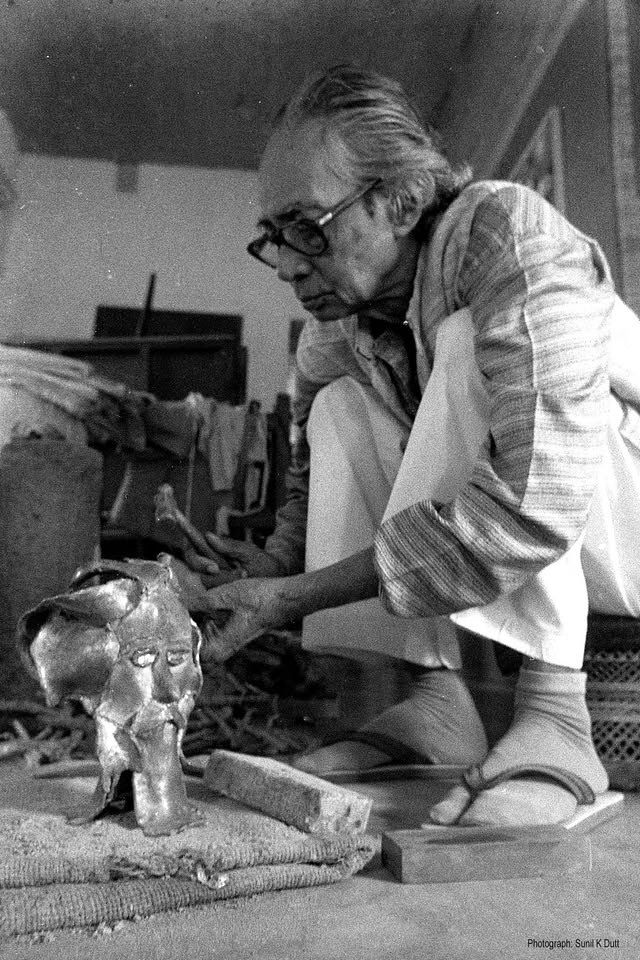
Somnath Hore occupies a critical position in the history of modern Indian art as one of the most profound exponents of socially engaged modernism, whose practice traversed drawing, printmaking, and sculpture. Born in 1921 in Chittagong (now in Bangladesh), Hore’s artistic formation was deeply shaped by the political and humanitarian crises of his time.
He received his early training at the Government College of Art & Craft, Calcutta, but it was his involvement with the Communist Party of India and the Indian People’s Theatre Association (IPTA) that profoundly influenced his artistic direction. As a young artist, Hore directly witnessed the devastation of the Bengal Famine of 1943, an experience that left an indelible mark on his visual language.
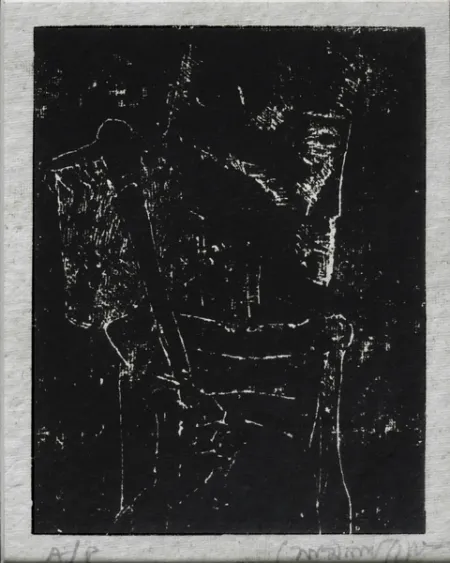
Hore initially worked in graphic media, particularly woodcuts, linocuts, and etchings, where he developed a stark, expressive vocabulary to depict suffering, displacement, and human vulnerability. His early works resonate with the urgency of reportage, aligning him with contemporaries such as Chittaprosad Bhattacharya, though Hore’s approach gradually evolved toward greater abstraction.
The most significant phase of his career is marked by the iconic Wounds Series, in which Hore moved beyond representation to create deeply symbolic and tactile forms. Executed in printmaking and later in paper pulp reliefs and bronze, these works reduce the human body to scarred surfaces, ruptures, and voids, transforming pain into a universal visual language. The “wound” becomes both a literal and metaphoric motif—representing not only physical trauma but also historical and collective suffering.
Hore’s aesthetic is characterised by economy of form, material sensitivity, and emotional restraint. His works reject spectacle, instead offering a quiet yet devastating meditation on violence, memory, and endurance. This minimalism places him in dialogue with international modernist tendencies, while remaining deeply rooted in the socio-political realities of India.
In addition to his artistic practice, Hore was an influential educator, associated with institutions such as the Faculty of Fine Arts, M.S. University, Baroda, and later Kala Bhavana, Santiniketan, where he contributed to shaping a generation of artists.
His works have been exhibited widely in India and internationally and are held in major collections. Today, Somnath Hore is regarded as one of the most important voices in post-independence Indian art, whose work continues to resonate for its ethical depth and formal innovation.
Somnath Hore’s legacy lies in his ability to transform historical trauma into a universal visual language, positioning his work at the intersection of art, memory, and human conscience.