Profile:
Meera Mukherjee occupies a distinguished position in modern Indian sculpture for her pioneering synthesis of indigenous craft traditions and modernist sensibilities. Born in 1923 in Calcutta, she received her early artistic training at the Government College of Art & Craft, Calcutta, before pursuing further studies at the Delhi Polytechnic (College of Art). A formative phase of her education took place in Europe, particularly in Munich, where she was exposed to modernist sculptural practices.
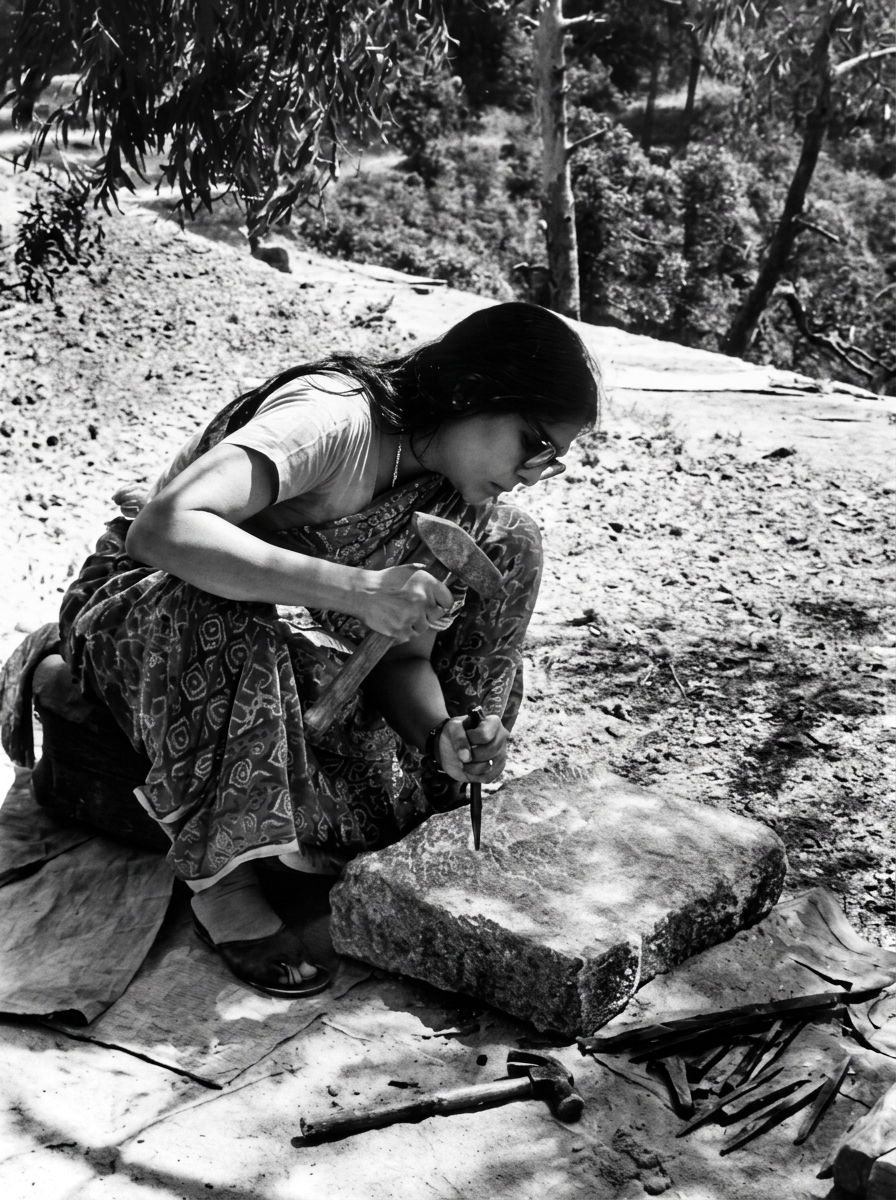
However, the defining turn in Mukherjee’s artistic trajectory emerged from her engagement with traditional Indian metal casting. She undertook extensive fieldwork among artisans in central and eastern India, especially those practising the lost-wax (dokra) technique, integrating their methods into her own sculptural vocabulary. This engagement was not merely technical but conceptual, reflecting a conscious effort to bridge the divide between “art” and “craft”.
Mukherjee’s sculptures, predominantly cast in bronze, are characterised by intricately textured surfaces, rhythmic linearity, and a tactile immediacy derived from the hand-modelling of wax threads. Her works often depict figures drawn from everyday life—musicians, workers, rural communities, and performers—imbued with a quiet dignity and narrative presence. Unlike monumental modernist abstraction, her practice remained deeply rooted in human experience and social observation.
A key aspect of her work is its structural vitality, where form is built through an accumulation of lines and textures rather than mass alone. This lends her sculptures a sense of movement and internal rhythm, echoing both folk traditions and modern sculptural experimentation.
Mukherjee’s contribution extends beyond her artistic output; she played a crucial role in revalorising traditional artisanal practices within contemporary art discourse. By foregrounding collaborative knowledge systems, she challenged hierarchical distinctions between trained artists and craft communities.
Her works have been widely exhibited in India and internationally and are held in major public and private collections. She was also the recipient of several honours, including recognition from the Lalit Kala Akademi.
Today, Meera Mukherjee is regarded as a seminal figure whose practice redefined the possibilities of sculpture in India—creating a language that is at once modern, indigenous, and profoundly humanistic. Her legacy continues to influence contemporary artists engaging with materiality, tradition, and community-based practices.