A Printmaker’s Printmaker: Dattatreya Apte
Studio Visit & Reflections
PART 1
Dattatreya Apte is an energetic man, spry with a playful crown of grey hair set at a jaunty angle on the back of his head,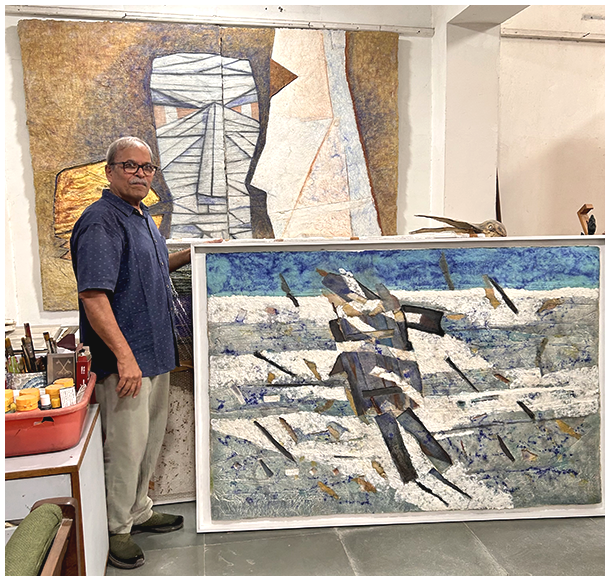 his movements are decisive, uncompromising, and has some of the brisk alertness of an astute printmaker, his speech is overwhelming, voluminous and without hesitation or effort. He has a slight Punekar accent, commands attention, but is expressive. He has a keen saintly face, sharp humourous eyes and well defined features.
His studio at Kaladham, a gated artist commune situated outside Delhi in Greater Noida stands opposite expanse of landscaped green; contriving to form a part of the row of studio houses of other fellow artists, it lies only a little back from the road, behind small overgrown garden, thick with bushes, where stands a large sculpture of an owl done by Apte, under a full bloomed amaltas tree.
His studio is a large room with high ceiling, well lit by natural sunlight, the standard of comfort of a practicing artist, the atmosphere heavy with the typical chemicals of printmakers studio hung with a distinguished smell of turpentine, and acetic acid; solid, relaxed but attentive, modest with no obtrusive bric –a –brac. Along one wall is a group of pulp paintings done by him separated by a large table to work with paper-pulp in the middle of the room.
I was accompanied by a young printmaker who interviewed him during the period of studio visit.
The Work: Memory, Surface and the Return of the Repressed
It is like copying a reality, lining, non-repressed reality, printmaker Apte’s wood-cut, pulp print multiple media works, that actuate the anamnesis of reality, fixing the return of its repressed domains, for there is no more reality than meets the eye, and then listen to what is produced in addition to the exchange identifiable in the dialogue to keep the record of these invisible events.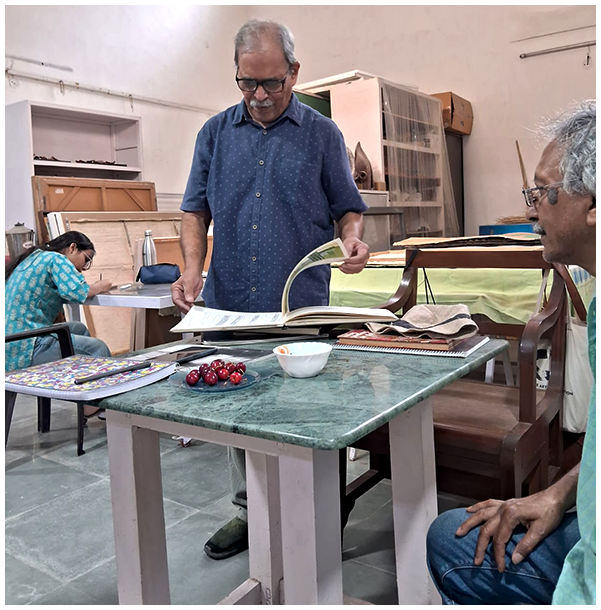
The acrobatics make knowledge and utility a surrendering of language and define this rich oeuvre in purely temporal terms, rather by reference to any particular cultural style, an intellectual climate, a reversion to the past or the sway of their brilliant legacy - through a pleasurable text that would include our own interpretation of one particular printmaker’s work/method/medium and own experience of engagement, the bond you share with his/her visual text- sometimes volatile, sometimes magnificent and sometimes inseparable.
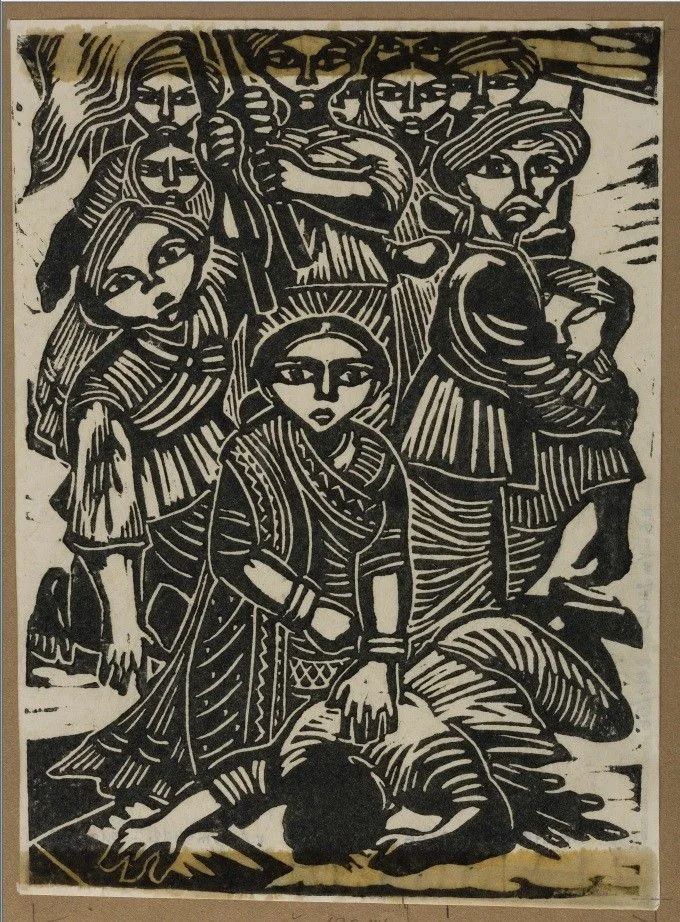
Dattatreya Apte never allows the visual text to become inactive. A founding member of the Indian Printmakers Guild, there is an element in him that makes his work both resistant to categorization yet intellectually irresistible. From the late 80s to the present his personality expressed through drawing, painting, and printmaking has presented a challenging conundrum to the viewer.
Regarding his photogravures he made earlier, the light which falls on the body belongs to the light, shadows cast by the body in response to light are absent of light thus reinventing art and space. It gives us a feeling of catharsis, purification of the soul. For all the ideas Dattatraya Apte is an exemplary printmaker.
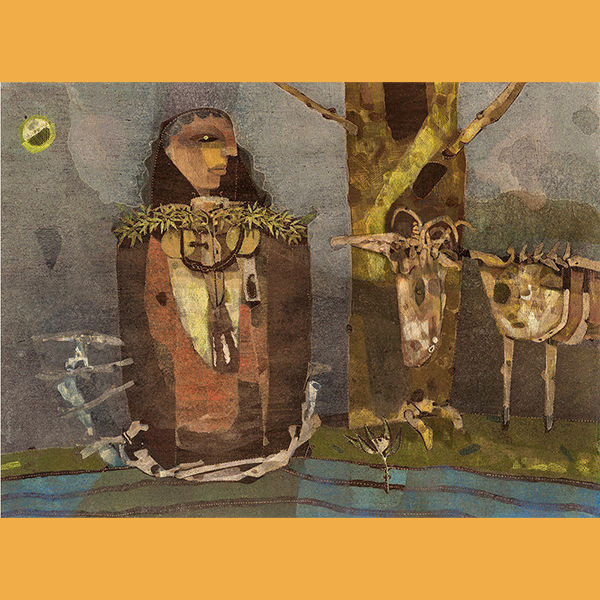
His field of glowing colours expressed in elliptical terms in unique pulp print done earlier in 1999, or the wavering between transcendence and materiality in dyed and hand coloured pulp cast done recently this year are exactly located and precisely finished. The joy and somberness, solipsism and an inner spirituality in his pulp paintings are triumphant as though Apte set out to escape the confines of everyday reality. The colours of the intermediate zone do not suggest the etherealized ambience of ecstatic release; they are imbued with an almost material weight and beauty; but it never gives itself away as external sign- rich in privacy and inwardness.
If inwardness is prison, it is also a set of capacities; if the narrative of the self is vital for subjugation. One may notice the capacity of harnessing single forms to plural functions which has been the hallmark of his work and is visible here. However narratively inclined many of these pieces done in either ink on handmade paper or canvases, woodcuts or reversely done on acrylic sheets, their importance as a whole is that they remind us of one occasion of permanence that seems to lurk in an elucidation. His works are like journals that rally between public and private meanings, provide the impulse for a number of his works and open up an epistemological gulf between the object, its image -a blending of accuracy and imagination.
-- Nanak Ganguly
Curator & Art Critic
PART II
In Conversation: The interview
Dattatreya Apte
with Sudeshna
Printmaker
Dattatreya Apte: I started using paper pulp as a medium from 1990...I had visited paper factories in Pune before. So I knew how the paper was being made. The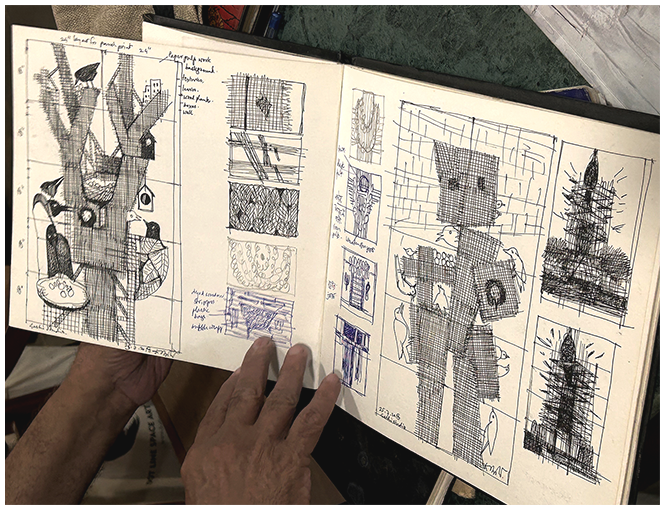 paper pulp has the facility that it cannot hide the surface on which it is cast. Like any handmade paper, if you see the surface, you can see the felt mark or the wire mesh mark, on it where dried. Paper tends to keep the characteristics of the surface where it was dried. So I thought if I could cast the paper pulp on any surface...and I started building different kinds of surfaces in clay, wax, plaster, anything, or in Styrofoam or in wood. Then I cast the pulp on top of it. After the casting and drying the dried paper pulp reveals the surface of the very material of the process. If it is on wood, it will show the surface of a wood. If it is on leaves, it will show the surface of the leaf. It's like a mirror. Wherever you cast, it will reveal the surface and regain the qualities of it. And it can catch the color also very fast. It's like printing. This is also another way of transferring an image. Printing is nothing but transferring of an image from one surface to another surface.
This was in '92, '93, a decade back from college. When I came from Baroda, I did almost two or three years of lithographs, mostly lithographs and etchings. Etchings very few, but lithographs more. Then I started working in etchings and wood engravings. I needed change, so I switch over from one to another.”
Interviewer: So, is the paper pulp your favorite medium right now?
Dattatreya Apte: All mediums are favourite but what catches my imagery, is more important. Paper pulp is very spontaneous. You have to plan it well, way before the execution. Maybe 10 days, 15 days, whatever time it takes. Once you have started there is no alteration. You can't really go back and do it again and again... You have to keep the pulp ready. You have to keep the surface ready. And you have to cast it in one go.
Interviewer: Have you ever looked at your work as a juxtaposition of print and a sculpture? It has both the characteristics!
Dattatreya Apte: See, if you go beyond the flat surface, it is going to be a sculptural thing, low relief, bas-relief, high relief, whatever you can say, it becomes part of sculpture. But again it is a two-dimensional thing. It has some dimension but not three-dimensional as such. It is again a flat, two-dimensional surface. Because I saw a lot of painters also using collage, mounted things stuck on each other, and wooden surfaces, like Rauschenberg's work. You can see an assemblage combines of so many things, like a rug is there, on top of it canvas, on top of it wooden plank. Ultimately, what is important is the visual, or the ultimate image that you are creating. The process involved in creating that image may be assemblage, may be printing, whatever it is. But in the end it doesn't matter which process you have gone through. But in the end the visual effect matters the most.
And I thought instead of duplicating any surface, it is better to use the same surface, available surface. Like in painting, what we do, if we want to do a chair, we draw a chair and paint it. If we want to have a door, we will draw a door and paint it. You want it to look like a ply, you paint like a ply. If you want to have silk, you paint like silk. But if I can use that very material itself, I am not replicating but I'm really getting that value, textural value, as it is. What I'm doing is I'm changing the color, I'm changing the pattern, I'm changing the position, I'm placing it differently the way I want it. That's the only thing. But I'm not changing the character of the material.
Interviewer: That very character is there as an impression.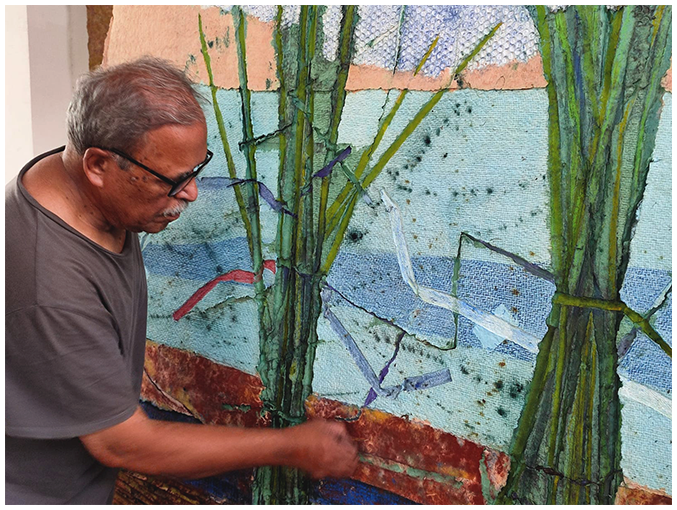
Dattatreya Apte: Because I did a few works with molds. I did reliefs in clay and took plaster cast molds and then cast it in paper pulp. And I thought that I'm losing something, I am not getting the thing that I wanted. Actually if you are doing images of your own, not making a bottle-like thing in clay and casting it in pulp, but I am doing free shapes or free images of my own which have no reference otherwise. So the image is within that space only. It doesn't have any reference outside that space. So it doesn't matter whether it is cast or painted. But the moment you do something realistic or the things you see around and you change the scale of it, the window is so big but I'm making it so small, so that makes things very odd. I thought I'm not getting that feeling that I wanted to. I started of doing those reliefs and making plaster molds and casting it, I left that process and then started assembling the surfaces and casting from them itself. I was not worried about losing the character there.
Interviewer: Because, the actual object along with all characters is present very much in the work.
Dattatreya Apte: The scale also changes with that. The scale becomes bigger, much more. Because actual the object is that big, so resultant cast is big. Like, elephant ear leaf. It's a big leaf. One day I was moving and somebody cut those leaves and they were thrown on the street. I got them, went to the studio, arranged them and cast it in dyed pulp. So that kind of effect you don't get otherwise.
Interviewer: It’s like making a collage...
Dattatreya Apte: Collage, assemblage. Pulp itself is very sensitive, very sensitive. Because if you see even paper, as you get in market paper, you see different textures, surface. How do they come? Because paper pulp absorbs all the qualities of the surface on which it is cast. So it is better why not using the texture which you want. You need to arrange the very materials and objects and put the pulp on that surface and you will get that surface quality as it is, that gives tactile feel of the surface.
Interviewer: How people were convinced now that that is printmaking? You have said before that was a challenge to convince people initially…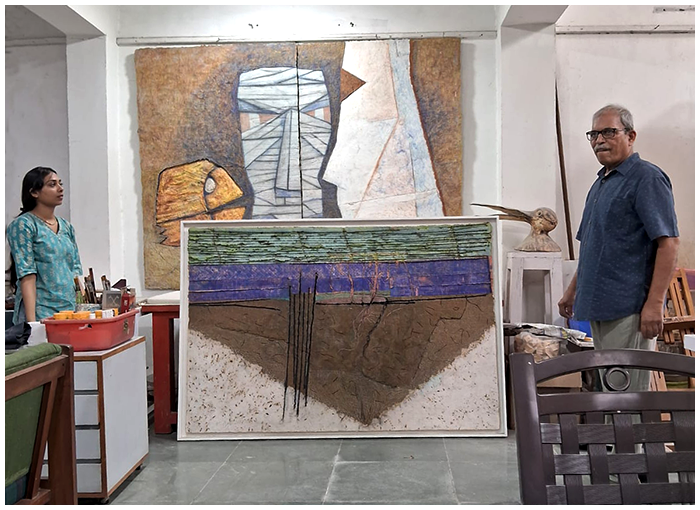 Dattatreya Apte: Actually printmaking over a period, if you start doing prints, a painter's mindset and printmaker's mindset, or the conceiving or conceptualizing or realizing the image you desire, the painters do differently. They paint, they paint, they overlap it, they change it, and they can't go beyond, they can't reverse back their images. What they have done, they can't see it. But a printmaker has the possibility. They can take the proof, keep it there and then work on the same plate. If the plate is damaged, it doesn't matter, but what he has done earlier he has that proof.
Printmakers have to calculate minutely every step of the process before. Every step from the same plate he gets every step. So, he has that documentation of every image of the image making with him. He can change the image at any point of time. And if he is satisfied, it's okay. Otherwise, he can still see what he has lost in the process. Printmakers work with minimum colours. They go for variations, line variation, textural variation, and tonal variation. They want to achieve maximum in minimum colours. The printmakers get this attitude developed over a period.
Interviewer: How much time does it actually take to complete this kind of work, Sir?
Dattatreya Apte: To conceive the work, it may take 10 minutes, 15 minutes, one hour. To ponder upon may take a few days, because when I think about some image, if it stays for a week, then I think, yes, it is worth working on it, otherwise I will not work. And then I start scribbling what kind of material I'm going to use, what kind of textures I want, what kind of surfaces I'm looking for, what kind of arrangements I can do. So these are the thoughts building up in your mind. Then what kind of pulp you want to dye or you want just white pulp, something of the sort. Then the preparation starts for your work. It may take 10-15 days, whatever time it takes. Because I'm not in a hurry to produce work, whenever it comes it will come. When the thought process is complete, then you start arranging the surfaces on actual size. Because there is one sort of sketch which is a small one, but when you are thinking that this is going to be 3 feet... So, what kind of surfaces are you looking for which can accommodate that area? Is it going to look that interesting what you have thought or not? Do you need to change the arrangement or do you need to change the material? What way do you want to change? So after every arrangement, one can take a photograph, you can change the arrangement, take another photograph and you can decide. Because you can't, you can't remember every time where you have kept one thing. So the device, mobile device works very well. You can record all your changes in that and finally you decide, okay, this looks better, this is what I wanted. So you lay down the images, surfaces, and start making pulp. So pulp making may take a day and casting may take another day, that's all. Actual process of casting is just a few hours. Thinking is one day, two weeks. And drying is another aspect. You can't force anything to dry. It will take its own time. You have to leave it to nature. Whenever it is dry…bone dry, then only you can remove it.
It can take a month if it is in November. But now in June with this weather it will take 10 to 15 days. But again you have to leave it, you can't force it. If you try to fiddle in between, it will change the shape... it may tear up or break down, whatever. So one has to have patience to see what is going to happen. Like in printmaking, the same thing happens. When you pull the paper, oh, everything comes like a mirror, what you have done blunders it has, they are all there. So you can't really hide anything. So that is the exciting part. And the beauty of... at times you get goosebumps what is going to happen… sometimes you get good surprises, other times you have to work again.
____________________________________________________________________________________________________________________________________________________________________________________________________________________
For all the ideas Dattatraya Apte’s fields express in elliptical terms the wavering between transcendence and materiality, joy and somberness, solipsism and an inner spirituality. Change has given rise to a visual text charting the mind’s subterranean terrain with a blood-rushed ecstasy.
He says, “I like the sensitiveness of the medium Etching and process of colour intaglio and viscosity; also the play of minute textures on the surface of the plate which help to bring out the colour and value of tone in my work; and as a print maker for me the transformation of image process …”
It is as though Apte set out to escape the confines of everyday reality, the colours of the intermediate zone do not suggest the etherealized ambience of ecstatic release; they are imbued with an almost material weight and beauty.
____________________________________________________________________________________________________________________________________________________________________________________________________________________
Editorial Note:
This essay presents two complementary perspectives on the artist Dattatreya Apte and his distinctive practice. The first section offers a vivid studio portrait and critical reflections by Nanak Ganguly, capturing the atmosphere of Apte’s workspace at Kaladham in Greater Noida and exploring the philosophical and material concerns that shape his innovative pulp prints and multi-media works. The second section features a direct conversation between Apte and a young printmaker Sudeshna, in which the artist elaborates on his techniques, creative process, relationship with materials, and the unique challenges and pleasures of working with paper pulp.
Comments
Join the Discussion
Please login to post comments.
Login