Academic Realism in India: The Forgotten Tradition That Shaped Modern Indian Art
From Raja Ravi Varma to Hemendranath Mazumdar, the story of Indian academic realism is one of technical brilliance, ideological resistance, and remarkable artistic achievement.
When the history of modern Indian art is told, it often begins with the Bengal School and moves swiftly to the Progressive Artists’ Group, leaving an entire chapter in the shadows. Yet for nearly a century, a parallel movement flourished across Calcutta, Bombay, Madras, and the royal courts of Travancore—a movement devoted to anatomy, perspective, chiaroscuro, and the disciplined study of nature. This was Academic Realism, a tradition that not only produced some of India’s finest painters but also laid the technical foundation for modern visual culture.
Far from being a mere colonial import, academic realism in India evolved into a uniquely Indian language. Its practitioners painted Hindu mythology, Indian royalty, village life, urban scenes, and portraits with extraordinary fidelity while adapting European techniques to indigenous narratives. The movement created an alternative vision of Indian modernity—one that celebrated craftsmanship, observation, and universal artistic principles.
Colonial Foundations: The Arrival of Academic Training
The roots of academic realism in India can be traced to the mid-nineteenth century when the British administration established formal art schools to train draftsmen, designers, and artisans.
The Government School of Industrial Art, Calcutta (1854), the Government School of Arts and Crafts, Madras (1850), and the Sir J.J. School of Art, Bombay (1857) introduced systematic instruction in life drawing, plaster casts, perspective, anatomy, modelling, and oil painting. Their curricula were modelled on European academies and reflected Victorian ideas of observation and technical precision.
Initially intended to support colonial industry and architecture, these institutions unexpectedly produced a generation of Indian artists who mastered academic realism while adapting it to local subjects and sensibilities.
The Great Ideological Divide
By the beginning of the twentieth century, Indian art witnessed one of its most significant intellectual debates.
Under E.B. Havell and Abanindranath Tagore, the Government School of Art in Calcutta moved decisively away from European realism towards the revival of Mughal miniatures, Rajput painting, Ajanta murals, and Japanese wash techniques. The Bengal School argued that India’s artistic identity should be spiritual rather than material and viewed oil painting as fundamentally foreign.
Not everyone agreed.
A parallel community of artists believed that anatomy, perspective, and oil painting were universal tools rather than colonial impositions. For them, realism could coexist with Indian themes without compromising cultural identity.
This disagreement produced one of the richest yet least discussed chapters in Indian art history.
Raja Ravi Varma: The Pioneer of Indian Academic Realism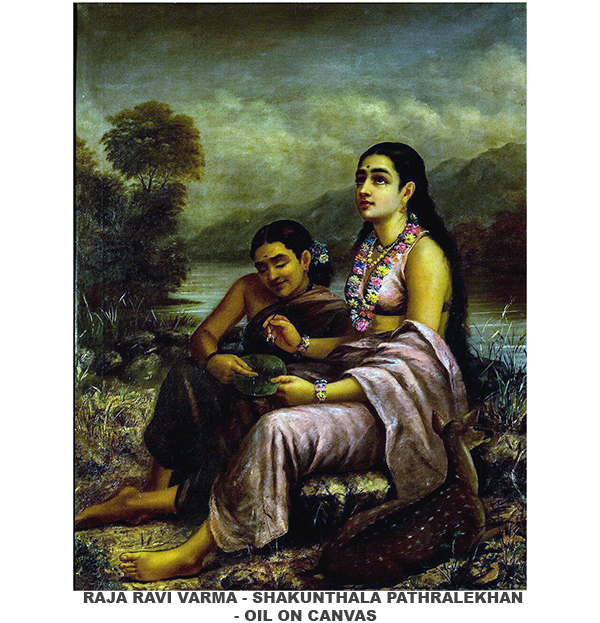
No discussion can begin without Raja Ravi Varma (1848–1906).
Largely self-taught, Ravi Varma absorbed European oil techniques through observation of visiting artists and court painters before transforming them into a distinctly Indian idiom. His monumental depictions of scenes from the Mahabharata, Ramayana, and Puranas combined classical realism with Indian mythology in a manner never previously attempted.
Even more revolutionary was his lithographic press, established in the 1890s, which democratised art by bringing affordable reproductions into ordinary homes across the country.
His influence extended far beyond Kerala, inspiring generations of academic painters throughout India.
The Bengal Academic Realists: Defending Oil Painting
While the Bengal School gained nationalist prominence, another circle of artists quietly defended realism.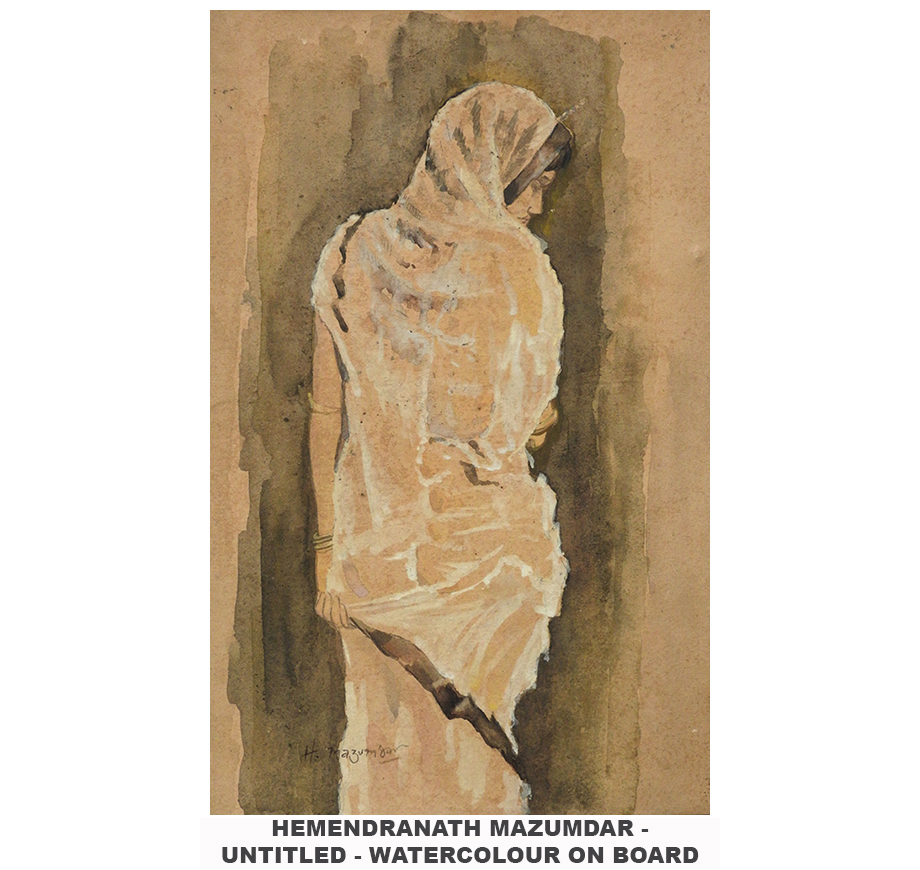
Hemendranath Mazumdar (1894–1948)
Perhaps the finest exponent of Bengali academic painting, Hemendranath Mazumdar became renowned for his extraordinary mastery of the female figure and the celebrated “wet sari” effect. His paintings demonstrated exceptional control over light, drapery, anatomy, and emotional atmosphere.
Dissatisfied with the declining emphasis on academic training, he associated himself with independent institutions that continued to champion oil painting and life study.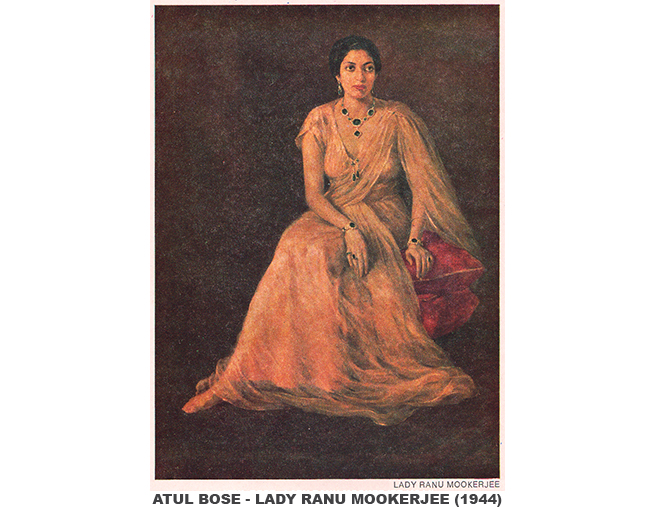
Atul Bose (1898–1977)
Educated at the Royal Academy School in London, Atul Bose emerged as one of India’s greatest portrait painters. His works combined impeccable draftsmanship with psychological insight, earning commissions from political leaders, industrialists, and institutions.
As Principal of the Government College of Art in Calcutta, he helped restore rigorous academic training at a time when it had largely disappeared from formal curricula.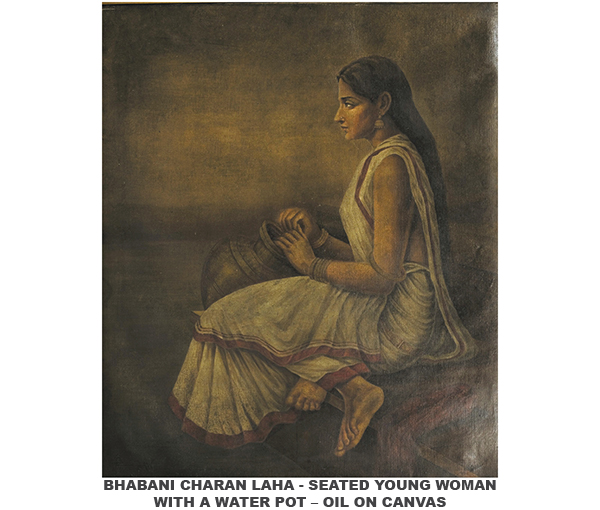
B.C. Law (Bhabani Charan Law, 1880–1946)
A distinguished painter, scholar, and patron, B.C. Law played a crucial role in sustaining Academic Realism through institutional support. His financial backing and intellectual leadership helped establish the Indian Academy of Fine Arts, providing an alternative platform for realist painters who found themselves increasingly marginalised.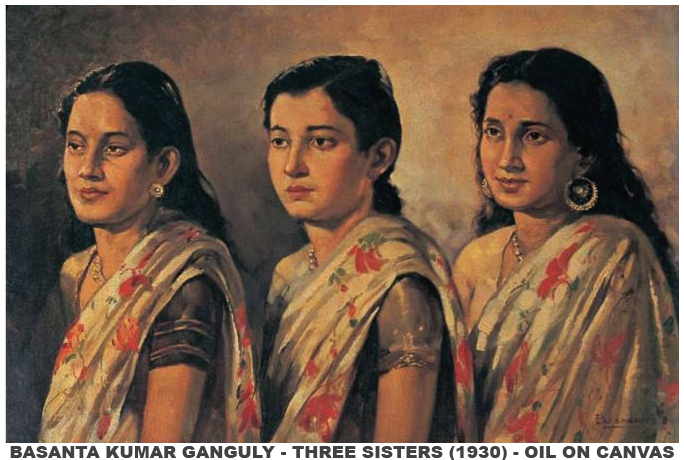
Basanta Kumar Ganguly
An accomplished portraitist and educator, Basanta Kumar Ganguly remained committed to British academic traditions while adapting them to Indian subjects. His teaching influenced several generations of artists who continued to value rigorous observation and technical excellence.
Ananda Mohan Shaha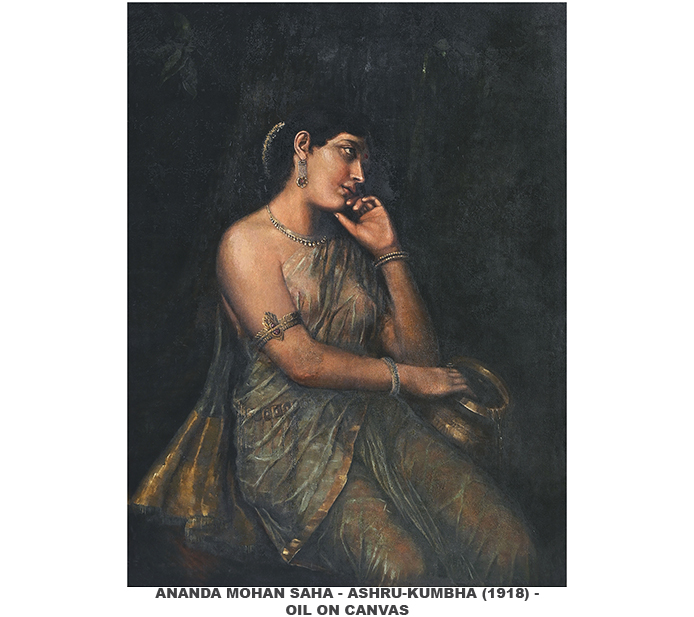
Although long absent from mainstream narratives, Ananda Mohan Shaha represents one of the most intriguing rediscoveries in recent scholarship. His 1918 masterpiece Ashru-Kumbha demonstrates refined emotional realism and confirms that highly accomplished academic painters continued working outside dominant institutional frameworks.
The Bombay School: Academic Realism at Its Finest
If Bengal debated realism, Bombay embraced it.
The Sir J.J. School of Art became the principal centre for academic painting in western India, producing artists whose technical standards rivalled contemporary European academies.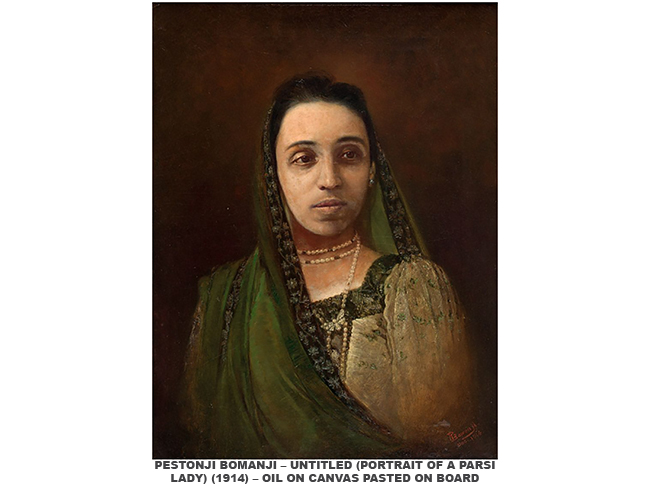
Pestonji Bomanji (1851–1938)
One of the earliest great masters of the Bombay School, Bomanji specialised in portraits and intimate studies of Parsi domestic life. His subtle colour harmonies and meticulous realism remain among the finest examples of nineteenth-century Indian painting.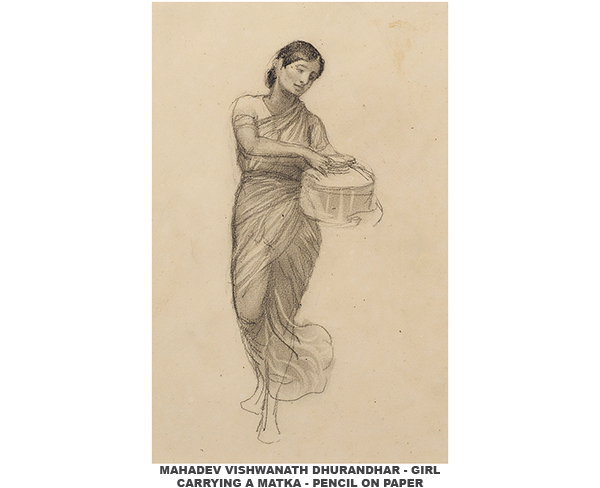
Mahadev Vishwanath Dhurandhar (1867–1944)
A towering figure in Indian academic art, M.V. Dhurandhar balanced historical painting, illustration, portraiture, and urban documentation with remarkable versatility. Later becoming the first Indian head of Sir J.J. School, he profoundly influenced art education across western India.
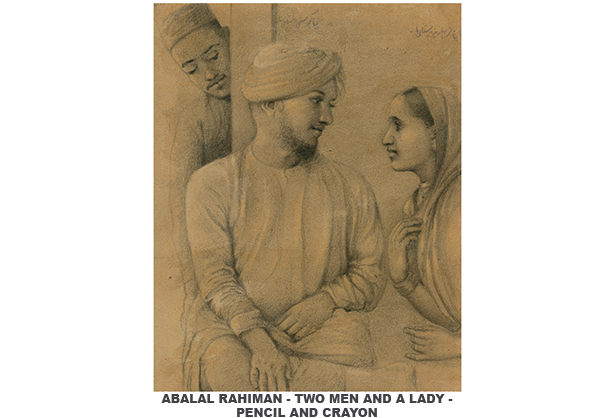
Abalal Rahiman (1860–1931)
Working under the patronage of Kolhapur’s royal court, Rahiman developed a lyrical realism that brought extraordinary sensitivity to landscapes and watercolours depicting rural Maharashtra.
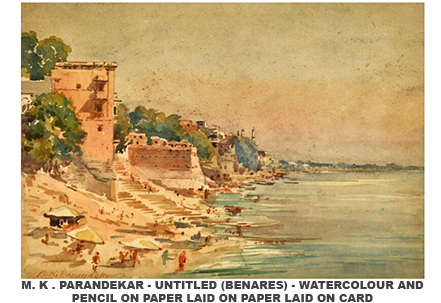
M.K. Parandekar (1877–1961)
Known for architectural precision, Parandekar documented temples, ghats, and historic monuments with exceptional mastery of perspective and atmosphere.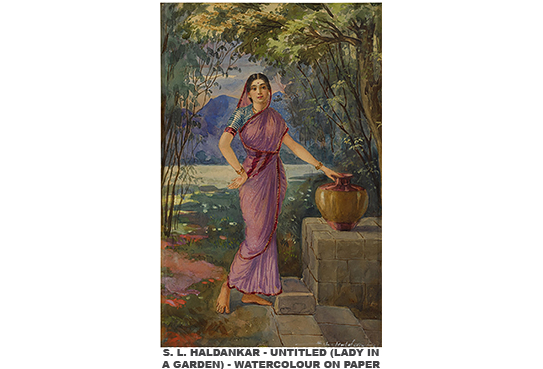
S.L. Haldankar (1882–1968)
His iconic watercolour Glow of Hope remains one of the greatest achievements of Indian academic painting. The delicate rendering of candlelight illuminating a young woman demonstrates extraordinary control over transparency, anatomy, and tonal modulation.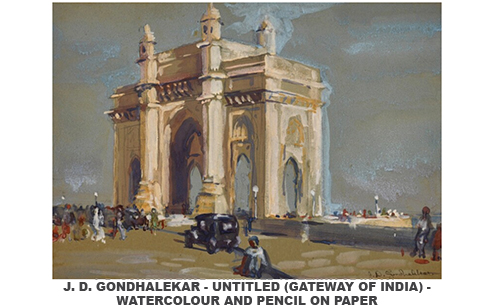
J.D. Gondhalekar (1909–1981)
Representing a later generation, Gondhalekar combined rigorous academic training with modern sensibilities acquired through studies in Europe, creating an important bridge between classical realism and twentieth-century design.
The Travancore and Kilimanoor Legacy
Kerala developed its own distinctive academic tradition through royal patronage rather than colonial institutions.
The Kilimanoor family became one of India’s earliest artistic ateliers, where generations of painters sustained and refined realist practices.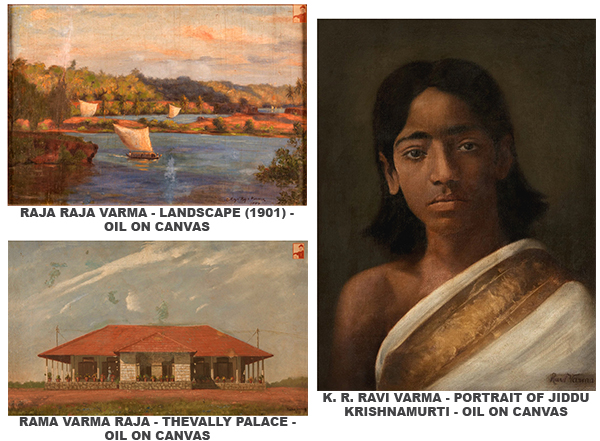
Alongside Raja Ravi Varma worked C. Raja Raja Varma, an accomplished landscape painter and diarist whose journals provide invaluable documentation of the period. Mangala Bayi Thampuratti, Ravi Varma’s sister, is believed to have contributed to studio production, while Rama Varma Raja, the master’s son, carried the tradition into the twentieth century through portraiture and mythological painting.
Later members including K.R. Ravi Varma continued the family legacy while consciously distinguishing their signatures to avoid confusion with the master.
The Travancore court thus nurtured one of India’s longest-running realist traditions.
Academic Realism Beyond the Canon
The movement extended far beyond its most celebrated figures.
Artists such as Shashi Kumar Hesh, Narendranath Sarkar, Phanindranath Basu, Pramatha Mallik, Jogendranath Shil, M.F. Pithawala, Antonio Xavier Trindade, and numerous regional portraitists contributed significantly to the development of Indian realism, yet many remain understudied.
Their works documented changing social structures, urbanisation, princely courts, domestic interiors, and emerging national identities with remarkable technical sophistication.
Why Was Academic Realism Marginalised?
Several factors contributed to its later neglect.
The nationalist movement increasingly privileged indigenous aesthetics over European techniques. Post-independence art history favoured the Bengal School and later the Progressives as symbols of cultural liberation. Modernist criticism often dismissed realism as conservative or derivative.
Ironically, many of these academic painters were deeply committed to Indian subjects and saw no contradiction between technical realism and national identity.
The result was that an entire tradition gradually slipped from mainstream narratives despite its artistic achievements.
A Revival of Interest
Today, scholars, collectors, and museums are reassessing academic realism with fresh eyes.
Exhibitions, archival research, and rediscoveries of artists such as Ananda Mohan Shaha demonstrate that the movement deserves a far more prominent place within Indian art history.
Collectors are increasingly recognising the technical brilliance, rarity, and historical significance of these works, while institutions are beginning to document overlooked regional traditions with greater seriousness.
This reassessment enriches our understanding of Indian modernism by revealing that it was never a single narrative but a constellation of parallel experiments.
Academic realism in India was not an imitation of Europe but an adaptation—a dialogue between imported techniques and indigenous imagination.
It produced artists who combined anatomical precision with mythology, portraiture with psychology, and observation with cultural identity. Their paintings became visual records of a nation negotiating modernity while remaining rooted in its own stories.
To study Indian art without academic realism is to read only half the book.
The forgotten chapter is now slowly being restored.
Endnotes
- Tapati Guha-Thakurta, The Making of a New Indian Art (Cambridge University Press, 1992).
- Partha Mitter, Art and Nationalism in Colonial India, 1850–1922 (Cambridge University Press, 1994).
- R. Siva Kumar (ed.), Santiniketan: The Making of a Contextual Modernism (NGMA, 1997).
- M.V. Dhurandhar, The Art of My Life (autobiographical memoir).
- Archival records of the Sir J.J. School of Art, Government College of Art & Craft, Kolkata, and Travancore royal collections.
- Research and publications relating to Raja Ravi Varma Heritage Foundation, Indian Academy of Fine Arts, and recent scholarship on Ananda Mohan Shaha.
Selected Bibliography
- Guha-Thakurta, Tapati. The Making of a New Indian Art. Cambridge University Press.
- Mitter, Partha. Art and Nationalism in Colonial India. Cambridge University Press.
- Dhurandhar, M.V. The Art of My Life.
- Siva Kumar, R. (ed.). Santiniketan: The Making of a Contextual Modernism. NGMA.
- Various catalogues and archival publications from Sir J.J. School of Art, Government College of Art & Craft Kolkata, Raja Ravi Varma Heritage Foundation, and Indian Academy of Fine Arts.
Note : For collectors and scholars alike, academic realism remains one of the richest yet most underexplored chapters of Indian art history—a tradition whose technical excellence and cultural significance continue to reward fresh study and renewed appreciation.
- Research & Compiled by Aakriti Art Gallery team
Comments
Join the Discussion
Please login to post comments.
Login