From Revolution to Residences: What Happened to The Artist's Manifesto?
Art historian JohnyML traces the history of Manifesto based art and artistic life in the last century and its gradual decline with the advancing global art market logic.
Forever Manifestos, Revisionists and Compradors in Art. From the Progressive Artists’ Group and the Bengal School to the Radical Painters, this essay examines how artistic manifestos shaped modern Indian art, why they eventually lost their authority, and whether today’s artists continue to create personal manifestos without formal movements.
On one of the huge walls of the CCA Gallery in Bikaner House, during his solo exhibition,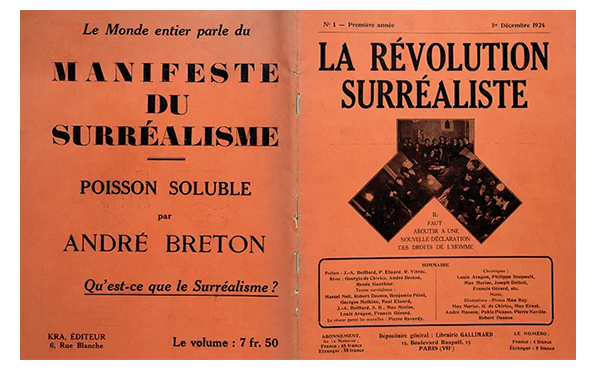 veteran art historian and artist, Prof. Ratan Parimoo had instructed his curators to paste a blown-up version of a ‘manifesto’ that he himself had prepared during his early years as an artist. Parimoo was young and impatient and he wanted to deal with the big bad world, if not change it forever through his art. He was not making art just for the sake of satisfying his own soul-demands. The intention was clear; facilitate certain positive changes in the society. He was an artist and art was his tool. It was not just a fascination. He had a blueprint about his art practice. That was his manifesto.
Whether Prof. Parimoo could stick to his manifesto as he ‘progressed’ in age and experience is a different matter; what mattered to him was the plan of action. Those were the good old days in the last century, which had started with a few manifestos.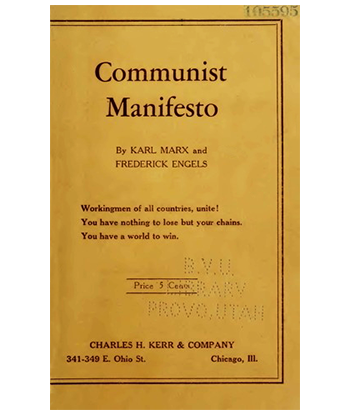 The one manifesto that had influenced the world considerably was the ‘Communist Manifesto’, jointly written by Karl Marx and Frederic Engels in 1848. The effect of it was felt after half a century and it took no time to reach beyond Russia where a radical revolution based on the manifesto had become a reality. Perhaps, we could say that the Communist Manifesto was the mother of all manifestos that followed in the 20th century.
As it was believed largely that the progressives of the society belonged to the ‘left’ of all ideologies, especially after the French Revolution and the establishment of the revolutionary parliament, those who thought ‘left’ even without being a ‘leftist’ or a ‘communist’ in its strictest sense, believed in having certain action plan in the form of a manifesto. It was not just a user’s manual but a philosophy, an elevated set of ideas that stood above the practical applications of the same. Manifestos were designed to give a moral and ethical foundation of certain ideas, which would become an ideology, taking hegemonic positions. Artists, poets and critics too thought that they needed manifestos.
Maybe, the critics and historians of the twentieth century thought of various -isms and movements in art mainly because they thought that a set of artistic expressions that came under the same aesthetical category needed some kind of a manifesto to push it further. But when all the artists in a historical category, like an -ism (for example Impressionism,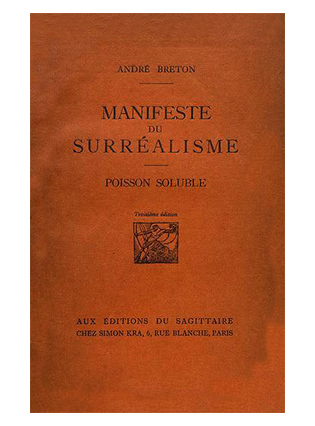 Cubism and so on) did not think it imperative to have an ideology, the -isms remained as isms to be replaced by the one that followed. But those artists who consciously came together to have a movement, wrote their own manifestos and demanded the followers to adhere to its basic tenets.
Surrealism had a manifesto written by the poet Andre Breton and historically speaking, the post First World War socio-scientific and cultural scenario was so radical and fast changing that the artists couldn’t have gone out to argue about their art without the help of a manifesto. But the Surrealists were not the only ones in the lot. Even before that, by the turn of the last century itself, anti-colonial sentiments in the colonies all over the world and the nascent nationalistic thoughts had made the intellectuals of those countries to think about making politico-cultural plans based on manifestos. Some came out as philosophical tracts, some as stylistic expressions and some as revivalist forms.
In India, though the Bengal School did not have a defined manifesto to go by, each of the doyens involved in the making of the early nationalist art had a set of philosophical ideas towards the cultural production of the country. Those great pioneers who were in Santiniketan including the Tagores worked towards a virtual manifesto from various fronts, facilitating a situation for the revival of all what had been thought as the great Indian heritage. In Europe, the Bauhaus group had their design manifesto, a somewhat persuasive model through example, which spread all over the world, making the designers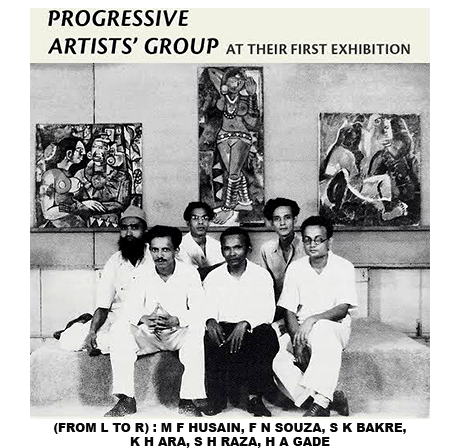 think differently. With the establishment of the Progressive Writers’ Association and Indian People’s Theatre Association established in various parts of India in the 1930s itself had set the agenda of the future progressive groups including the famous Progressive Artists’ Group (1947), which became a landmark in the history of Indian art.
The kinetic agency that all these Progressives had taken was doubly implied in the very choice of the word ‘progressive’ and also in their declared manifestos. One common thing that we could see in all these manifestos is that the members of the group were fed up with the kind of aesthetics which was prevalent at that time. They wanted to be forward looking in their art and found art as a medium and method to facilitate social changes. They were not party affiliates but followed a larger leftist ideological leadership, which in fact was international in its outlook. Hence, all the manifestos addressed the local needs and international aspirations alike at the same time. They were speaking to the immediate audience without losing sight of all what had been happening in the world. Almost all the manifestos demanded that art while addressing and solving aesthetical problems, should fundamentally be addressing the social issues, flagging them out and if possible, showing directions to solve it. Manifestos positioned artists as messiahs, anarchic visionaries, catalysts of social change and at the same time committed and responsible citizens.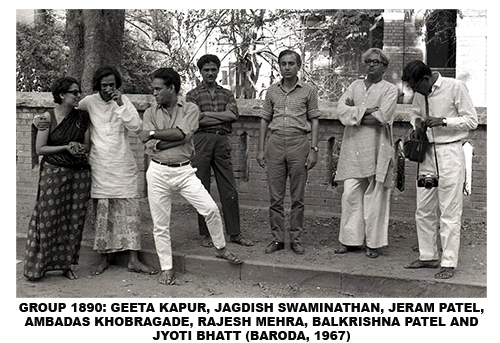 In the second half of the 20th century two manifestos came out as part of certain art groupings; 1890 Group, established under the leadership of J Swaminathan was a combination of Delhi and Gujarat based artists who believed in their vanguardism. Swaminathan was asking for an inclusive modernism that did not look down upon the traditional folk and tribal art expressions. The second manifesto appeared towards the end of the 1980s as a part of the Indian Radical Painters and Sculptors’ Association. Led by a group of artists from Kerala and some from the North, this short-lived movement was influential enough to linger on for almost two decades, till the effects of the new global economic order and the digital revolution pushed behind everything that came before. Radical Group (so it was known) was a romantic movement and their manifesto declared that they were against all kinds of retrogressive aesthetics.
The Radical Group held a couple of major exhibitions in Baroda and Kerala and its manifesto underlined that the artists should be socially committed and they should be finding their creative ideas and sustenance from the proletariat. In a time, when even the Communist Party was not cherishing such ideas. The artists in this group were not party members or cadres. They were a part of the larger global left which stood for local articulations and global vision. They were against elitism in art and did not like the art market. They outcasted those artists from the group who chose to participate in certain exhibitions led by corporate houses. The irony today is that the same Radical group artists have become the darlings of the same corporate houses that they fought tooth and nail. The Radical manifesto had accused the Progressives for cherishing and nourishing ‘retrogressive aesthetics’ and today they have become strange bedfellows sharing the same wall space in national and international exhibitions, besides sitting pretty side by side in the corporate collections.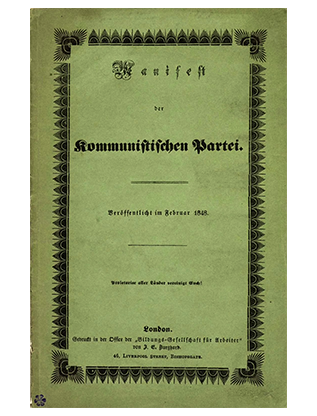 The question before us is crucial; have manifestos failed? Before answering that question, I prefer to address it differently by asking, are manifestos made forever. From the historical examples we have come to know that the manifestos of all sorts are either discarded along the way or have become archival materials. If they are not discarded, they have been revised. When a manifesto is revised and re-articulated with the change of/in times, there are possibilities of factionalism developing among the followers; they become traditionalists and revisionists. Conservatives stick to the original manifesto and the revisionists become liberals who don’t find it a problem to make some ‘adjustments’ with the changing times. The traditionalists are bound to become museum pieces and the revisionists would lack trust from a larger audience. This scenario takes us back to the initial question. No, the manifestos have not failed but they have run their time and have become obsolete. Experience and examples have taught one and all that manifestos are not made forever.
The second question is, does the lack of a manifesto, a working plan, make an artist a recluse with no commitment towards his society in general or to his own community in particular? In a global economic scenario with the AI threats looming large over the firmament of cultural productions, is it ethical to insist an artist to have a manifesto and stick to it? What purpose would a manifesto serve in today’s world? Will it be able to lead a group of artists to their chosen destination or the general goal of saving the society, at least aesthetically? Will they stand a chance against the corporate giants, including the banking conglomerates who have become a deciding factor of the art eco and economic systems? Is it necessary to produce art without the concept of market, and with a commitment to the society? Or is it necessary for the recluse to call themselves the proponents of the ‘art for art’s sake’ philosophy and always remain satisfied in the soul?
There are no conclusive answers to these questions. If one goes by a cursory data of personal interviews, one could see how artists want to have commitment to their aesthetics and society. They want to create their art and through the art some meaning which is useful to more than a set of people who could buy art. At the same time, the very same artists think that they have to be a part of the system that blindly follows glitter and glamour, leaving all painful realities aside, even insisting against the use of black color in their works of art, in order to be at the winning side. However, the romantic wish that the society will be a better place if it sees their art in its proper perspective has not died down completely. When everything fails, they find solace in their own souls.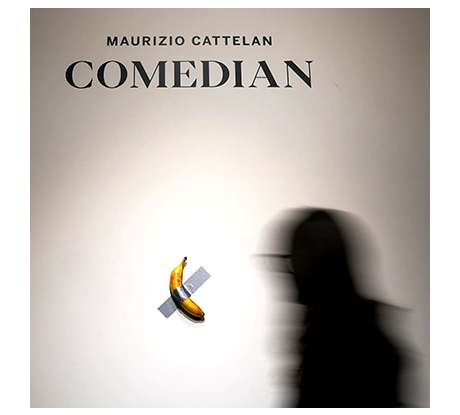
Interestingly, one could see that every commercially successful artist speaking about the need for some action plan, a manifesto of sorts in order to change the society or convey something more than money and glamour could convey, whereas those who have not made it yet at the market vehemently say that speaking about social concerns personally or through art could mar the chances of them getting ahead in the market. While the former could preach as they are in a comfortable zone, we do not see that they do anything towards creating manifestos or implementing with a set of like-minded artists. The ones who are still struggling, ironically, are not interested in making any manifesto.
I have a feeling that the space of the erstwhile manifestos and art movements or groupings is now taken over by project spaces and residencies where the artists come together, ideate, create and spread out to different parts of the world with their accumulated ideas and plans. They have their personal manifestos, not only of their art but also about a possible good life. It is not a thing about the Indian artists alone; world over, the young artists are now doing it. I have come across some underground practitioners of art with radical ideas and blasphemous ways of art production. They are not led by any manifestos. Their works are manifestos in themselves. Banksy and Ai Weiwei did not have manifestos but most of their works carried the personal manifesto of the artists. But then we see them in auction houses and in the streets alike. We are confused and we ask, which part is real, the one in the street or the one under the gavel? Then I remember ‘Comedian’ by Maurizio Cattelan. When the banana wilts, you just replace it with a fresh one. Yes, when your personal manifesto fails, replace it with a new one and fly to a new residency for a couple of years.
-- JohnyML
Curator & Art Historian

Comments
Join the Discussion
Please login to post comments.
Login