Looking Beyond the Obvious: Senior Indian Masters Whose Time for Wider Recognition May Still Be Ahead
A Closer Look at Senior Indian Artists of Enduring Significance
The history of art collecting is filled with examples of artists who were deeply respected by their peers, celebrated within professional circles, and admired by scholars long before their markets reflected their true stature.
In India too, there exists a remarkable generation of senior painters and sculptors who have built distinguished careers over decades through consistent practice, institutional exhibitions, and critical acclaim. They are by no means unknown—they are well regarded within the artistic community—but many remain relatively less represented in the broader gallery, auction, and collecting narrative than their contributions might warrant.
For collectors willing to look beyond the most frequently discussed names, these artists offer an opportunity to engage with mature and highly individual artistic practices that have already stood the test of time.
Looking Beyond the Familiar
The Indian art market has understandably focused much of its attention on a relatively small group of blue-chip artists. Yet the country’s artistic landscape has always been far richer and more diverse.
Many senior practitioners have quietly developed distinctive visual languages, influenced generations of younger artists, participated in important exhibitions, and produced substantial bodies of work that deserve continued study and appreciation.
Their significance lies not in market speculation but in the depth and consistency of their artistic achievement.
Akhilesh: Abstraction Born from Fire and Light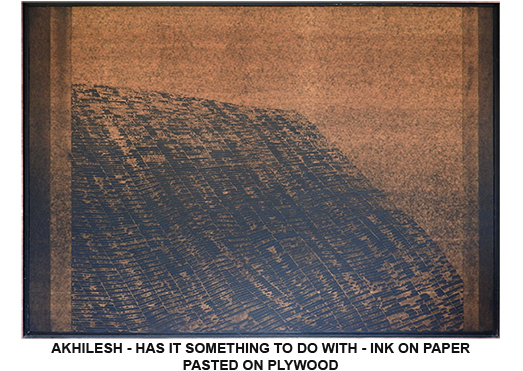
Among contemporary Indian abstractionists, Akhilesh has forged a language that is unmistakably his own.
His canvases often appear as dramatic confrontations between darkness and illumination, where volcanic reds, incandescent yellows, molten ochres, and glowing oranges emerge from charred monochromatic grounds. Rather than depicting literal landscapes, these paintings evoke elemental forces—fire, earth, memory, and transformation.
The result is abstraction that is at once energetic and contemplative, revealing an artist who has continuously expanded the expressive possibilities of colour and texture.
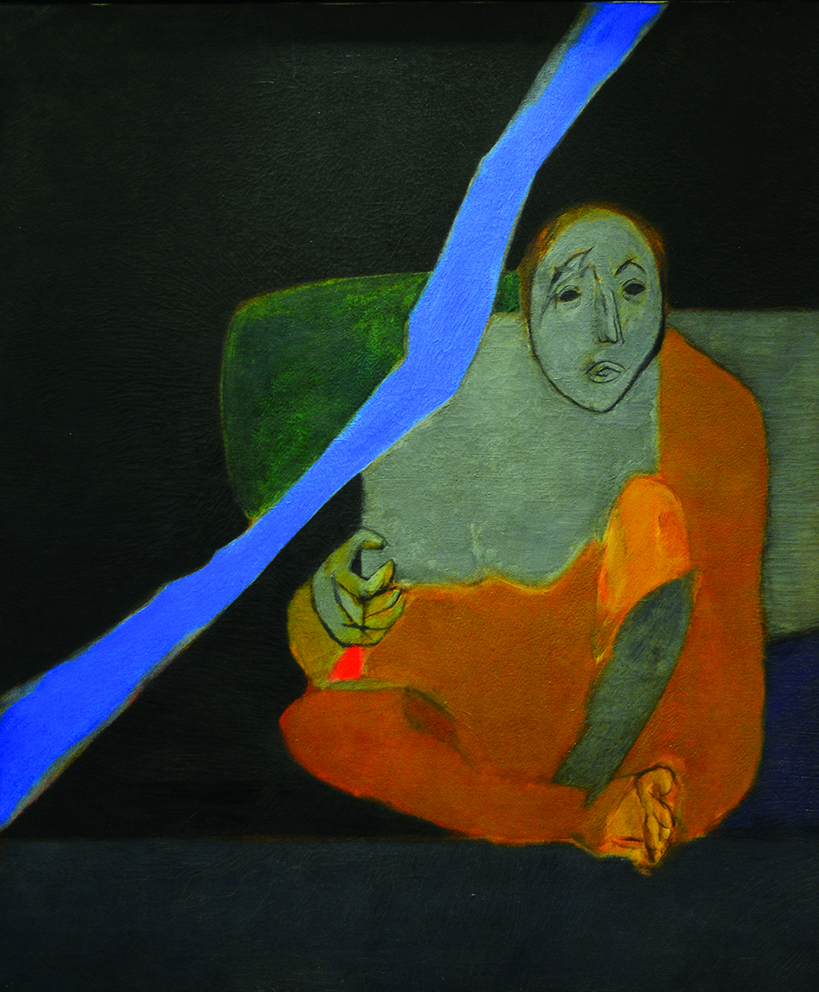
Yusuf: Quiet Narratives and Human Presence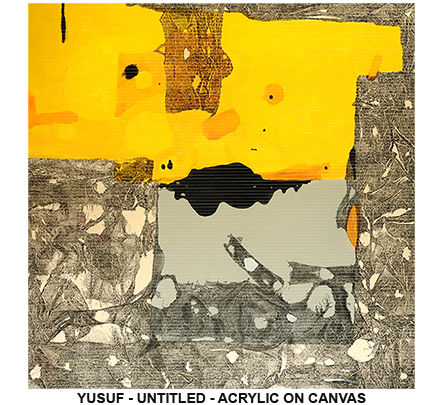
The paintings of Yusuf are characterised by remarkable restraint and emotional depth.
Through simplified forms and carefully balanced compositions, he creates intimate narratives that speak of memory, solitude, and the poetry of everyday existence. His works avoid unnecessary complexity, allowing subtle human relationships to emerge with quiet dignity.
This consistency of vision has made Yusuf one of the distinctive voices in contemporary Indian painting.
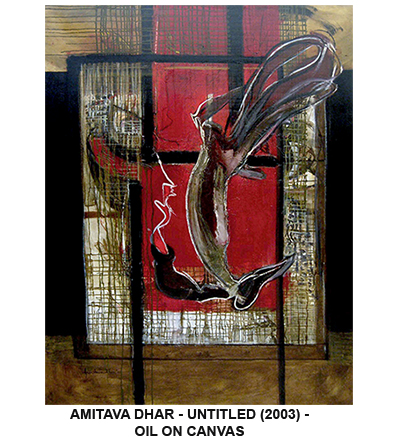
Amitava Dhar: A Lifetime Devoted to Abstraction
For decades, Amitava Dhar has remained committed to abstraction as a deeply personal visual language.
His richly layered surfaces, gestural brushwork, and carefully orchestrated colour relationships reveal an artist interested less in representation than in the emotional architecture of painting itself. Rather than following trends, Dhar has pursued a sustained exploration of rhythm, movement, and spatial tension that has earned him admiration among artists and collectors alike.
Sunil De: The Discipline of Pure Abstraction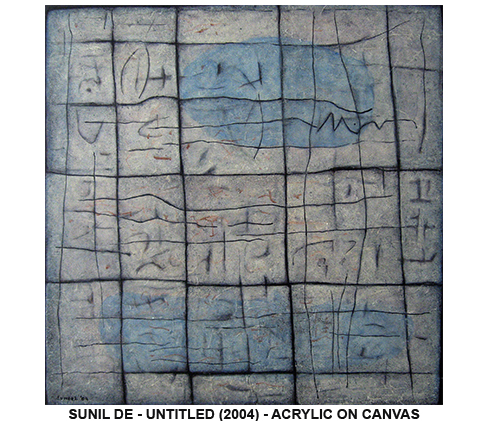
Sunil De occupies a singular position within contemporary Indian abstraction.
Working almost exclusively within the language of non-objective painting, his compositions are distinguished by their lyrical movement, sophisticated colour harmonies, and refined structural balance. His paintings demonstrate an unwavering commitment to abstraction as an autonomous mode of expression, where gesture and chromatic relationships create their own internal logic and emotional resonance.
His practice stands as an important contribution to the continuing evolution of abstract art in India.
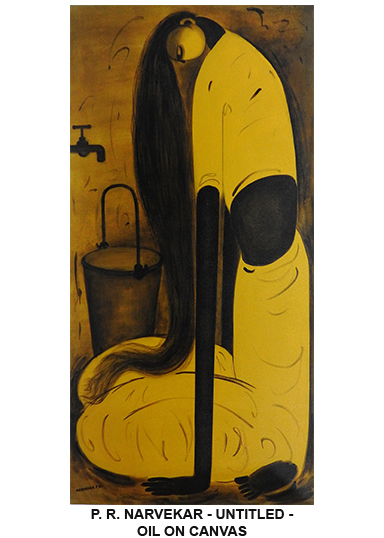
P. R. Narvekar: The Elegance of the Elongated Form
Few Indian painters have developed a figurative vocabulary as distinctive as P. R. Narvekar.
His signature elongated figures—particularly graceful female forms—lend his paintings an unmistakable lyrical quality. Through rhythmic distortion and carefully extended proportions, Narvekar transforms the human body into a poetic visual metaphor, simultaneously fragile and monumental.
Equally characteristic is his restrained palette. Dominated by blacks, deep browns, ochres, and luminous yellows, his colours create an atmosphere of quiet introspection, where melancholy and serenity coexist with remarkable subtlety.
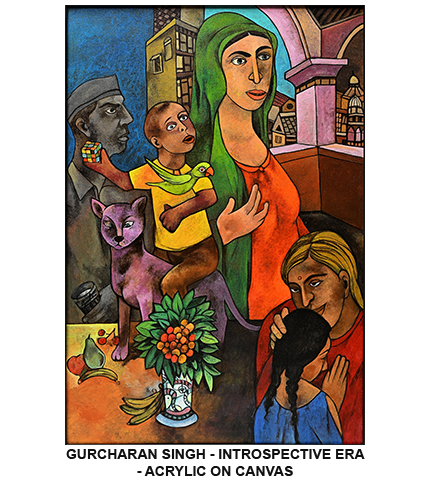
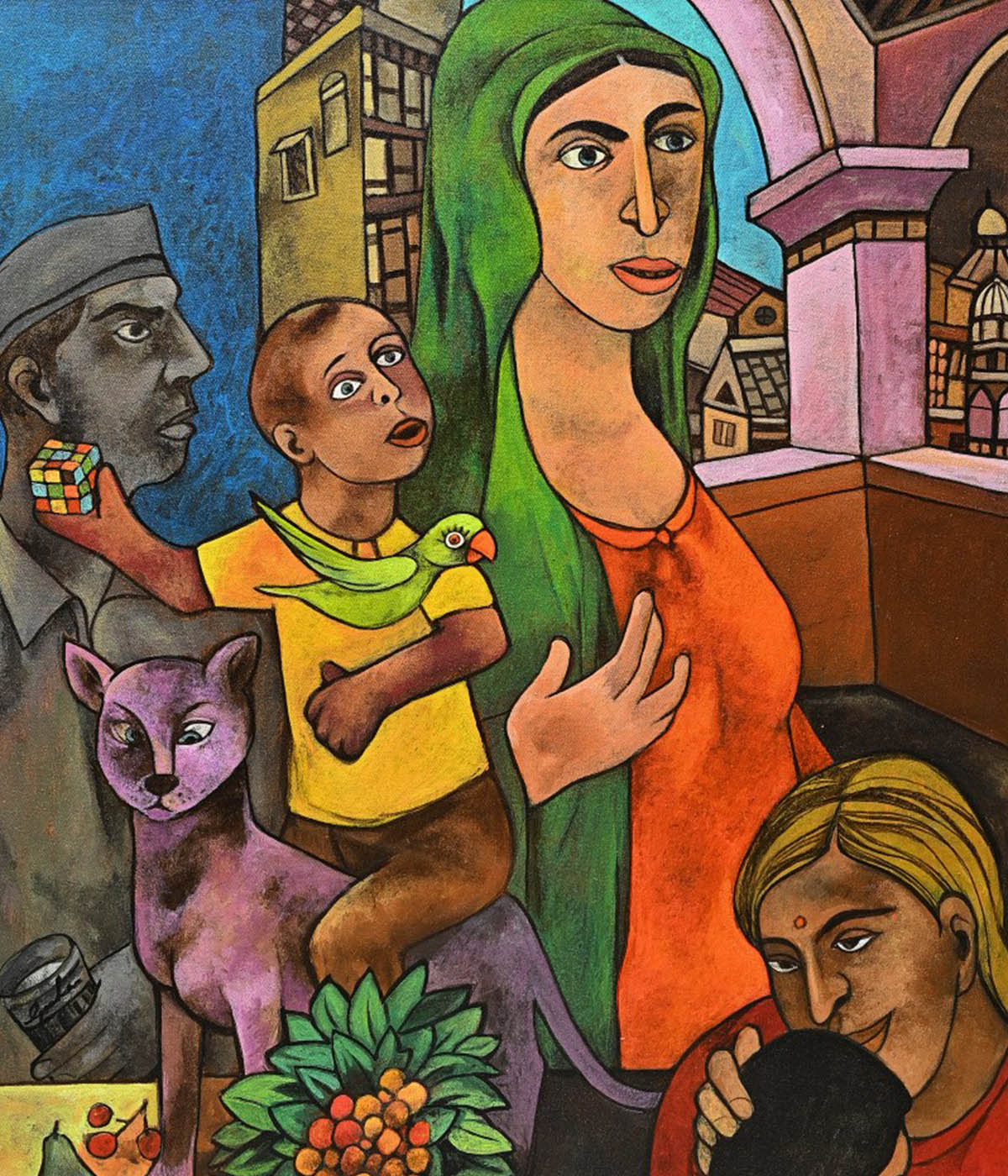
Gurcharan Singh: Simplicity as Sophistication
The enduring appeal of Gurcharan Singh lies in his ability to communicate profound ideas through deceptively simple forms.
His compositions, populated by stylised figures and understated symbolism, explore memory, relationships, spirituality, and the rhythms of ordinary life with exceptional sensitivity. The clarity of his visual language allows emotional complexity to emerge naturally, making his paintings both accessible and deeply contemplative.
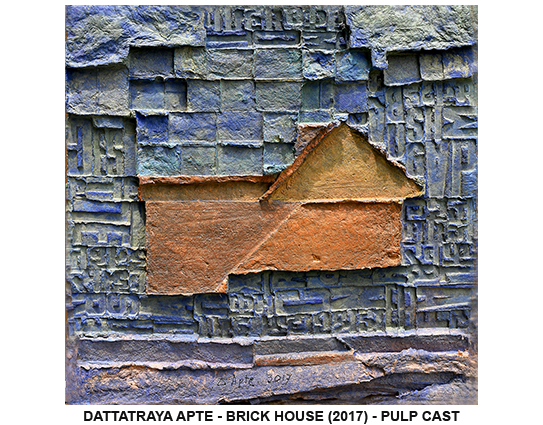
Dattatraya Apte: Redefining the Possibilities of Paper
Among contemporary Indian artists, Dattatraya Apte occupies a unique position through his pioneering experiments with handmade paper pulp.
Transforming paper into an expressive sculptural medium, he has produced reliefs and mixed-media works of extraordinary originality while simultaneously making significant contributions to printmaking. His innovative material practice demonstrates how traditional media can be reimagined into entirely new artistic forms.
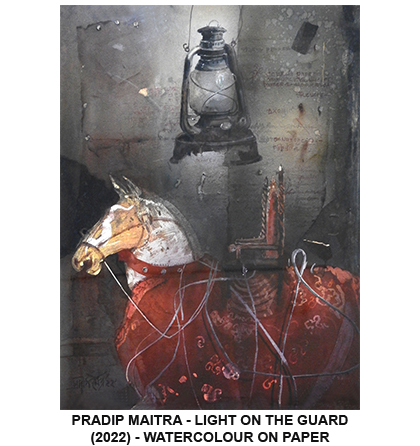
Pradip Maitra: The Quiet Brilliance of Watercolour
Watercolour remains one of the most demanding mediums in painting, requiring precision, confidence, and extraordinary technical control.
Pradip Maitra has devoted decades to mastering these challenges, producing works that capture atmosphere, light, and landscape with remarkable delicacy. His transparent washes and subtle tonal transitions exemplify the enduring sophistication of the watercolour tradition within Indian art.
Sculptors of Exceptional Distinction
The history of modern Indian sculpture is enriched by artists whose contributions deserve continued scholarly and institutional attention.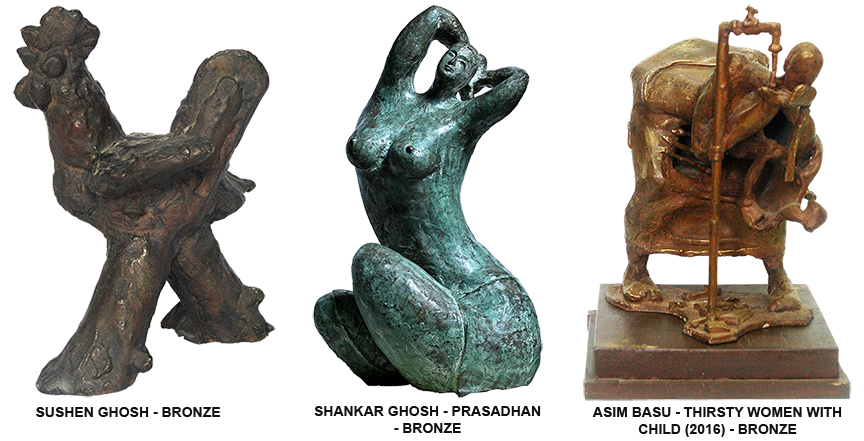
Sushen Ghosh has developed a sculptural practice distinguished by elegant modelling, structural confidence, and emotional sensitivity. His works demonstrate an exceptional understanding of mass and movement while retaining an intimate human presence.
Shankar Ghosh is recognised for his commanding figurative sculptures and public commissions that combine technical mastery with contemporary expression. His ability to balance monumentality with subtle narrative has established him as an important figure in modern Indian sculpture.
Similarly, Asim Basu has pursued an individual sculptural language that moves fluently between abstraction and figuration. His nuanced treatment of form, surface, and spatial relationships reflects decades of experimentation and artistic maturity.
Collecting Through Scholarship
What connects these artists is not a shared style but a shared commitment to sustained artistic inquiry.
Each has developed an individual practice through years of disciplined work rather than short-term trends. Their paintings and sculptures occupy significant positions within the broader narrative of modern and contemporary Indian art and invite closer study by collectors, scholars, and institutions alike.
As research expands and regional histories receive greater attention, many such artists are likely to be understood in richer and more comprehensive contexts than before.
Beyond the Headlines
The most meaningful collections are often built not by following publicity alone but by engaging deeply with artistic quality, historical context, and personal conviction.
The artists discussed here have already earned the respect of the art community through their contributions to painting and sculpture. Their works reflect decades of exploration, craftsmanship, and intellectual engagement that continue to resonate with contemporary audiences.
Looking beyond the obvious does not mean discovering forgotten names.
It means recognising that the story of Indian art has always been broader, richer, and more nuanced than the headlines suggest—and that some of its most rewarding journeys begin with artists whose significance has long been evident to those who have looked closely.
Editorial Disclosure
This article is intended as an editorial reflection on collecting and art history. It does not constitute investment or financial advice. The acquisition of art should be guided by scholarship, personal engagement, provenance, authenticity, condition, and professional consultation.
Endnotes
- Artist profiles and exhibition catalogues relating to Akhilesh, Yusuf, Amitava Dhar, Sunil De, P. R. Narvekar, Gurcharan Singh, Dattatraya Apte, Pradip Maitra, Sushen Ghosh, Shankar Ghosh, and Asim Basu.
- Gallery records, institutional collections, and curatorial essays documenting the practices of these artists.
- Scholarship on modern and contemporary Indian painting and sculpture emphasising the plurality of artistic trajectories beyond the canonical market narrative.
Selected Bibliography
- Exhibition catalogues and monographs on the individual artists.
- Museum publications on modern and contemporary Indian art.
- Scholarly essays on Indian abstraction, figurative painting, printmaking, and sculpture.
- Gallery archives and curatorial texts documenting the careers of the artists discussed.
- Research & Compiled by Aakriti Art Gallery team
Comments
Join the Discussion
Please login to post comments.
Login