Rediscovering Rabindranath Tagore: New Archival Evidence from the Work of Santiniketan Artist Ardhendu Prasad Banerjee
A previously unpublished 1953 portrait, an identical artist’s seal preserved in the pages of Modern Review, and recent archival research combine to restore attention to one of Kala Bhavana’s earliest painters while demonstrating how forgotten archives continue to reshape the history of modern Indian art.
Art history is often rewritten not through spectacular discoveries in museums, but through quiet acts of research.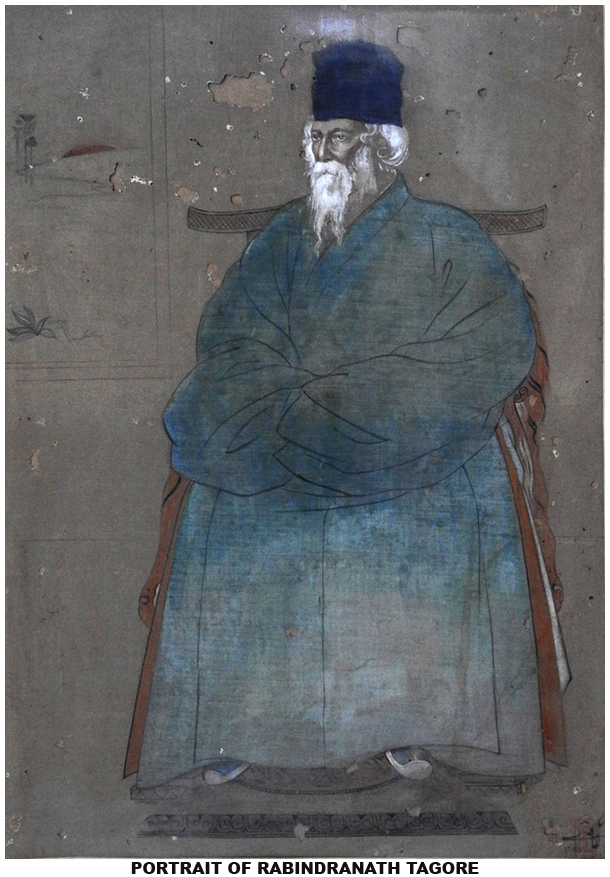
A forgotten exhibition catalogue, a family archive, an old journal, or a painting hanging unnoticed in a private home can suddenly illuminate an artist whose contribution has slipped from public memory. Such discoveries rarely overturn accepted history; instead, they enrich it, adding missing voices and overlooked narratives.
One such discovery concerns a previously unpublished portrait dated 1953,which can now be attributed with considerable confidence to Ardhendu Prasad Banerjee (1902–1965)—one of the earliest students of Kala Bhavana, Santiniketan. Through the convergence of archival evidence, stylistic analysis, and the identification of the artist’s distinctive personal seal, the painting also emerges as an important posthumous portrait of Rabindranath Tagore, painted twelve years after the poet’s death.
The significance of the work lies not merely in the portrait itself, but in what it reveals about an artist whose place within the history of the Bengal School deserves renewed attention.
Among Kala Bhavana’s Earliest Artists
Ardhenduprasad Banerjee occupies a distinctive position in the formative history of Kala Bhavana.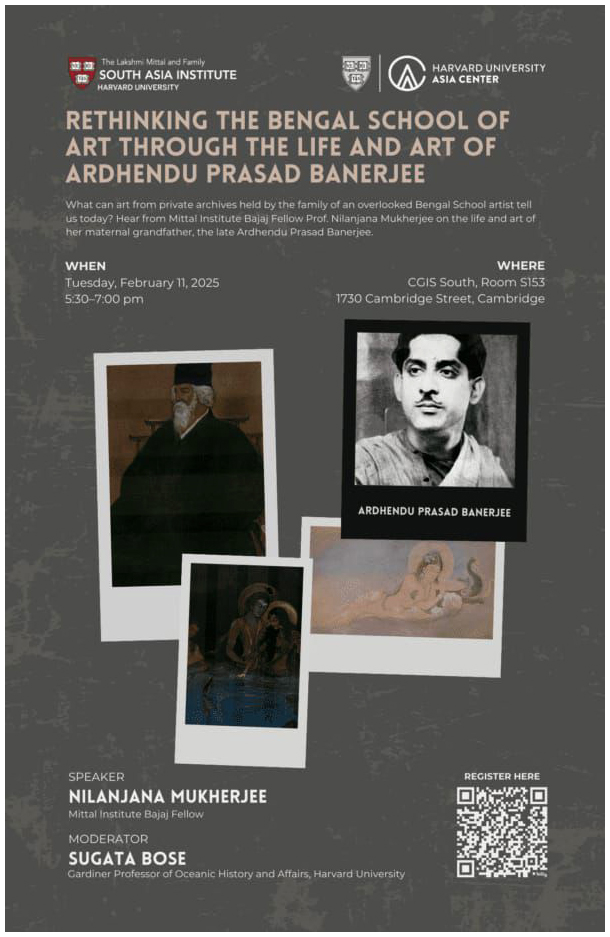
Born on 7 February 1902 in Kotalipara, Faridpur (present-day Bangladesh), he entered the Government School of Art in Calcutta in 1918 before accompanying Asit Kumar Haldar to Santiniketan in 1919, when Kala Bhavana was beginning to emerge as Rabindranath Tagore’s experimental school of art. Recent scholarship identifies Banerjee among the institution’s earliest five trainees, studying under Asit Kumar Haldar, Nandalal Bose and within the wider intellectual influence of Abanindranath Tagore.
These formative years coincided with one of the most significant moments in modern Indian art, when Santiniketan sought to create an artistic language rooted in Indian traditions while remaining open to Asian and international influences.
Unlike many of his celebrated contemporaries, however, Banerjee remained largely outside the mainstream narratives of twentieth-century Indian art.
A Remarkably Diverse Oeuvre
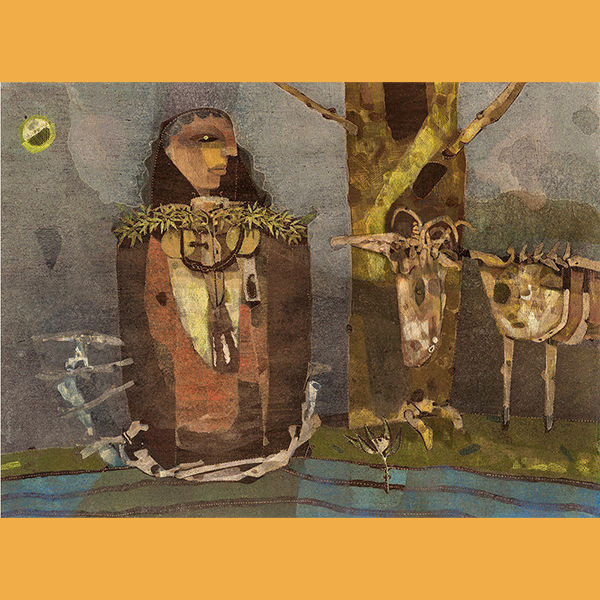
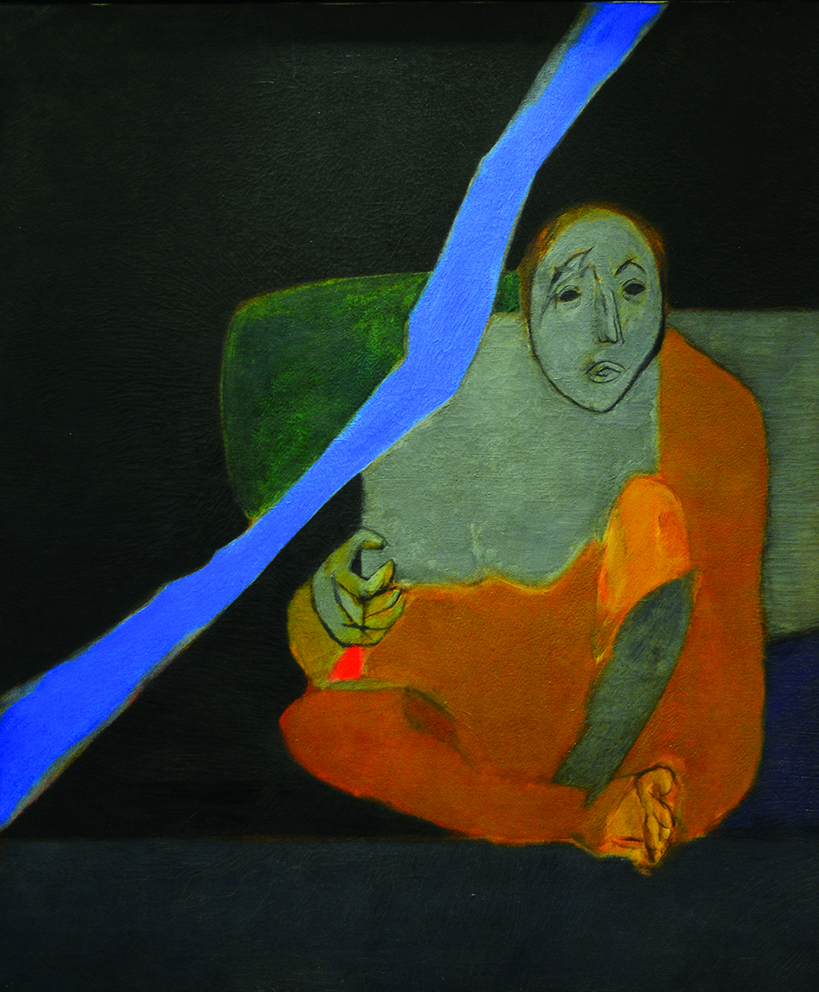
Although relatively little has been published about him, surviving family archives reveal the breadth of Banerjee’s artistic practice.
His known works include Durgarani, Barshasnata Bithika, Ganga, Khelar Sathi, Parabat, Gocharaner Math, Meghmallar, Hater Din, Nabajatak, Bisram, Chandrodoy, Hara-Parvati, Taimur Lung, China Samrat, Nababadhu, Alor Shikha, Sri Krishna Lila, Mandir, Sabitri-Satyaban, Kolkatar Khelonawala, Kabi Samrat, Gurudeb, Malabika, A Festival of Flowers, Water and Earth, and Lotus.
Collectively these works demonstrate an artist equally comfortable with portraiture, mythology, devotional imagery, literary subjects, landscapes and studies from everyday life. Rather than confining himself to one genre, Banerjee embraced the broad humanistic vision that characterised early Santiniketan.
The Rediscovered Portrait
The newly identified portrait bears the date 1953.
The sitter, seated frontally with folded arms, wears a flowing blue-green robe and deep blue cap. His long white beard, flowing hair and contemplative gaze closely resemble the familiar late-life image of Rabindranath Tagore.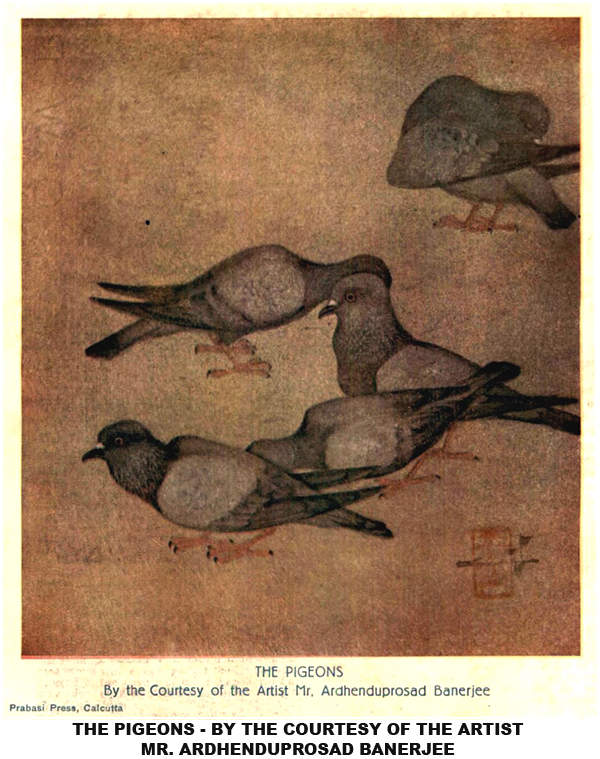
Executed with restrained brushwork and subtle tonal modelling, the portrait reflects the quiet lyricism associated with Santiniketan painting.
Although the canvas has suffered scattered paint loss, abrasion and punctures over time, its expressive quality remains remarkably intact.
Since Tagore died in August 1941, the painting is clearly posthumous. Yet such commemorative portraits were entirely consistent with artistic practice in the years immediately following Independence, particularly among artists whose lives had been shaped by Santiniketan.
Modern Review and a Crucial Archival Discovery
The decisive breakthrough emerged unexpectedly.
A fellow artist shared a scan of The Pigeons, reproduced in Modern Review in 1926.
Founded by Ramananda Chatterjee, Modern Review was among the most influential English-language literary and cultural journals published in colonial India, regularly reproducing works by leading Indian artists and writers.
The reproduction carries a contemporary credit:
“The Pigeons – By the Courtesy of the Artist Mr. Ardhenduprosad Banerjee.”
Even more significant is what appears in the lower right corner.
The painting bears Banerjee’s distinctive red personal seal.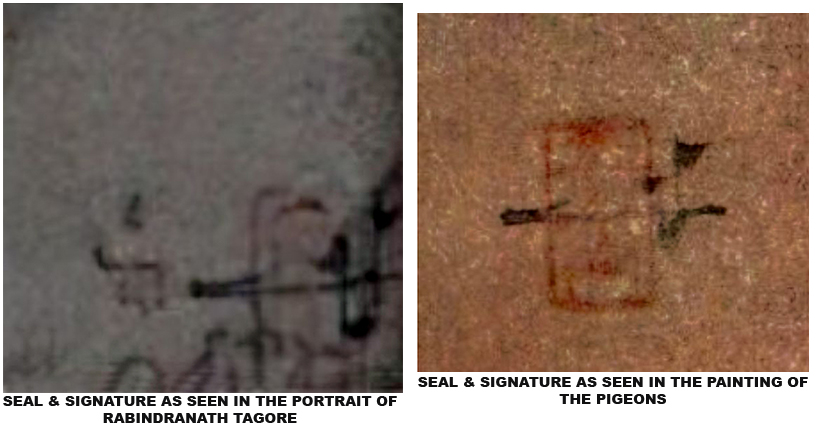
Comparison with the rediscovered 1953 portrait reveals that both works carry an identical rectangular seal with the same internal geometric device, rendered in the same red pigment and positioned in virtually the same area of the composition.
Such seals were widely used by Bengal School artists as marks of authorship, often accompanying or replacing handwritten signatures.
In the present portrait, traces of faded inscription adjacent to the seal suggest that a handwritten signature may once have existed before being lost through age and surface deterioration.
While no single element proves attribution independently, the identical seal, combined with stylistic consistency and documented biography, provides compelling comparative evidence linking the portrait to Ardhendu Prasad Banerjee.
Banerjee’s Portraits of Tagore
Recent research presented by Prof. Nilanjana Mukherjee at Harvard University’s Lakshmi Mittal and Family South Asia Institute further strengthens the context.
Drawing upon the family’s archive, Mukherjee notes that Banerjee painted portraits of both Rabindranath Tagore and Mahatma Gandhi, while also examining the economic realities faced by many Bengal School artists in post-Independence India despite their early promise.
This documentary evidence significantly reinforces the identification of the rediscovered portrait.
Rather than striving for photographic realism, Banerjee sought to capture Tagore’s spiritual presence—an approach deeply rooted in the Santiniketan aesthetic.
Rediscovering an Overlooked Artist
Perhaps the greatest importance of this discovery lies elsewhere.
It reminds us that Indian art history remains incomplete.
Many artists who participated in the making of Kala Bhavana, exhibited during their lifetimes, and contributed to the Bengal School have gradually disappeared from standard surveys—not because their work lacked quality, but because scholarship has not kept pace with surviving material.
Private collections, forgotten journals, exhibition catalogues and family archives continue to preserve works capable of enriching our understanding of modern Indian art.
The rediscovered portrait therefore becomes both an individual work of art and a symbol of the wider need for sustained archival research.
Ardhendu Prasad Banerjee deserves recognition not merely because a previously unpublished portrait has come to light, but because his career illuminates an important generation of artists who helped build Santiniketan during its formative years.
The rediscovered portrait of Rabindranath Tagore, viewed alongside The Pigeons reproduced in Modern Review, the identical artist’s seal, documented family archives, and renewed scholarly interest culminating in Harvard University’s 2025 programme, presents a persuasive case for re-examining Banerjee’s contribution to modern Indian art.
More broadly, it demonstrates that some of the most meaningful discoveries in Indian art continue to emerge not from institutional collections but from careful scholarship, forgotten publications and private archives.
Every rediscovered work adds another fragment to the larger history of Indian art.
In the case of Ardhendu Prasad Banerjee, that history is only now beginning to be written.
New Archival Evidence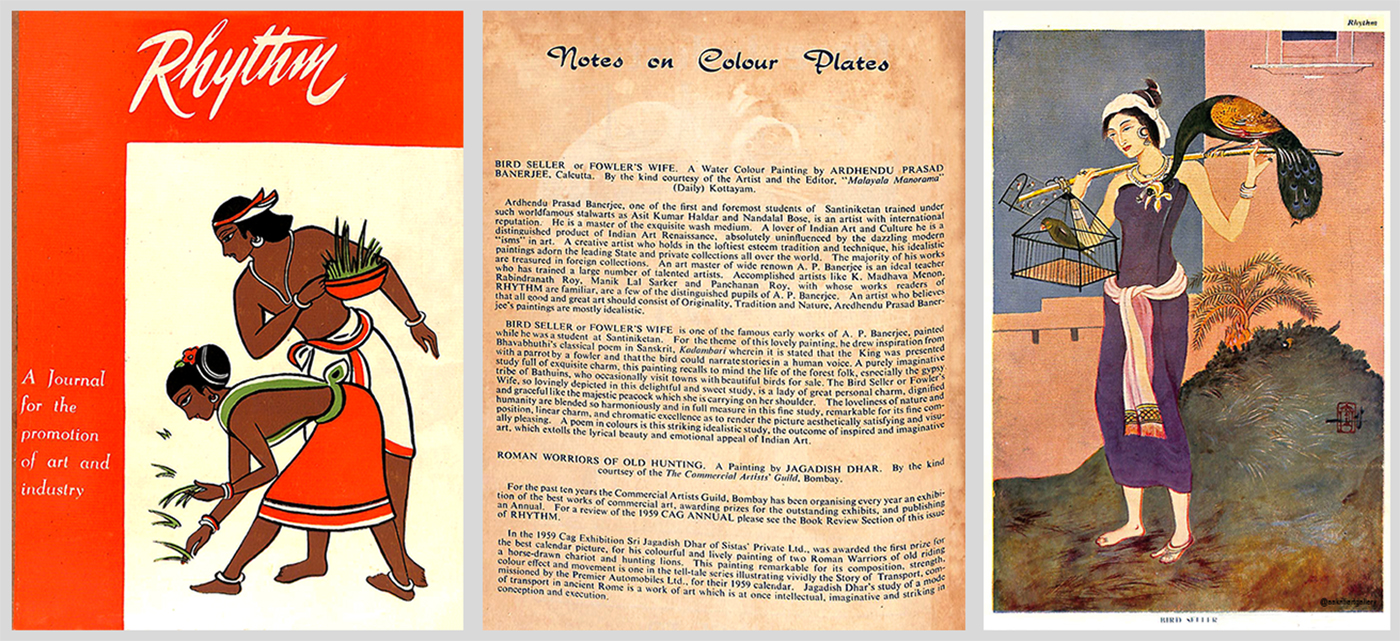
One of the more revealing aspects of this research is the contrast between Banerjee’s reputation during his lifetime and his relative absence from later art historical writing.
The April 1960 issue of Rhythm described him as “one of the foremost students of Santiniketan,” praised his mastery of the wash medium and referred to his international reputation. The article further noted that his paintings were represented in religious institutions and private collections around the world and recognised him as a respected teacher whose students included K. Madaswamy, Rabindranath Roy, Manik Lal Sarkar and Panchanan Roy. It also recorded Banerjee’s artistic conviction that “all good and great art should consist of Originality, Tradition and Nature.”
Seen today, these contemporary observations are significant. They suggest that Banerjee was regarded as an accomplished artist within his own generation. His subsequent disappearance from mainstream histories therefore reflects changing patterns of scholarship rather than a lack of artistic merit. The rediscovered portrait of Rabindranath Tagore, together with archival material such as Modern Review, Rhythm and the recent Harvard research, now provides an opportunity to reassess his contribution to the Santiniketan tradition.
Acknowledgement
- Prof. Samindranath Mazumdar
- Prof. Nilanjana Mukherjee
Selected Bibliography
- Modern Review (Calcutta), reproduction of The Pigeons by Ardhenduprasad Banerjee, c.1926.
- Family archive and research presented by Prof. Nilanjana Mukherjee.
- R. Siva Kumar, Santiniketan: The Making of a Contextual Modernism.
- K.G. Subramanyan, writings on Kala Bhavana and the Santiniketan tradition.
- Publications on Asit Kumar Haldar, Nandalal Bose and the early history of Kala Bhavana.
- Research & Compiled by Aakriti Art Gallery team
Comments
Join the Discussion
Please login to post comments.
Login