The Elongated Figure: A Transcultural Journey from Modigliani to Modern Indian Art
A Transcultural Journey from Modigliani to Modern Indian Art
In figurative painting, the decision to distort the human body is rarely arbitrary. When an artist deliberately elongates the neck, stretches the limbs, and simplifies the torso into a graceful arc, the figure ceases to be a mere record of physical appearance. It becomes a vessel for something larger — psychological depth, cultural memory, spiritual stillness, or quiet resistance.
Few formal devices in twentieth-century art have travelled as fluidly across continents and artistic traditions as the elongated female silhouette. This essay traces one such lineage: from the Italian modernist Amedeo Modigliani in early twentieth-century Paris, to the post-Independence Indian painter B. Prabha, and onward to the contemporary artist P.R. Narvekar. Though separated by geography, generation, and intent, these three artists arrived at a remarkably similar formal solution. For each, the stretched silhouette became a language of grace, interiority, and transcendence.
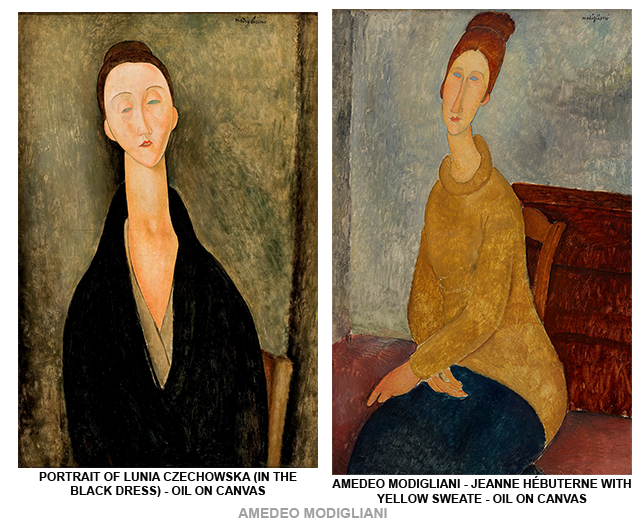
Amedeo Modigliani: The Lyrical Architecture of Melancholy
Amedeo Modigliani (1884–1920) did not invent the elongated figure, but he perfected it as a modern idiom. Working in the feverish atmosphere of pre-war Paris, he absorbed influences from Italian Mannerism, Cycladic and African sculpture, and the structural lessons of Cézanne. The result was a highly personal style in which the female body is reduced to a sequence of elegant, almost architectural lines.
Modigliani’s women typically possess swan-like necks, tilted heads, and almond-shaped eyes that often appear blank or inward-turning. The elongation is not merely decorative; it functions as a structural filter. By stretching the form, Modigliani removes his subjects from the anecdotal world of everyday life and elevates them into timeless archetypes. The famous portraits of Jeanne Hébuterne, for instance, transform a specific young woman into an emblem of fragile, urban melancholy.
Technically, Modigliani achieved this through a masterful tension between line and colour. Strong, sculptural contours cage areas of warm, relatively flat colour. The figures feel both weightless and anchored, sensual yet strangely distant. In an age obsessed with fragmentation and Cubist analysis, Modigliani chose instead a classical elegance pushed to the point of stylisation. His elongation was, in part, a response to the alienating speed of modern Paris — a way of slowing time and restoring dignity to the human figure.
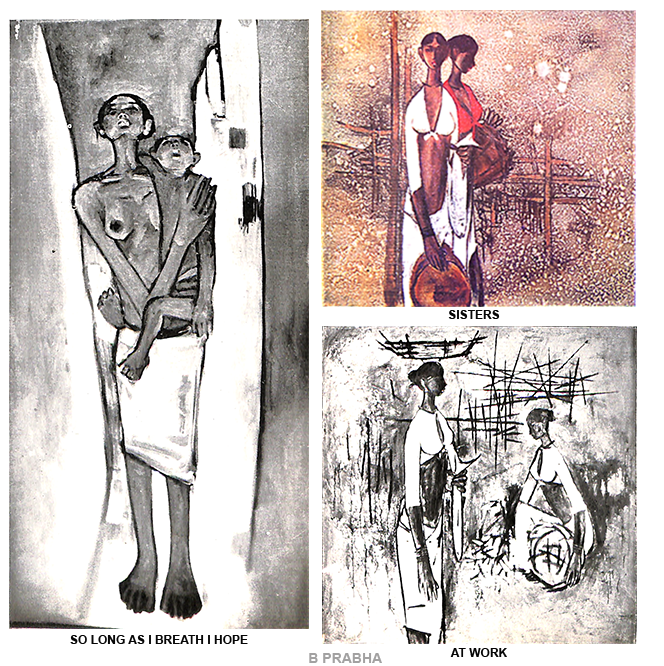 B. Prabha: The Monumental Rural Silhouette
Decades later and thousands of miles away, the Indian artist B. Prabha (1933–2001) developed a strikingly similar formal vocabulary, but applied it to an entirely different social reality.
Prabha, who trained at the Sir J.J. School of Art in Bombay, became known for her oil paintings of rural Indian women — fisherwomen, labourers, and village figures — rendered with elongated necks, oval faces, and downcast or contemplative eyes. Her canvases are often dominated by a single, resonant colour that isolates the figure against a minimalist background.
Where Modigliani’s elongation served urban melancholy and erotic reverie, Prabha’s served as a monument to quiet endurance. Her women do not recline in Parisian studios; they stand or sit with architectural poise, their stretched forms conveying both physical labour and inner resilience. The elongation here is not about sensuality but about dignity. By stretching the figure, Prabha removes anecdotal detail and forces the viewer to confront the essential humanity and silent struggles of her subjects — women facing drought, migration, and the changing realities of post-Independence rural India.
Prabha’s method was deceptively simple: strong linear contours, restrained palettes, and a compositional clarity that owes as much to Indian folk traditions and miniature painting as to any Western modernist source. Her elongated silhouette became a language of empathy and quiet monumentality, perfectly suited to representing the often-invisible labour and grace of Indian women.
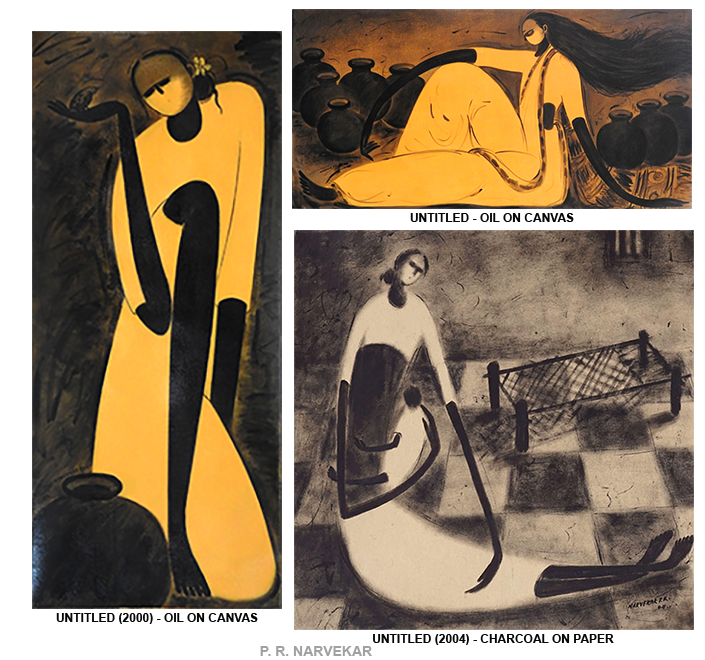
P.R. Narvekar: Fluidity, Dream, and Contemporary Interiority
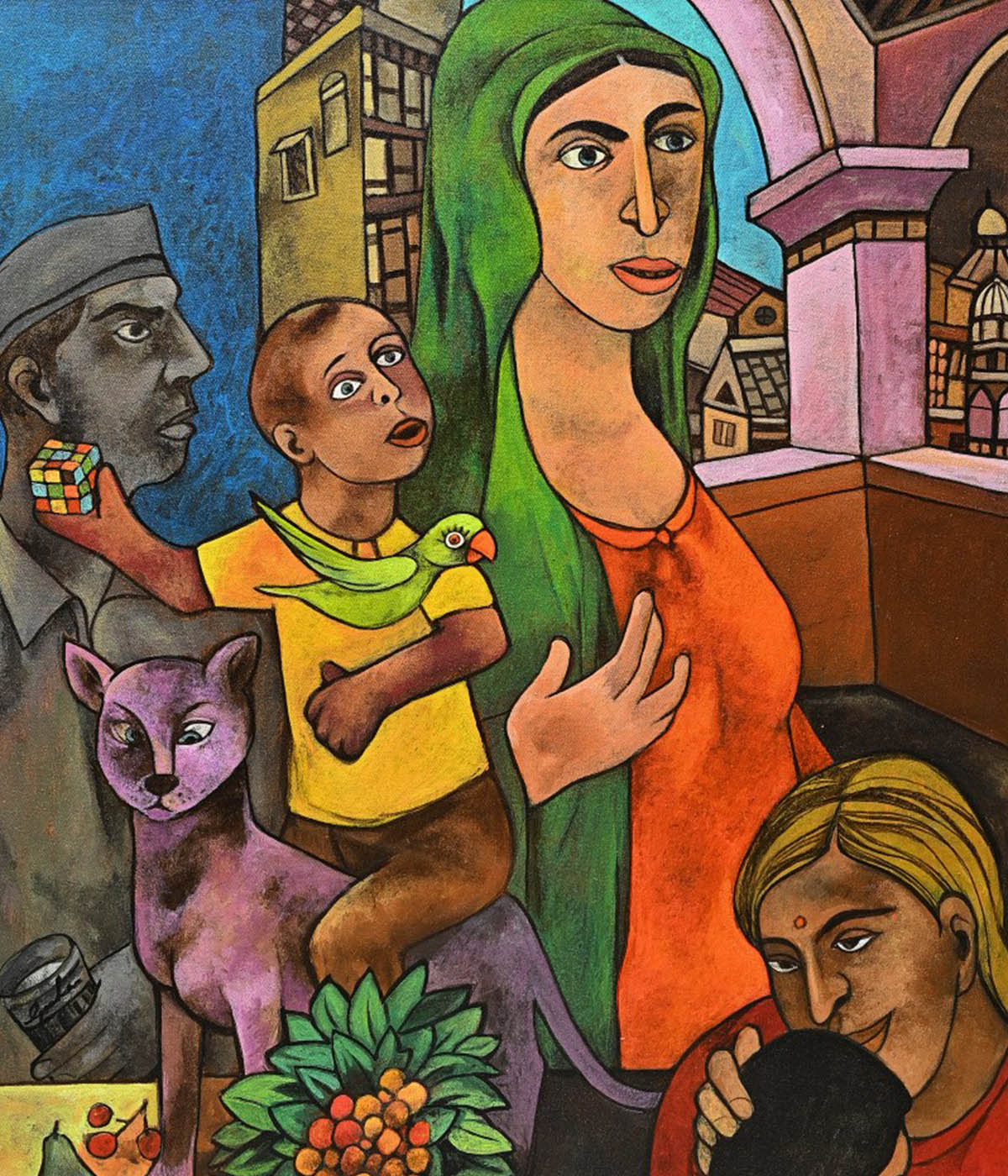
The stylistic thread continues into the late twentieth and early twenty-first centuries with P.R. Narvekar (1950–2021). A painter deeply attuned to both Western modernist lessons and the lyrical draughtsmanship of the Indian subcontinent, Narvekar took the elongated female form into more fluid, introspective, and sometimes surreal territory.
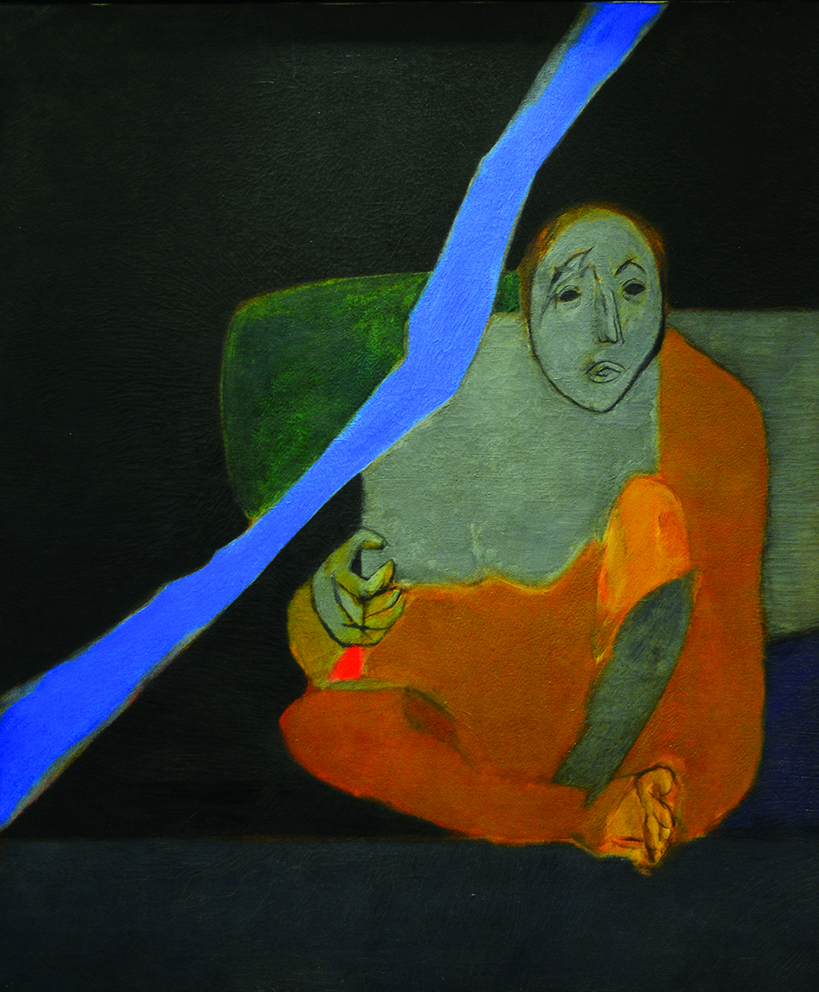
Narvekar’s women are languid, rhythmic, and often appear to occupy dreamlike or psychologically charged spaces. The elongation is no longer primarily about monumentality or melancholy; it becomes a vehicle for exploring modern feminine identity, memory, companionship, and the porous boundary between self and world. His figures seem to dissolve slightly at the edges, as though existing simultaneously in the physical and the imagined.
Technically, Narvekar worked with thin, layered paint and sharp, musical contours. The line itself carries emotional weight — sometimes delicate, sometimes assertive — creating a kinetic grace that feels weightless and deeply contemplative. Where Modigliani’s figures are iconic and Prabha’s are stoic, Narvekar’s are lyrical and inward-turning. The stretched silhouette here becomes a metaphor for the fluid, often contradictory nature of contemporary identity.
A Shared Formal Language Across Cultures
What makes this lineage remarkable is not influence in the direct, derivative sense, but convergence. Modigliani, Prabha, and Narvekar each discovered that stretching the human figure could achieve something realism could not: it could strip away the transient and reveal the essential.
For Modigliani, elongation was a bridge between classical idealism and modern alienation. For Prabha, it was a tool of social empathy and quiet monumentality rooted in Indian realities. For Narvekar, it became a language of psychological and poetic interiority. In each case, the stylised silhouette functions as a transcultural device — capable of carrying very different cultural and emotional cargoes while retaining its essential power.
This is not a story of Western influence flowing one way into India. Rather, it reveals how certain formal solutions — clarity of line, reduction of volume, emphasis on contour and posture — possess a kind of universal resonance. Indian artists have long stylised the figure (from Ajanta murals to Kalighat pats to the modern experiments of Jamini Roy). The elongated silhouette simply offered a particularly potent meeting point between these indigenous traditions and the formal discoveries of European modernism.
Beyond Caricature
The elongated female figure in the hands of these artists is never a gimmick or a mere stylistic signature. It is a deliberate painterly language. By stretching the human frame, Modigliani, Prabha, and Narvekar pulled their subjects out of the ordinary world and placed them into the timeless realm of high art — where grace, interiority, and cultural meaning could be contemplated without distraction.
In an age when figurative painting is once again being re-examined, this lineage reminds us that distortion, when used with intelligence and feeling, is not a betrayal of the human form but one of its most profound celebrations. The stretched silhouette continues to speak across cultures because it addresses something fundamental: the desire to see the human figure not merely as it appears, but as it feels, remembers, and endures.
Editorial Note
The elongated figure was not entirely foreign to Indian visual culture. Classical Indian sculpture frequently privileges idealised bodily proportion over anatomical realism, while Ajanta murals, Chola bronzes, Pahari painting, and Kalighat pats all demonstrate that stylisation has long been central to Indian aesthetics. Modern artists such as B. Prabha and P.R. Narvekar therefore encountered European modernism through a visual culture that already valued expressive distortion.
Bibliography:
- Kenneth Wayne. Modigliani and the Artists of Montparnasse.
- Kenneth Wayne (ed.). Modigliani: Beyond the Myth.
- Doris Krystof (ed.). Modigliani.
- Partha Mitter. Art and Nationalism in Colonial India.
- R. Siva Kumar. Santiniketan: The Making of a Contextual Modernism.
- Tapati Guha-Thakurta. The Making of a New “Indian” Art.
- Research & Compiled by Aakriti Art Gallery team
Comments
Join the Discussion
Please login to post comments.
Login