The Forgotten First Students of Kala Bhavana: The Artists Who Helped Shape Santiniketan
Before Kala Bhavana became one of India’s most celebrated centres of artistic education, its foundations were laid by a handful of pioneering students who studied under Asit Kumar Haldar and Nandalal Bose. Today, their contributions remain largely overlooked. This article revisits the lives and works of Ardhenduprasad Banerjee, Hirachand Dugar, Krishnakinkar Ghosh and Dhirendrakrishna Debbarma—the artists who stood at the very beginning of Santiniketan’s artistic journey.
The history of Kala Bhavana is usually told through the achievements of its great masters. The names of Nandalal Bose, Benode Behari Mukherjee and Ramkinkar Baij have become inseparable from Santiniketan’s artistic identity, while the institution itself is celebrated as the birthplace of a uniquely Indian modernism.
Yet every institution has a beginning.
Long before Kala Bhavana acquired international recognition, before its studios expanded and generations of artists passed through its classrooms, there were only a handful of young students learning under challenging circumstances. These first trainees did more than receive instruction—they helped shape the character of the institution itself.
Among them were Ardhendu Prasad Banerjee, Hirachand Dugar, Krishnakinkar Ghosh and Dhirendrakrishna Debbarma. Although their names rarely appear in standard histories of modern Indian art, they formed the nucleus around which the earliest teaching at Kala Bhavana developed.
Their stories deserve to be told not merely because they came first, but because they reveal how Santiniketan evolved from an educational experiment into one of the most influential art schools in Asia.
Kala Bhavana: An Experiment in Indian Art Education
When Rabindranath Tagore envisioned an art school at Santiniketan, he did not intend to reproduce the academic model of colonial art education. Instead, he sought an environment where artistic practice would grow organically from Indian culture, nature and everyday life.
The appointment of Asit Kumar Haldar in the early years marked an important beginning. Soon afterwards, artists associated with the Bengal School—including Nandalal Bose—would shape the institution’s philosophy.
Unlike the crowded Government School of Art in Calcutta, Kala Bhavana began on an intimate scale. Classes were small, resources were modest and the relationship between teacher and student was unusually close.
It was in this atmosphere that the institution’s first generation of students emerged.
The Four Pioneers
Historical accounts indicate that Ardhenduprasad Banerjee, Hirachand Dugar, Krishnakinkar Ghosh and Dhirendrakrishna Debbarma formed the earliest group of students around whom teaching at Kala Bhavana commenced.
Although each came from a different social and cultural background, they shared an uncommon experience: they participated in the formative years of an institution that had no established traditions, no celebrated alumni and no guarantee of success.
They were not simply students.
They were participants in the making of an entirely new model of Indian art education.
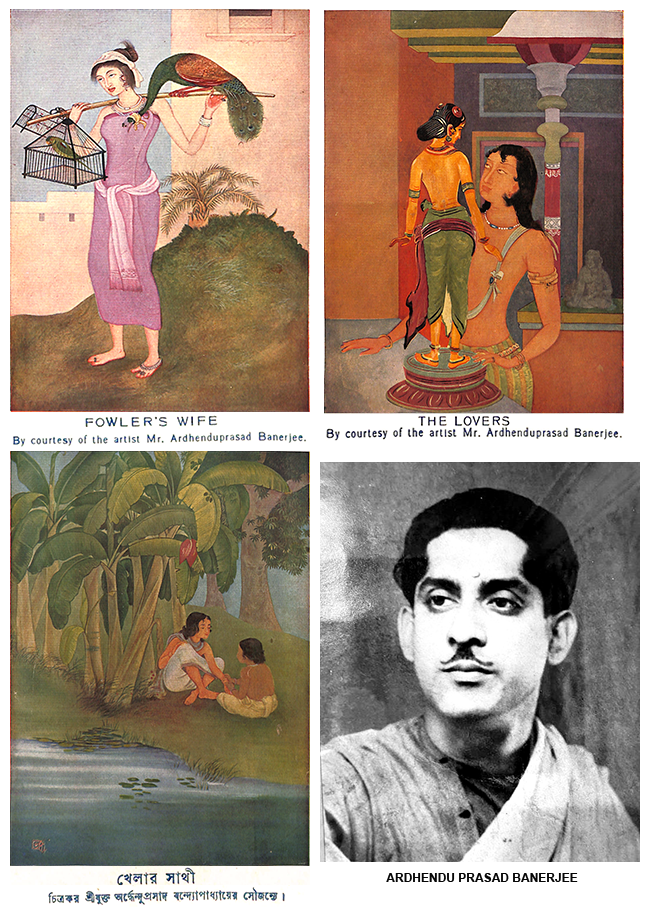 Ardhenduprasad Banerjee (1902–1965)
Among the four, Ardhenduprasad Banerjee remains perhaps the least studied today despite occupying a significant place in Santiniketan’s early history.
Born in Kotalipara, Faridpur, on 7 February 1902, Banerjee entered the Government School of Art in Calcutta before accompanying Asit Kumar Haldar to Santiniketan in 1919. For nearly five years he trained under both Haldar and Nandalal Bose, absorbing the ideals of the Bengal School while developing a refined sensitivity towards portraiture, birds, landscapes and natural studies.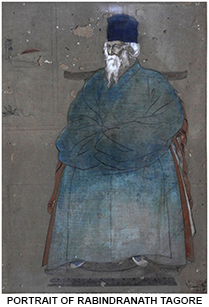 Recent archival discoveries—including a previously unpublished 1953 portrait of Rabindranath Tagore and the identification of Banerjee’s distinctive red artist’s seal through a reproduction of The Pigeons in Modern Review—have begun to restore attention to his work.
Family records also indicate that he painted portraits of both Rabindranath Tagore and Mahatma Gandhi, suggesting that portraiture formed an important aspect of his mature practice.
Rather than pursuing public prominence, Banerjee continued to work quietly throughout his life, leaving behind a body of work that deserves renewed scholarly attention.
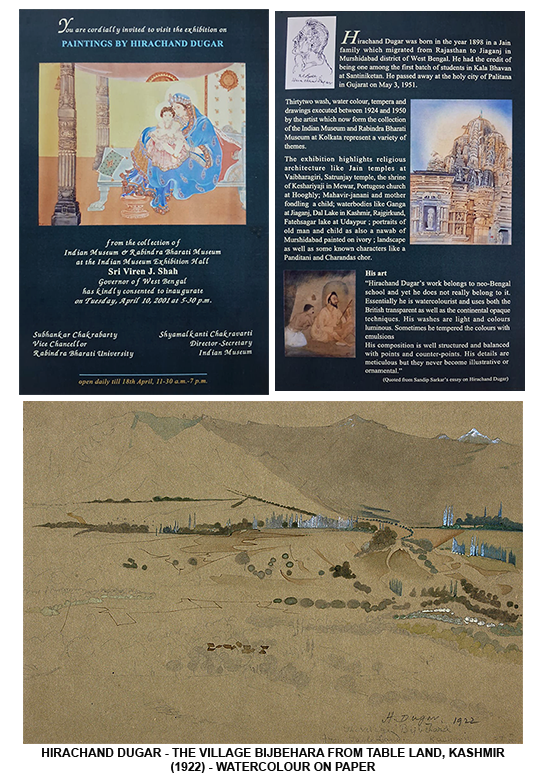 Hirachand Dugar (1909–1996)
If Banerjee remained largely forgotten, Hirachand Dugar achieved wider recognition while remaining faithful to the ideals of Santiniketan.
Born in Rajasthan, Dugar studied under Nandalal Bose before establishing himself as one of the finest practitioners of the Bengal School wash technique. His paintings of village women, musicians, devotional subjects and rural life reveal remarkable delicacy of line and colour.
Unlike many artists of his generation who embraced European modernism after Independence, Dugar continued to refine the lyrical language of the Bengal School, demonstrating that tradition itself could remain a living practice rather than a historical style.
Today his paintings are represented in several important collections, yet his role as one of Kala Bhavana’s earliest students is seldom emphasised.
Krishnakinkar Ghosh
Far less has been written about Krishnakinkar Ghosh, illustrating how incomplete the documentation of Kala Bhavana’s early years still remains.
Although references to him survive in institutional histories and memoirs, his artistic career awaits comprehensive scholarly investigation.
His inclusion among the earliest students nevertheless confirms that the founding generation of Kala Bhavana was more diverse than later histories suggest.
For researchers, Ghosh represents one of the many artists whose contributions remain hidden within archives, family collections and scattered exhibition records.
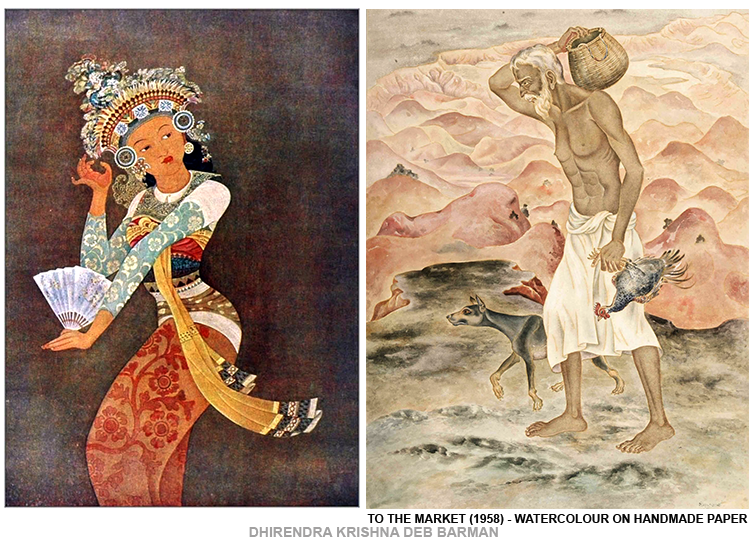 Dhirendrakrishna Debbarma
The presence of Dhirendrakrishna Debbarma, associated with the royal family of Tripura, further demonstrates the geographical reach of Santiniketan during its formative years.
His decision to study under Tagore’s educational vision reflects the attraction that Kala Bhavana already held for young artists seeking an alternative to conventional academic training.
Although comparatively little has been published about his later artistic career, his place within the first generation of students forms an important chapter in the institution’s history.
Why Have They Been Forgotten?
Art history often remembers teachers more readily than students.
It also favours artists who transformed artistic language dramatically or achieved sustained public visibility.
Those who quietly continued their practice, remained regionally active or left relatively small documented oeuvres gradually slipped from mainstream narratives.
The result is that the history of Kala Bhavana has become identified almost exclusively with its celebrated masters, while many of its earliest participants have disappeared from public memory.
Recovering their stories does not diminish the achievements of Nandalal Bose or Ramkinkar Baij.
Instead, it enriches our understanding of how artistic institutions are actually built.
A Beginning Worth Remembering
Kala Bhavana’s international reputation did not emerge overnight.
It was shaped by teachers, students, craftsmen and administrators who collectively transformed Rabindranath Tagore’s educational vision into reality.
Among the first generation of students, Ardhenduprasad Banerjee, Hirachand Dugar, Krishnakinkar Ghosh and Dhirendrakrishna Debbarma occupy a special place. They entered an institution still finding its identity and helped establish traditions that later generations would inherit.
Their stories remind us that the history of Indian art is not only the history of celebrated masters. It is equally the history of those whose names gradually faded from view but whose contributions remain woven into the foundations of one of India’s greatest artistic institutions.
- Research & Compiled by Aakriti Art Gallery team

Comments
Join the Discussion
Please login to post comments.
Login