The Man Who Painted Kanchenjunga
Rediscovering M. Sain, Darjeeling’s Forgotten Artist
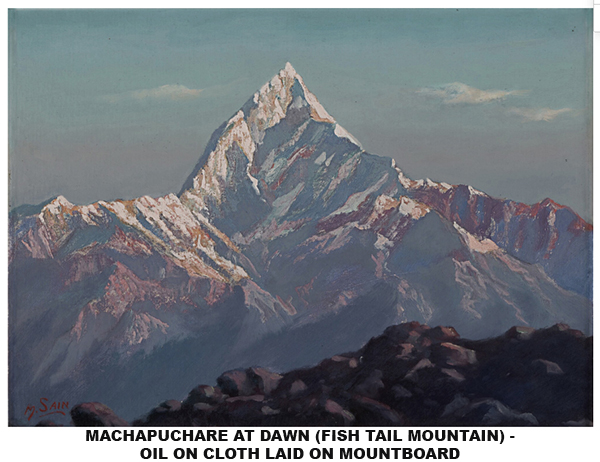 The history of Indian art is often written through its major centres—Calcutta, Bombay, Madras, Santiniketan, and Delhi. Yet scattered across the country are artists whose contributions unfolded far from these metropolitan narratives, rooted instead in specific landscapes and local histories. Among them is the intriguing figure of M. Sain, a painter, photographer, and amateur botanist whose life and work were intimately connected to the Eastern Himalayas.
Born in 1891, M. Sain spent much of his life in Darjeeling, a town that was then emerging as one of the most important hill stations of British India. Over the course of several decades, he established himself as a respected local artist, operating a studio that served residents, travellers, and visitors drawn to the region’s extraordinary scenery.
At a time when photography was becoming increasingly accessible, Sain occupied a unique position between painter and photographer. His practice reflected a transitional moment in visual culture when artists frequently moved between mediums rather than confining themselves to a single discipline.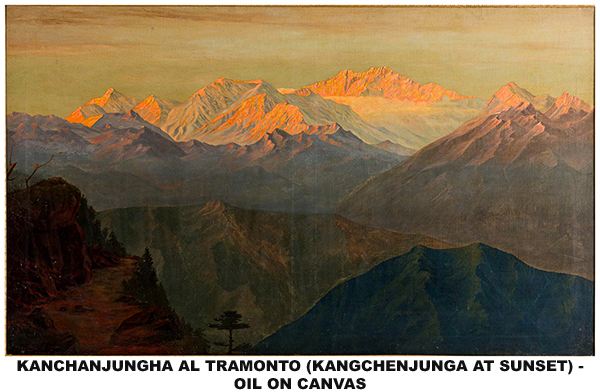
His oil paintings of Kanchenjunga, Everest, Darjeeling, Kalimpong, and the surrounding Himalayan landscape reveal a deep familiarity with the mountains. Unlike many visiting artists who treated the Himalayas as exotic spectacles, Sain painted them as a resident observer. His works capture changing atmospheric conditions, shifting light, and seasonal transformations with remarkable sensitivity.
Particularly noteworthy are his hand-coloured and hand-painted photographs. These works occupy a fascinating space between documentation and artistic interpretation. Combining the mechanical accuracy of photography with the expressive possibilities of painting, they offer a visual record of a Himalayan world that was itself undergoing profound transformation.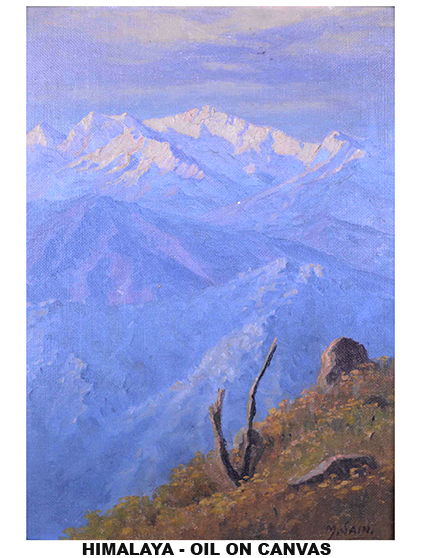
Today, such works are increasingly valued not only for their aesthetic qualities but also for their historical significance. They document a period when Darjeeling functioned as a crossroads of colonial administration, tourism, trade, and cultural exchange between India, Nepal, Bhutan, Tibet, and Sikkim.
Yet Sain’s interests extended beyond landscape and photography.
An enthusiastic botanist, he devoted considerable attention to the region’s flora, particularly its celebrated rhododendrons. His publication Rhododendrons of Darjeeling and Sikkim Himalayas reflects a rare synthesis of artistic observation and scientific curiosity. The project demonstrates how closely he engaged with the natural environment that surrounded him.
This combination of painter, photographer, and naturalist places Sain within a broader tradition of artist-explorers whose work transcended conventional disciplinary boundaries.
Despite these achievements, M. Sain remains largely absent from mainstream histories of modern Indian art.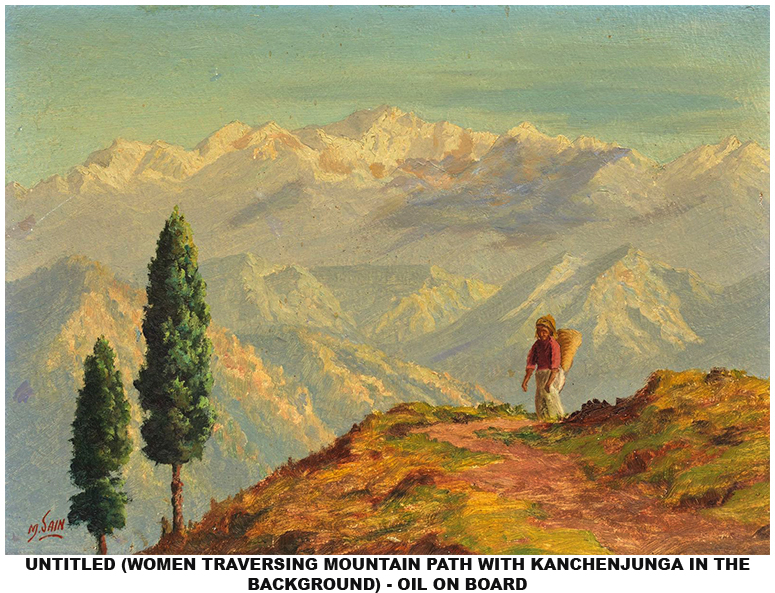
Part of this neglect stems from geography. Artists working outside major cultural centres have often been overlooked by scholars and institutions. Partly it reflects the dominance of larger art-historical narratives focused on nationalism, modernism, and metropolitan movements. Artists whose work was rooted in regional identity and observational practice frequently fell outside these frameworks.
Yet contemporary collectors are increasingly recognising the value of such figures.
M. Sain’s works offer something that many better-known artists cannot: a deeply personal record of a specific place and time. His paintings and photographs preserve a visual history of the Eastern Himalayas while simultaneously demonstrating considerable artistic accomplishment.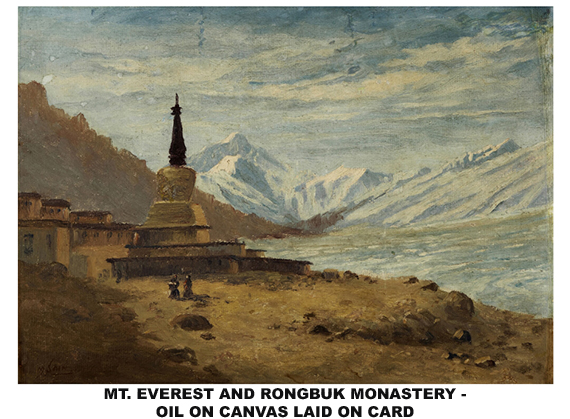
In an age when regional histories are receiving renewed scholarly attention, Sain emerges as a compelling example of how much remains to be discovered beyond the established canon of Indian art.
His legacy reminds us that the history of Indian art was not shaped solely in the great cities.
It was also written in mountain towns, private studios, and landscapes far from the centres of power—by artists who quietly documented the worlds they knew best.
Footnotes
- Archival references relating to M. Sain’s Darjeeling studio and photographic practice.
- Rhododendrons of Darjeeling and Sikkim Himalayas, attributed to M. Sain.
- Studies on colonial Darjeeling, Himalayan visual culture, and regional art practices in Eastern India.
- Research on hand-coloured photography in South Asia during the late nineteenth and early twentieth centuries.
Selected Bibliography
• Regional histories of Darjeeling and the Eastern Himalayas.
• Publications on Himalayan photography and visual culture.
• Botanical literature relating to rhododendrons of Darjeeling and Sikkim.
• Exhibition and archival materials relating to M. Sain and regional artists of the Eastern Himalayas.
- Research & Compiled by Aakriti Art Gallery team

Comments
Join the Discussion
Please login to post comments.
Login