Women Sculptors in Modern India: Reclaiming Form, Space and Material
From Piloo Pochkhanawala and Kanaka Murthy to Meera Mukherjee and Mrinalini Mukherjee, a reappraisal of the women artists who expanded the language of modern Indian sculpture through innovation, craftsmanship and material experimentation.
The history of modern Indian art is often told through painters. The names of Raja Ravi Varma, Abanindranath Tagore, Amrita Sher-Gil, M.F. Husain, S.H. Raza and Tyeb Mehta dominate books, exhibitions and auction catalogues. Sculpture, by comparison, has frequently occupied a secondary position within discussions of Indian modernism. Within the history of sculpture itself, women artists have often received even less attention.
Yet throughout the twentieth century, a remarkable group of women sculptors transformed the language of modern Indian sculpture. Working in bronze, stone, wood, fibre, terracotta and mixed media, they expanded both the materials and ideas associated with sculptural practice. Some drew inspiration from traditional craft techniques; others embraced abstraction, monumentality, portraiture or experimental forms. Together, they challenged assumptions about what sculpture could be and who could create it.
This article revisits the contributions of several important women sculptors whose work helped shape modern Indian sculpture. While some have received growing recognition in recent years, many remain less discussed than their achievements deserve.
Sculpture and the Challenge of Visibility
Historically, sculpture presented challenges different from those faced by painters. It required specialised workshops, heavy materials, technical expertise and access to foundries, stone yards or fabrication facilities. Public commissions and large-scale projects were often controlled by institutions that remained largely male-dominated throughout much of the twentieth century.
Despite these obstacles, women sculptors emerged across India and developed distinctive artistic practices that expanded the field in important ways. Their careers demonstrate not only artistic achievement but also persistence in negotiating professional spaces traditionally associated with men.
Pilloo Pochkhanawala: Breaking New Ground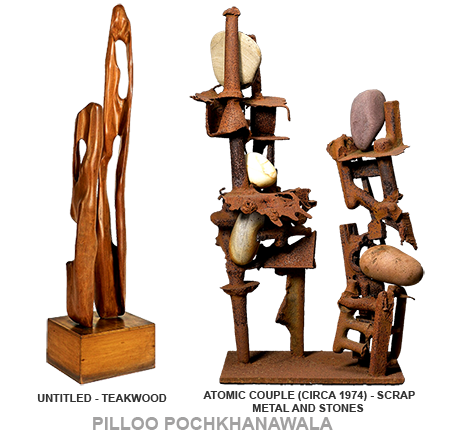
Among the earliest major women sculptors in modern India was Piloo Pochkhanawala (1923–1986).
Remarkably, she was largely self-taught. Beginning her artistic journey as a painter, she eventually turned to sculpture and developed a powerful abstract language that distinguished her from many contemporaries. At a time when Indian sculpture was still finding its modern identity, Piloo embraced monumentality, movement and formal experimentation.
Her works often explored dynamic relationships between mass and space. Rather than relying upon narrative or figurative traditions, she sought a sculptural language rooted in structure, rhythm and abstraction. Her large public commissions demonstrated that women artists could successfully engage with monumental sculpture on equal terms.
Today, Piloo Pochkhanawala is increasingly recognised as a pioneer who helped establish modern sculpture as a serious and independent artistic discipline in post-independence India.
Kanaka Murthy: Monumentality and Public Art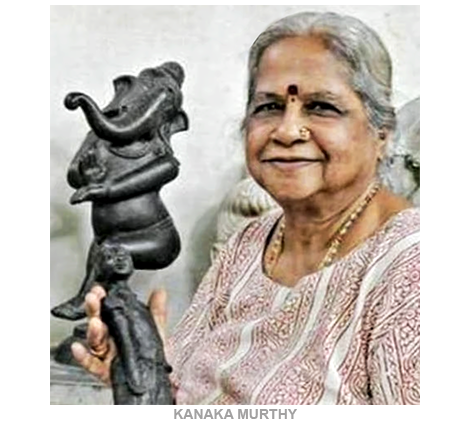
Another important pioneer was Kanaka Murthy (1921–2013), among the earliest professionally trained women sculptors in India.
A graduate of the Government School of Arts and Crafts in Madras, she developed a career at a time when few women pursued sculpture as a profession. Her works ranged from portrait busts to public monuments and large-scale commissions.
Kanaka Murthy’s significance lies not only in her artistic achievements but also in her visibility. Through public sculpture and institutional commissions, she demonstrated that women could participate actively in a field traditionally dominated by male sculptors.
Her career represents an important chapter in the professionalisation of sculpture in twentieth-century India.
Meera Mukherjee: Craft, Community and Modernism
If one artist embodies the successful 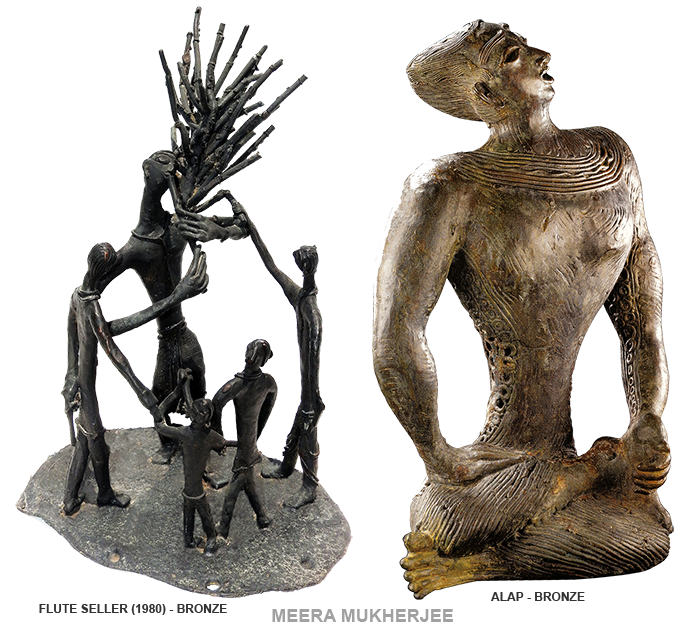 synthesis of tradition and modernity, it is Meera Mukherjee (1923–1998).
Born in Calcutta and trained at the Government College of Art & Craft, she later studied in Munich before returning to India. Rather than adopting European modernism uncritically, Meera immersed herself in indigenous craft traditions, particularly the metal-casting practices of Bastar.
The encounter proved transformative.
Working closely with traditional craftsmen, she adapted the lost-wax casting techniques associated with Dhokra metalwork and integrated them into her own sculptural language. The resulting works are immediately recognisable through their textured surfaces, rhythmic forms and deeply human subjects.
Her sculptures celebrate musicians, workers, artisans, children and everyday life. They possess warmth, humour and humanity while remaining formally sophisticated.
Meera Mukherjee demonstrated that modern Indian sculpture need not reject traditional knowledge. Instead, it could emerge through dialogue with craft communities and local artistic traditions.
Today, she remains one of the most influential sculptors of modern India.
 Leela Mukherjee: The Santiniketan Legacy
Leela Mukherjee (1916–2003) occupies a unique place within Indian art.
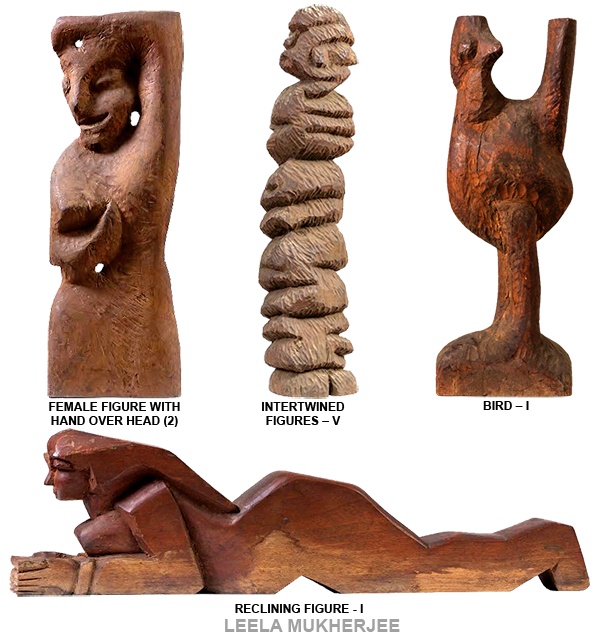
Associated with Santiniketan and influenced by the educational philosophy of Kala Bhavana, she worked across sculpture, wood carving and teaching. Her artistic practice reflected the Santiniketan emphasis on integrating art with everyday life and cultural traditions.
Leela’s sculptures often reveal a sensitivity to material and form that distinguishes them from more academic approaches. She explored folk traditions, indigenous aesthetics and organic forms while maintaining a modern sensibility.
Equally important was her role as an educator. Through teaching and mentorship, she helped shape future generations of artists.
While her contribution is less frequently discussed today than that of some contemporaries, her work remains an important bridge between the Santiniketan tradition and modern sculptural practice.
Usha Rani Hooja: Experimentation in Material and Form
Usha Rani Hooja represents a different direction within modern Indian sculpture.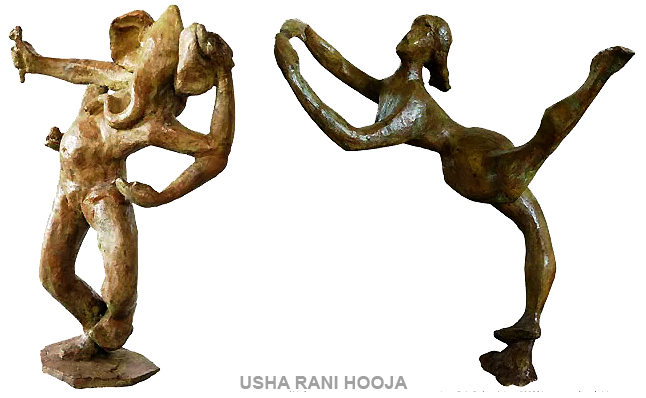
Working primarily in bronze and mixed media, she developed a sculptural language characterised by experimentation and formal innovation. Her works frequently move beyond conventional figurative traditions, exploring abstraction, movement and spatial relationships.
Over several decades, Usha Rani Hooja established an international reputation through exhibitions and public commissions. Her career reflects the growing confidence of women sculptors in post-independence India as they expanded the boundaries of sculptural practice.
Her work also demonstrates how Indian sculpture increasingly engaged with global artistic conversations while retaining distinct local identities.
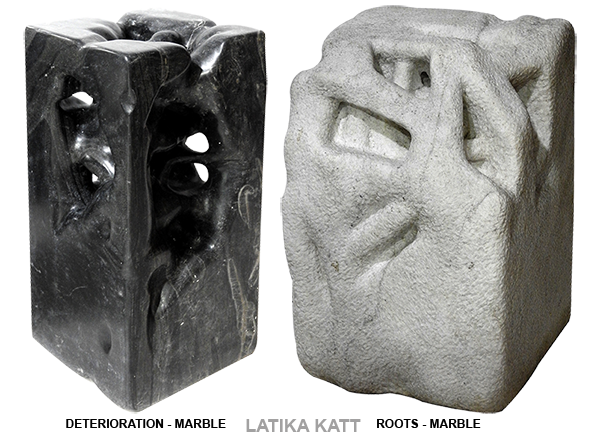 Latika Katt: Portraiture, Humanity and Social Reality
Latika Katt (1948–2025) was among the most accomplished sculptors of contemporary India, recognised for her deeply humanistic approach to portraiture and figurative sculpture. Working across bronze, marble, terracotta, plaster and mixed media, she brought remarkable psychological insight to her subjects. Unlike traditional commemorative portrait sculpture, which often emphasises idealisation, Katt sought to capture individuality, vulnerability and lived experience.
Her practice frequently engaged with people who occupied the margins of society—workers, rural communities, the elderly and those often overlooked within mainstream narratives. Through sensitive observation and technical mastery, she transformed portraiture into a powerful vehicle for social reflection. Following her passing in 2025, her oeuvre stands as an important testament to sculpture’s ability to combine artistic excellence with empathy and social engagement.
Mrinalini Mukherjee: Reinventing Material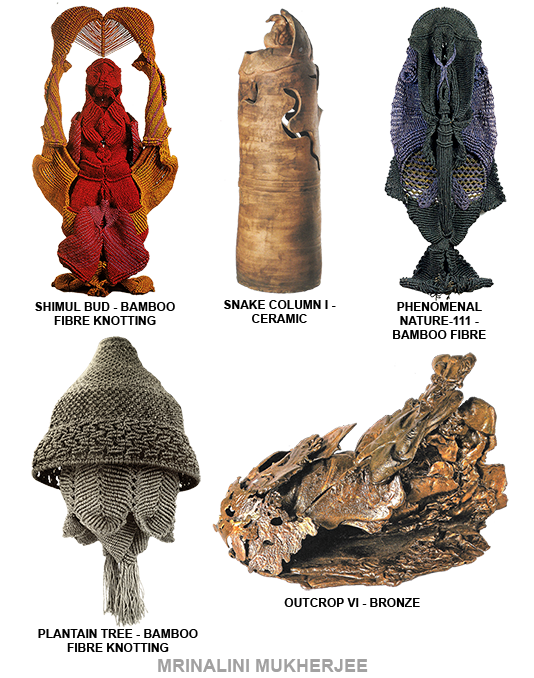
Few artists transformed the language of sculpture as radically as Mrinalini Mukherjee (1949–2015).
Initially trained as a painter at Maharaja Sayajirao University in Baroda, she became internationally known for her extraordinary fibre sculptures created from knotted hemp rope. These monumental works challenged conventional definitions of sculpture.
At a time when bronze and stone still dominated sculptural practice, Mrinalini embraced materials traditionally associated with craft. Through intricate knotting techniques, she created organic forms that suggested vegetation, mythology, fertility and the human body.
Her sculptures resist easy categorisation. They are simultaneously abstract and figurative, monumental and intimate, sensual and mysterious.
In later years, she expanded her practice to include ceramics and bronze, yet her fibre works remain among the most innovative achievements in modern Indian sculpture.
Recent international exhibitions and scholarly reassessments have reinforced her position as one of India’s most important sculptors of the twentieth century.
Uma Siddhanta: Breaking Barriers in Indian Sculpture
Uma Siddhanta (1933–2025) occupies a significant place in the history of modern Indian sculpture as one of the earliest women to enter a profession long dominated by men. She was the first woman to 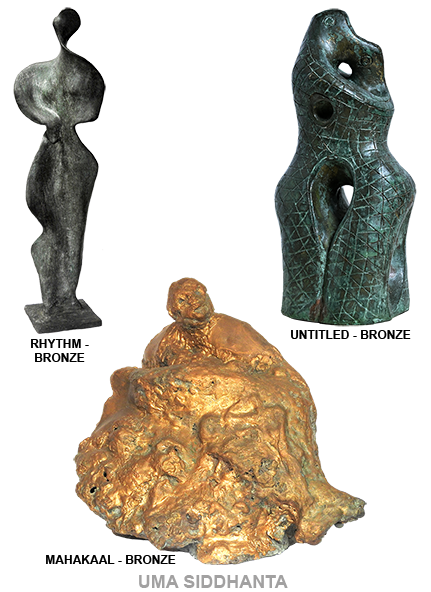 graduate from the Sculpture Department of the Government College of Art & Craft, Kolkata, an achievement that marked an important milestone for women pursuing professional sculptural practice in India.
Over a career spanning more than six decades, Siddhanta worked in stone, wood, bronze and other media, developing a body of work characterised by technical discipline, sensitivity to material and a deep understanding of form. Alongside her artistic practice, she contributed to art education and inspired subsequent generations of sculptors. Her passing in 2025 marked the conclusion of a remarkable career that helped expand opportunities for women within Indian sculpture and secured her place among the pioneering figures of modern Indian art.
The development of modern Indian sculpture cannot be understood without acknowledging the contributions of women artists who expanded its possibilities.
From the pioneering abstraction of Piloo Pochkhanawala and the public monuments of Kanaka Murthy to the craft-based modernism of Meera Mukherjee, the Santiniketan legacy of Leela Mukherjee, the experimentation of Usha Rani Hooja, the social engagement of Latika Katt and the material innovations of Mrinalini Mukherjee, these artists transformed the language of sculpture in India.
Their achievements remind us that modern Indian art was never shaped solely by painters or by a handful of canonical figures. It was also shaped by sculptors who reimagined form, material and space, often against considerable odds.
Revisiting their work does more than recover overlooked histories. It enriches our understanding of modern Indian art itself.
Selected Bibliography
- Kapur, Geeta. When Was Modernism: Essays on Contemporary Cultural Practice in India.
- Siva Kumar, R. Santiniketan: The Making of a Contextual Modernism.
- Mukherjee, Meera. The Making of a Sculptor.
- National Gallery of Modern Art Exhibition Catalogues.
- Lalit Kala Akademi Publications on Modern Indian Sculpture.
- Exhibition Catalogue: Mrinalini Mukherjee (The Metropolitan Museum of Art).
- Roobina Karode (ed.), writings on Indian contemporary sculpture.
- Delhi Art Gallery research publications on modern Indian sculpture.
- Research & Compiled by Aakriti Art Gallery team
Comments
Join the Discussion
Please login to post comments.
Login